Iqamah

Resources · Surah Hud Tafsir Series

Part 6 of 6

The Anchored Heart — Surah Hud, Part 6

The Concluding Movement — Ruins as Diagnosis, the Witnessed Day, Istiqāmah, and the Anchored Heart

Sūrah Hūd, Part 6 — the sūrah's concluding movement (vv. 100–123), where the stories give way to their meaning. The session reads the ruins of fallen nations as a diagnosis of the soul (vv. 100–102), rises to the Witnessed Day and the two destinies of the wretched and the blessed (vv. 103–108), receives the Divine Prescriptionistiqāmah, the refusal to lean toward wrong, prayer, and patience (vv. 109–115) — weighs the societal need for reformers and the design of human divergence (vv. 116–119), and closes on the anchor that holds a heart steady in any storm: worship and tawakkul in the Owner of the Unseen (vv. 120–123). Draws on Saʿdī, Maʿāriful Qurʾān, Sayyid Qutb, Zamakhsharī, and Ibn Kathīr.

Slides 24
Format Slides + notes
Series Surah Hud Tafsir Series
Cover slide: The Anchored Heart — Surah Hud, Part 6
Slide 1
Slide 1 of 24 #

Welcome to our session on the concluding movement of Sūrah Hūd — verses 100 through 123. We have travelled with Nūḥ, Hūd, Ṣāliḥ, Ibrāhīm, Lūṭ and Shuʿayb عليهم السلام, and watched nation after nation fall. Now the sūrah turns from the stories themselves to their meaning. Remember the atmosphere in which all of this was revealed: the depths of the Prophet’s ﷺ grief, the sūrah of which he ﷺ said that it and its sisters had aged him (Sunan al-Tirmidhī).

These final verses are a single, deliberate descent into the heart. They move from the ruins of the past as a diagnosis of the soul, to the certainty of the Witnessed Day and the two destinies, to the central command of the whole sūrah — istiqāmah, to stand firm — and finally to the anchor that holds a believer steady in any storm: tawḥīd, worship, and tawakkul. As Sayyid Quṭb observes, the entire movement is engineered for one purpose — to make the Prophet’s ﷺ heart, and ours, firm.

Slide 2
Slide 2 of 24 #

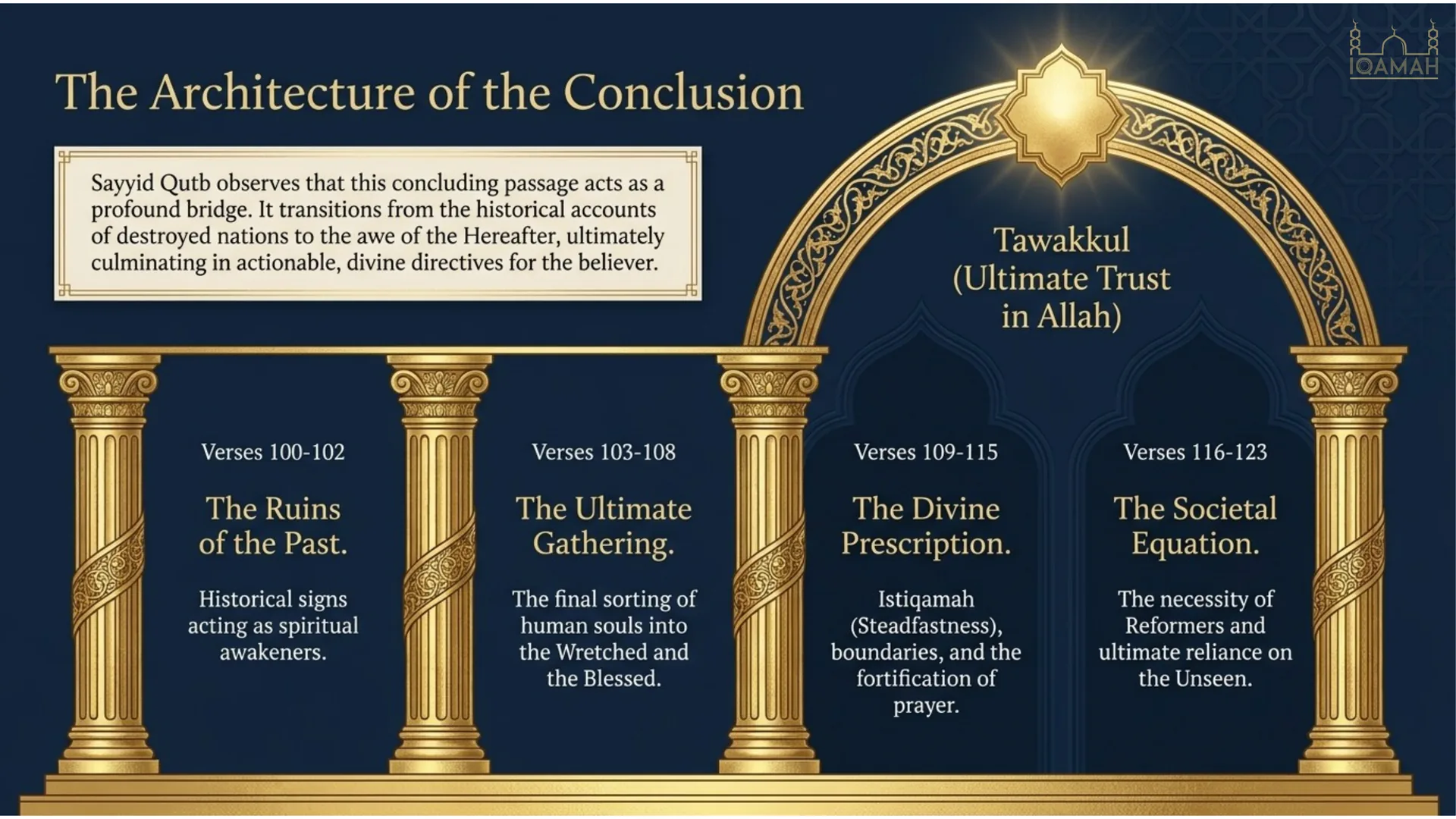
The map of our journey. Before we begin, hold the whole architecture of this conclusion in view, because the sūrah builds it deliberately. First, the Ruins of the Past (100–102) — history read as moral diagnosis. Then the Ultimate Gathering (103–108) — the Witnessed Day and the sorting of the wretched from the blessed. Then the Divine Prescription (109–115) — istiqāmah, the refusal to lean toward wrong, prayer, and patience. Then the Societal Equation (116–119) — the need for reformers and the design of human divergence. And crowning it all, Tawakkul (120–123) — the anchored heart that trusts the Owner of the Unseen.

Sayyid Quṭb draws our attention to a piece of Qurʼānic artistry here: the sūrah opened with the call to worship Allah alone and to turn to Him, and it will close on exactly that same call — worship Him and rely upon Him. The beginning and the end answer one another. Everything in between — the universe, the human soul, the histories of nations — serves that single, simple message.

Slide 3
Slide 3 of 24 #

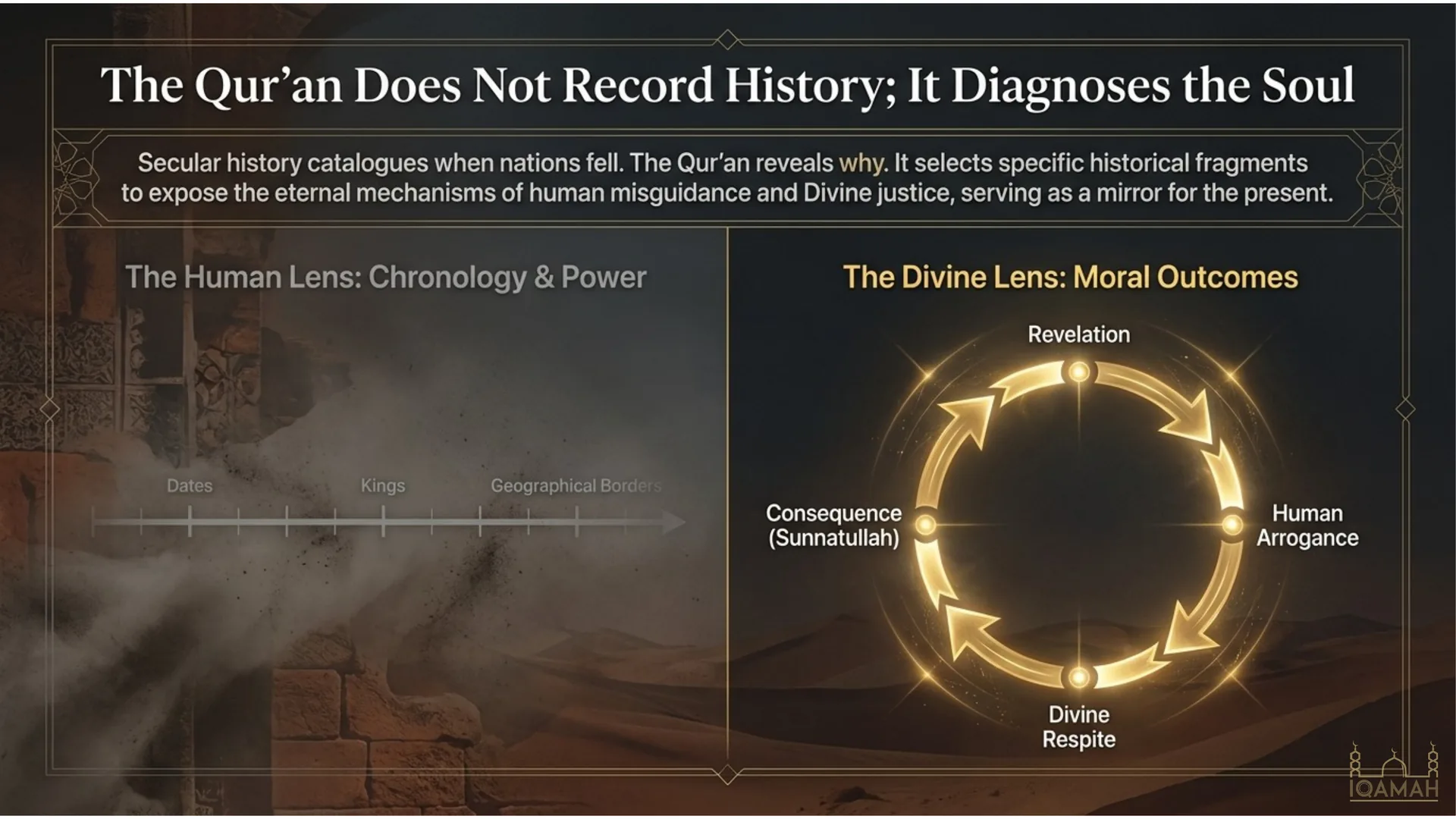
History as diagnosis, not chronicle. Sayyid Quṭb opens this section with a vital distinction. Secular history catalogues when nations rose and fell — kings, dates, the geography of power. The Qurʼān does something else entirely: it selects specific historical fragments in order to expose the eternal mechanisms of human misguidance and divine justice. It is not recording the past for its own sake; it is holding up a mirror to the present.

Read through the Divine lens, every fallen nation reveals the same cycle: revelation arrives, human arrogance rejects it, divine respite is granted as a window for repentance, and then — when the window closes — the consequence falls according to the unchanging way of Allah (sunnatullāh). These were not random catastrophes. They were the working-out of a moral law as reliable as any physical one. That is the lens through which we are about to read the ruins.

Slide 4
Slide 4 of 24 #

Here is the verse that frames the entire section — a survey of the ruins and what they signify:

ذَٰلِكَ مِنْ أَنۢبَآءِ ٱلْقُرَىٰ نَقُصُّهُۥ عَلَيْكَ ۖ مِنْهَا قَآئِمٌۭ وَحَصِيدٌۭ

“That is from the news of the cities, which We relate to you; of them, some are [still] standing and some are [as] a harvest [mowed down].”

Sūrah Hūd 11:100 — Saheeh International

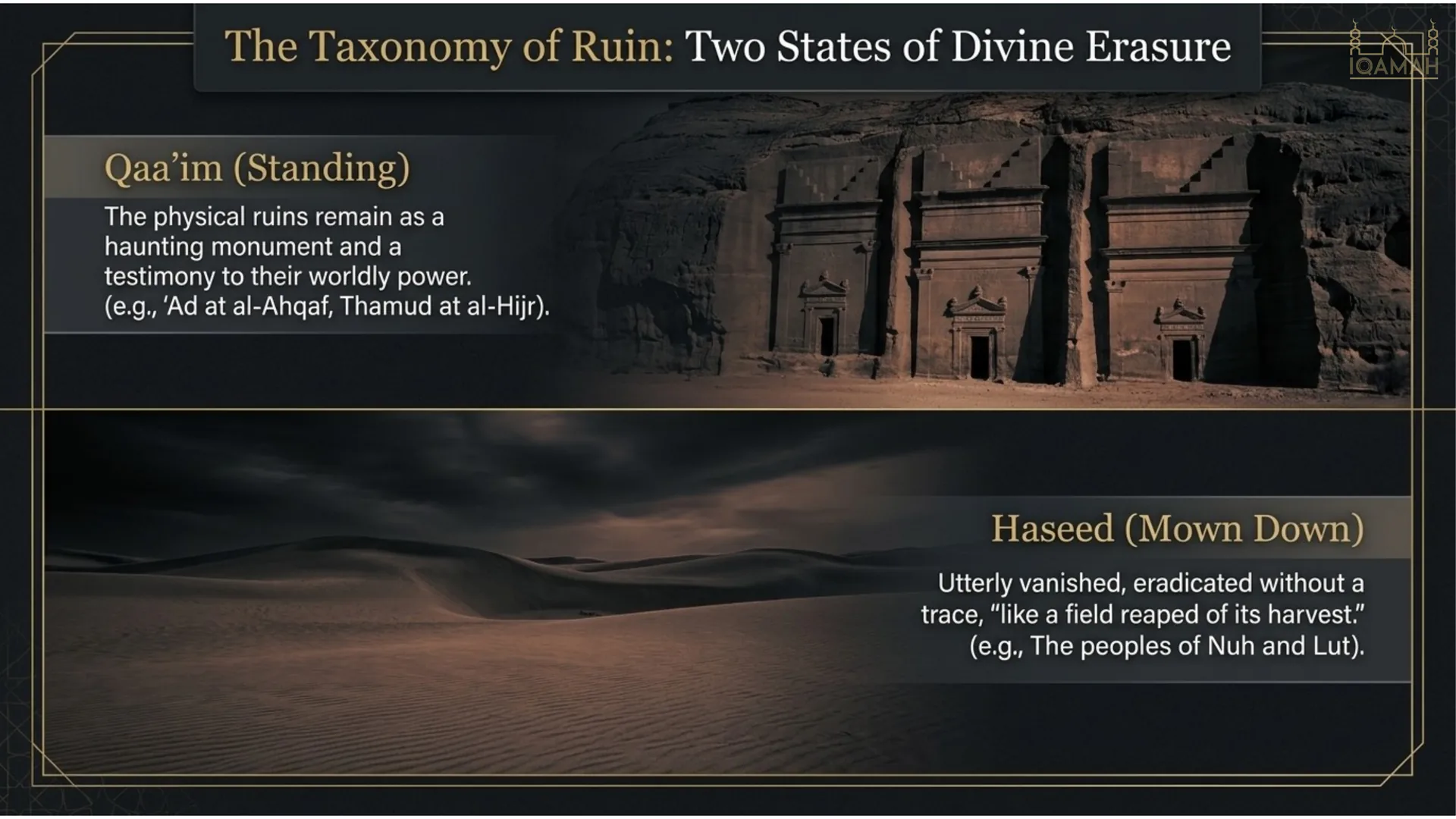
Two states of erasure. Notice the precise image the verse draws: of these cities, “some are still standing and some are as a harvest mown down.” The commentators read these as two distinct fates. Some ruins remain standing (qāʼim) — haunting monuments still visible as a testimony and a warning, like the dwellings of ʿĀd at al-Aḥqāf or Thamūd carved into the rock at al-Ḥijr. Others were mown down (ḥaśīd) — utterly erased without a trace, like the peoples of Nūḥ and Lūṭ, swept away by flood and overturning.

That word “harvest” is the doorway to one of Sayyid Quṭb’s most striking reflections. What, he asks, are people? What is a civilisation? They are but fields of human beings, like fields of crops. Some plants are good and pleasing, others are foul; some grow strong and spread, others wither and die — and the season of harvest comes for all of them. The towering permanence a civilisation imagines for itself is as fragile and temporary as an agricultural season. The ruins are simply fields after the reaping.

Slide 5
Slide 5 of 24 #

If the previous verse showed us the ruins, these two show us why reliance on anything but Allah is the very engine of ruin:

وَمَا ظَلَمْنَٰهُمْ وَلَٰكِن ظَلَمُوٓا۟ أَنفُسَهُمْ ۖ فَمَآ أَغْنَتْ عَنْهُمْ ءَالِهَتُهُمُ ٱلَّتِى يَدْعُونَ مِن دُونِ ٱللَّهِ مِن شَىْءٍۢ لَّمَّا جَآءَ أَمْرُ رَبِّكَ ۖ وَمَا زَادُوهُمْ غَيْرَ تَتْبِيبٍۢ

“And We did not wrong them, but they wronged themselves. And they were not availed at all by their gods which they invoked other than Allah when there came the command of your Lord. And they did not increase them in other than ruin.”

Sūrah Hūd 11:101 — Saheeh International

وَكَذَٰلِكَ أَخْذُ رَبِّكَ إِذَآ أَخَذَ ٱلْقُرَىٰ وَهِىَ ظَٰلِمَةٌ ۚ إِنَّ أَخْذَهُۥٓ أَلِيمٌۭ شَدِيدٌ

“And thus is the seizure of your Lord when He seizes the cities while they are committing wrong. Indeed, His seizure is painful and severe.”

Sūrah Hūd 11:102 — Saheeh International

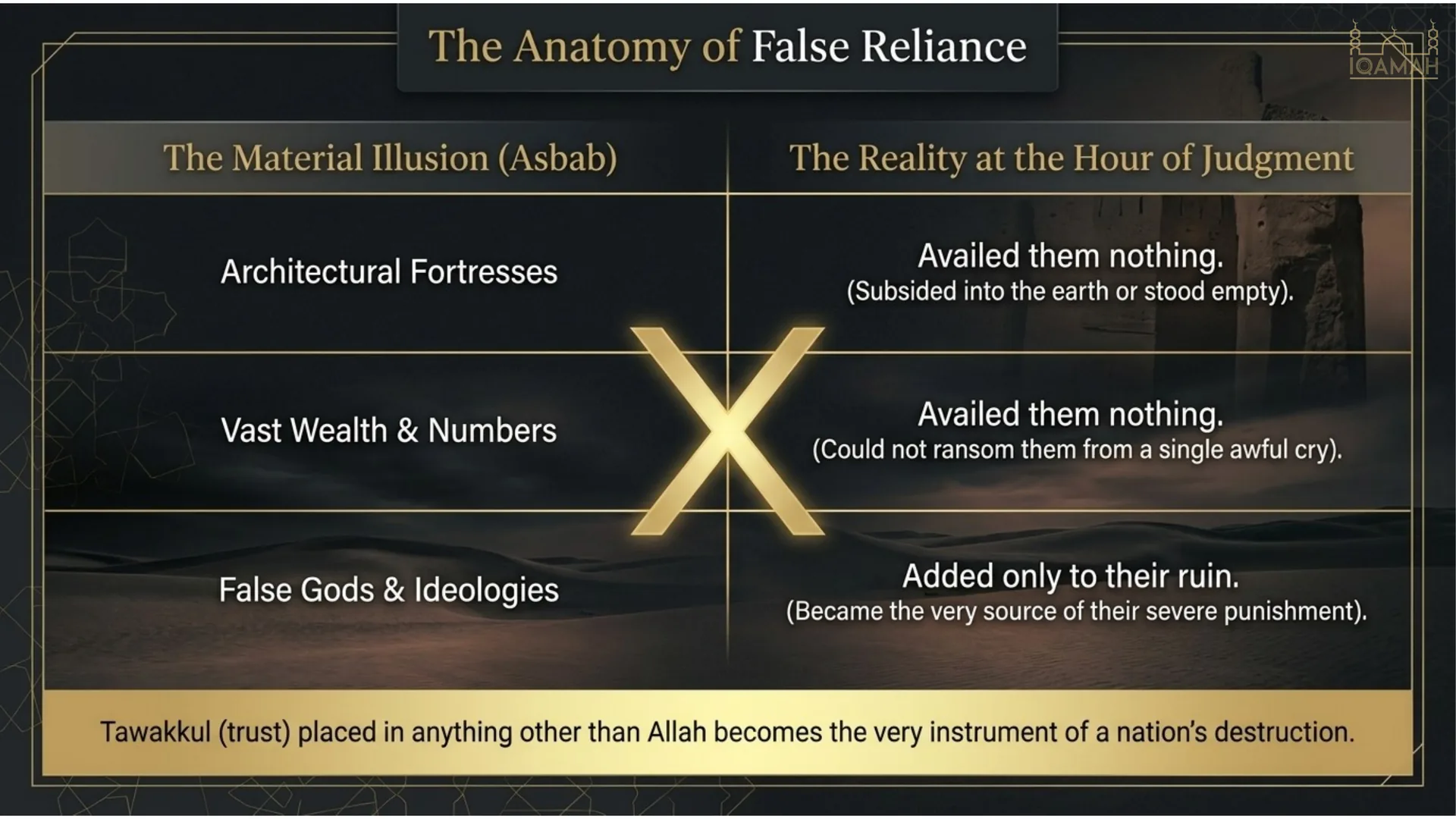
The anatomy of false reliance (101). “We did not wrong them, but they wronged themselves.” The verse forecloses any complaint against divine justice: the collapse was entirely self-inflicted. And then it exposes the illusion they had lived by: “their gods whom they invoked besides Allah availed them nothing when the command of your Lord came; they increased them in nothing but ruin.” Sayyid Quṭb sharpens the point: those false deities could do them neither good nor harm — yet they were not neutral. By relying on them, the people added contempt and provocation to their disbelief, so the very objects of their trust became the cause of their heightened punishment. The principle our slide draws out is permanent: architectural fortresses, vast wealth, sheer numbers, ideologies — every material support a nation leans on in place of Allah avails nothing at the hour of judgement. Tawakkul placed in anything other than Allah becomes the instrument of a nation’s destruction.

The nature of the seizure (102). “And thus is the seizure (akhdh) of your Lord when He seizes the cities while they are doing wrong. Indeed, His seizure is painful and severe.” Both Sayyid Quṭb and Maʿāriful Qurʼān stress what triggers it: the towns are seized “while they are doing wrong” — punishment in this world descends not upon bare disbelief but upon societies in which injustice and corruption have become the order of the day. The seizure is His settled practice, and it is grievous.

Slide 6
Slide 6 of 24 #

From the ruins the sūrah lifts our eyes to the Day they all point toward:

إِنَّ فِى ذَٰلِكَ لَءَايَةًۭ لِّمَنْ خَافَ عَذَابَ ٱلْءَاخِرَةِ ۚ ذَٰلِكَ يَوْمٌۭ مَّجْمُوعٌۭ لَّهُ ٱلنَّاسُ وَذَٰلِكَ يَوْمٌۭ مَّشْهُودٌۭ

“Indeed in that is a sign for those who fear the punishment of the Hereafter. That is a Day for which the people will be collected, and that is a Day [which will be] witnessed.”

Sūrah Hūd 11:103 — Saheeh International

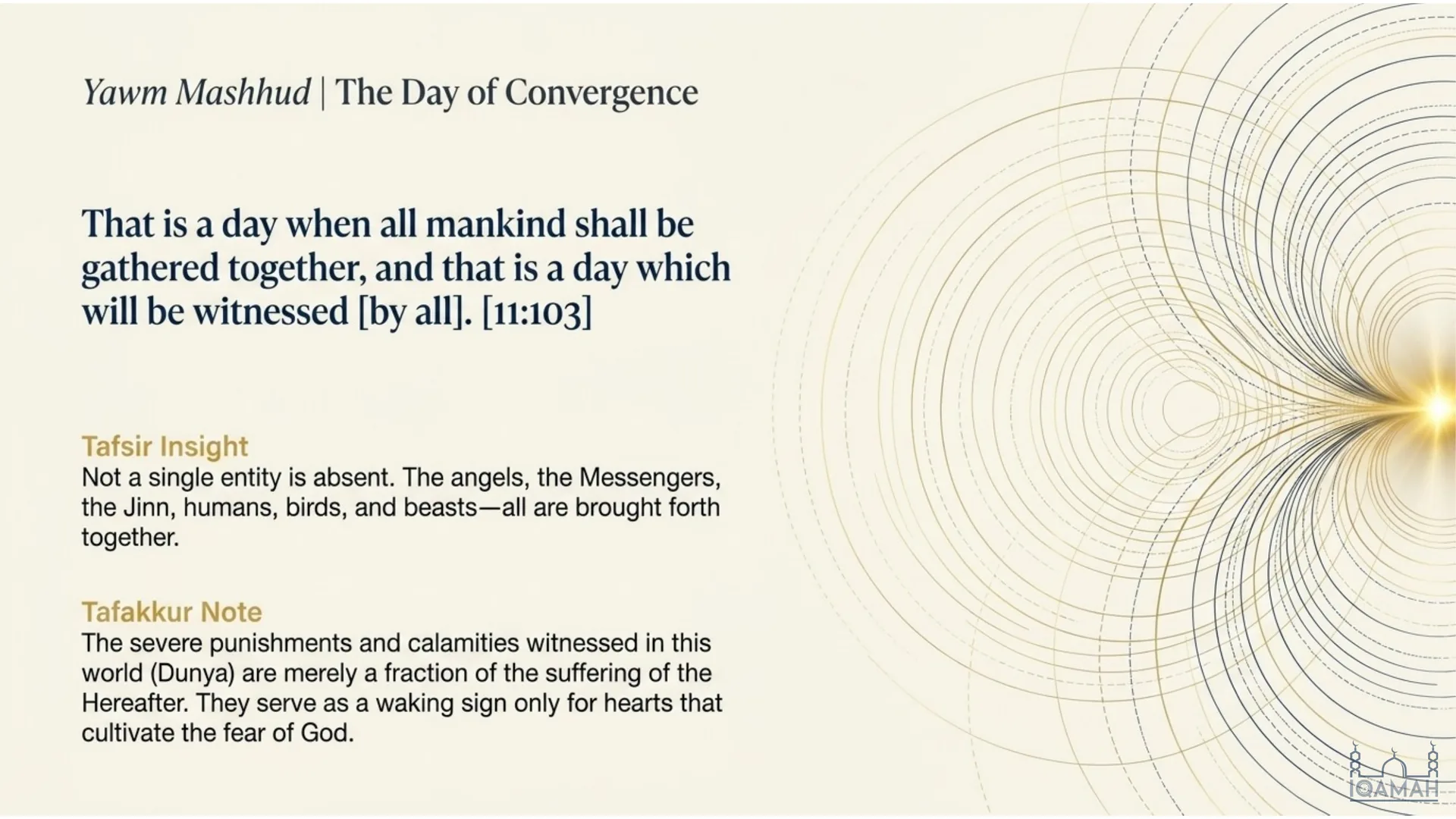
A sign for those who fear (103a). “Indeed in that is a sign for whoever fears the punishment of the Hereafter.” Sayyid Quṭb notes the careful limitation: the worldly punishment is a reminder of the Hereafter, but it is appreciated only by those who already fear that Day — their fear awakens the heart and opens the eyes, while the heedless look at the very same ruins and see nothing. The severe calamities of this world, says the sūrah’s logic, are only a fraction of what is to come; they serve as a waking sign for hearts that have learned to fear Allah.

The Day of Convergence (103b). “That is a Day for which mankind will be gathered, and that is a Day witnessed (yawm mashhūd).” Not a single being is absent: the angels, the messengers, the jinn, humanity, the very beasts — all are brought forth to the one gathering-place, all awaiting the outcome. It is the Day of total convergence, witnessed by all of creation.

Slide 7
Slide 7 of 24 #

And lest anyone mistake the delay of that Day for its cancellation:

وَمَا نُؤَخِّرُهُۥٓ إِلَّا لِأَجَلٍۢ مَّعْدُودٍۢ

“And We do not delay it except for a limited term.”

Sūrah Hūd 11:104 — Saheeh International

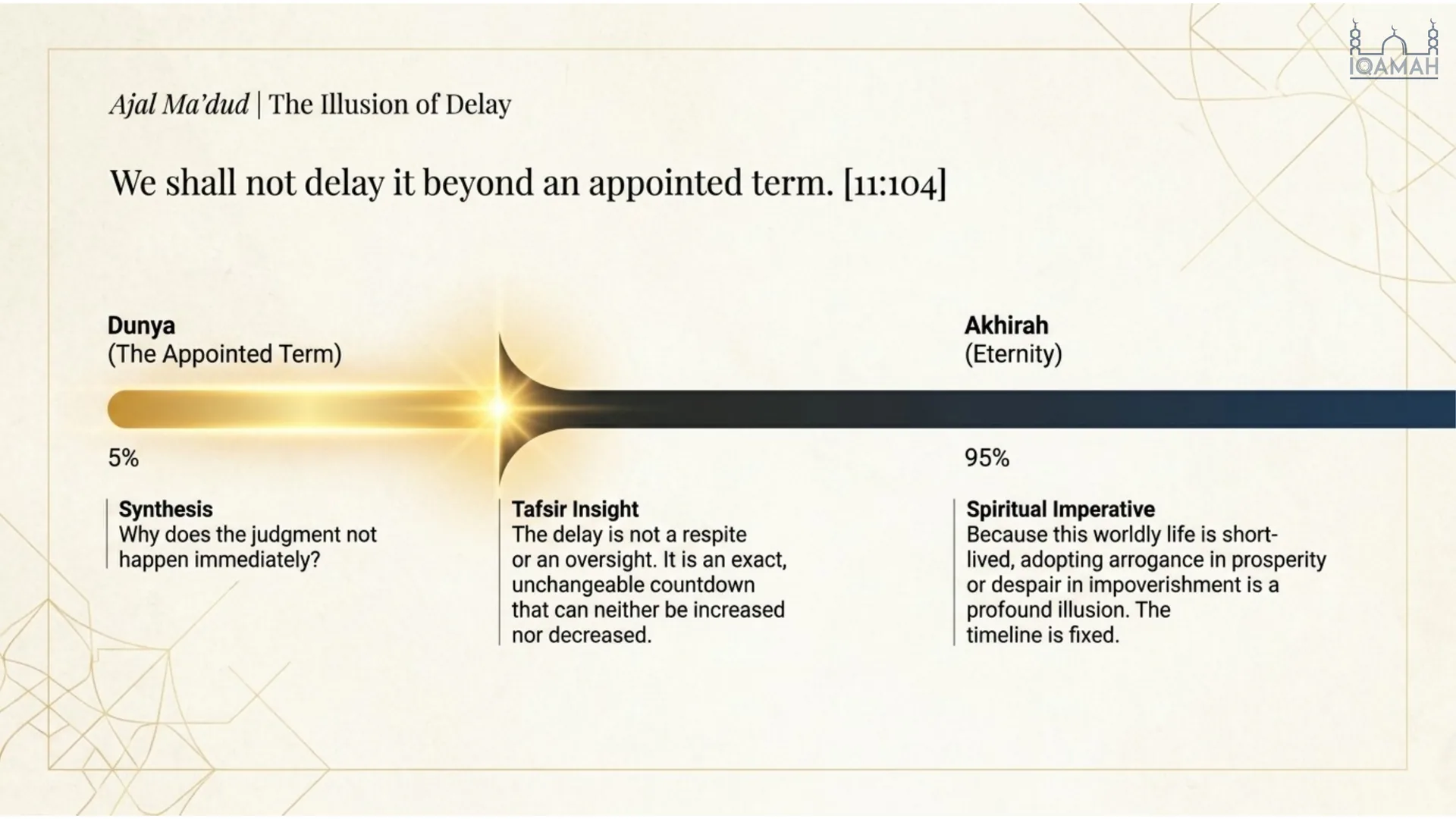
The illusion of delay. “And We do not delay it except for a limited term (ajal maʿdūd).” The postponement of the Day is not oversight, weakness, or uncertainty — it is an exact, appointed countdown, fixed to the moment, that can be neither advanced by a single hour nor pushed back. Why, then, does judgement not fall at once? Because the timeline is deliberate, and the interval is a respite — a mercy extended for repentance, not a sign that the reckoning will never arrive. The believer reads the delay as an opening; the heedless mistake it for permanence.

Slide 8
Slide 8 of 24 #

Now the sūrah carries us onto the Day itself, and the first thing we notice is the silence:

يَوْمَ يَأْتِ لَا تَكَلَّمُ نَفْسٌ إِلَّا بِإِذْنِهِۦ ۚ فَمِنْهُمْ شَقِىٌّۭ وَسَعِيدٌۭ

“The Day it comes no soul will speak except by His permission. And among them will be the wretched and the prosperous.”

Sūrah Hūd 11:105 — Saheeh International

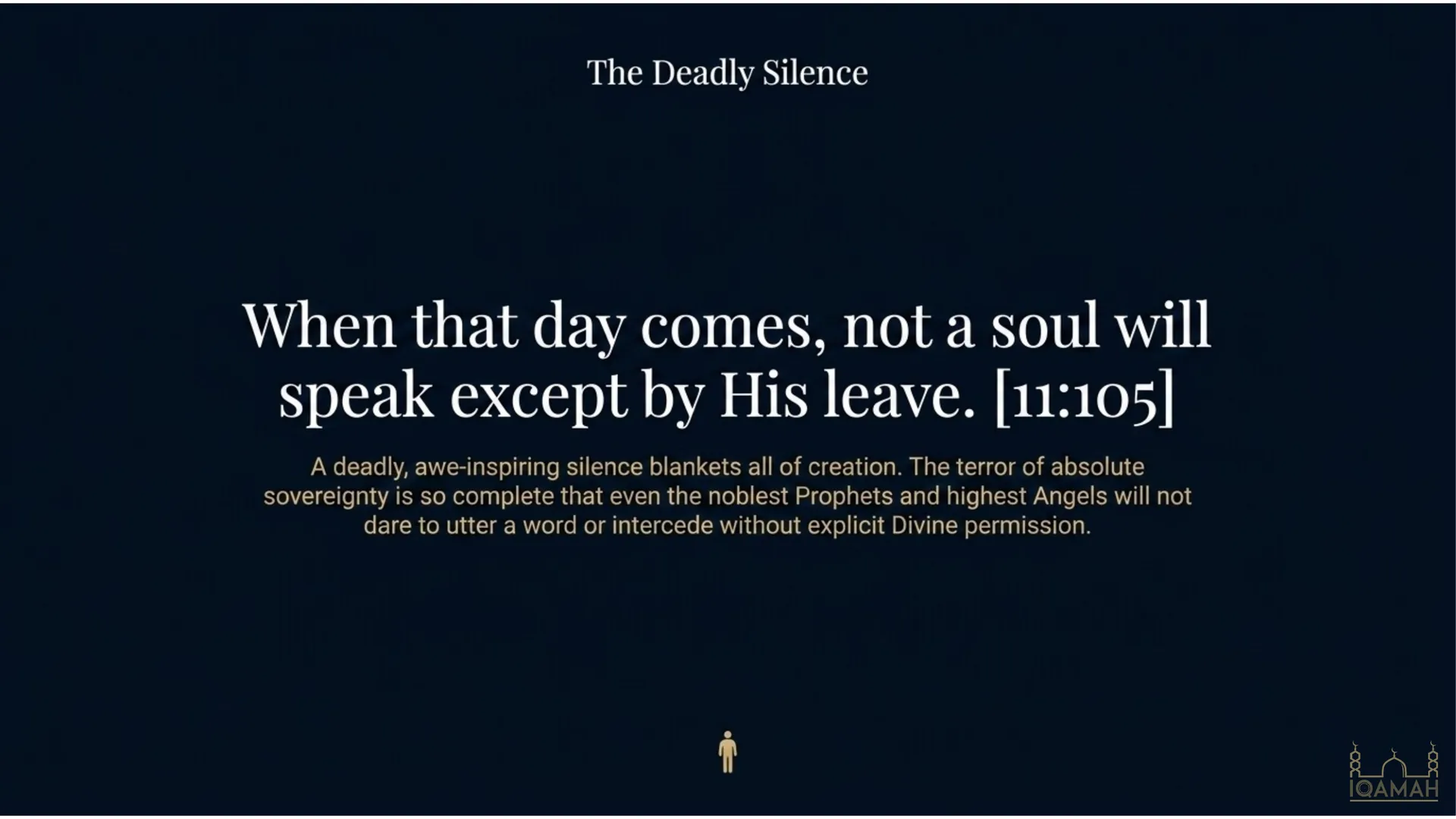
The day the voices are humbled. “The Day it comes, no soul will speak except by His permission.” Picture the scene Sayyid Quṭb paints: a silence so absolute, so saturated with awe, that it overwhelms all of creation — no one dares even to ask leave to speak. The sovereignty of Allah on that Day is so complete that the noblest prophets and the highest angels will not utter a word, nor intercede, except by His explicit permission. Every voice that was raised in arrogance in this world is humbled into stillness.

The ultimate sorting. Into that silence the verse drops the great division that will organise everything that follows: “among them will be the wretched (shaqī) and the prosperous (saʿīd).” The whole of humanity, sorted at last into two, and only two, camps. The next verses will take us into each.

Slide 9
Slide 9 of 24 #

First, the destiny of the wretched — and the sūrah does not look away from it:

فَأَمَّا ٱلَّذِينَ شَقُوا۟ فَفِى ٱلنَّارِ لَهُمْ فِيهَا زَفِيرٌۭ وَشَهِيقٌ

“As for those who were [destined to be] wretched, they will be in the Fire. For them therein is [violent] exhaling and inhaling.”

Sūrah Hūd 11:106 — Saheeh International

خَٰلِدِينَ فِيهَا مَا دَامَتِ ٱلسَّمَٰوَٰتُ وَٱلْأَرْضُ إِلَّا مَا شَآءَ رَبُّكَ ۚ إِنَّ رَبَّكَ فَعَّالٌۭ لِّمَا يُرِيدُ

“[They will be] abiding therein as long as the heavens and the earth endure, except what your Lord should will. Indeed, your Lord is an effecter of what He intends.”

Sūrah Hūd 11:107 — Saheeh International

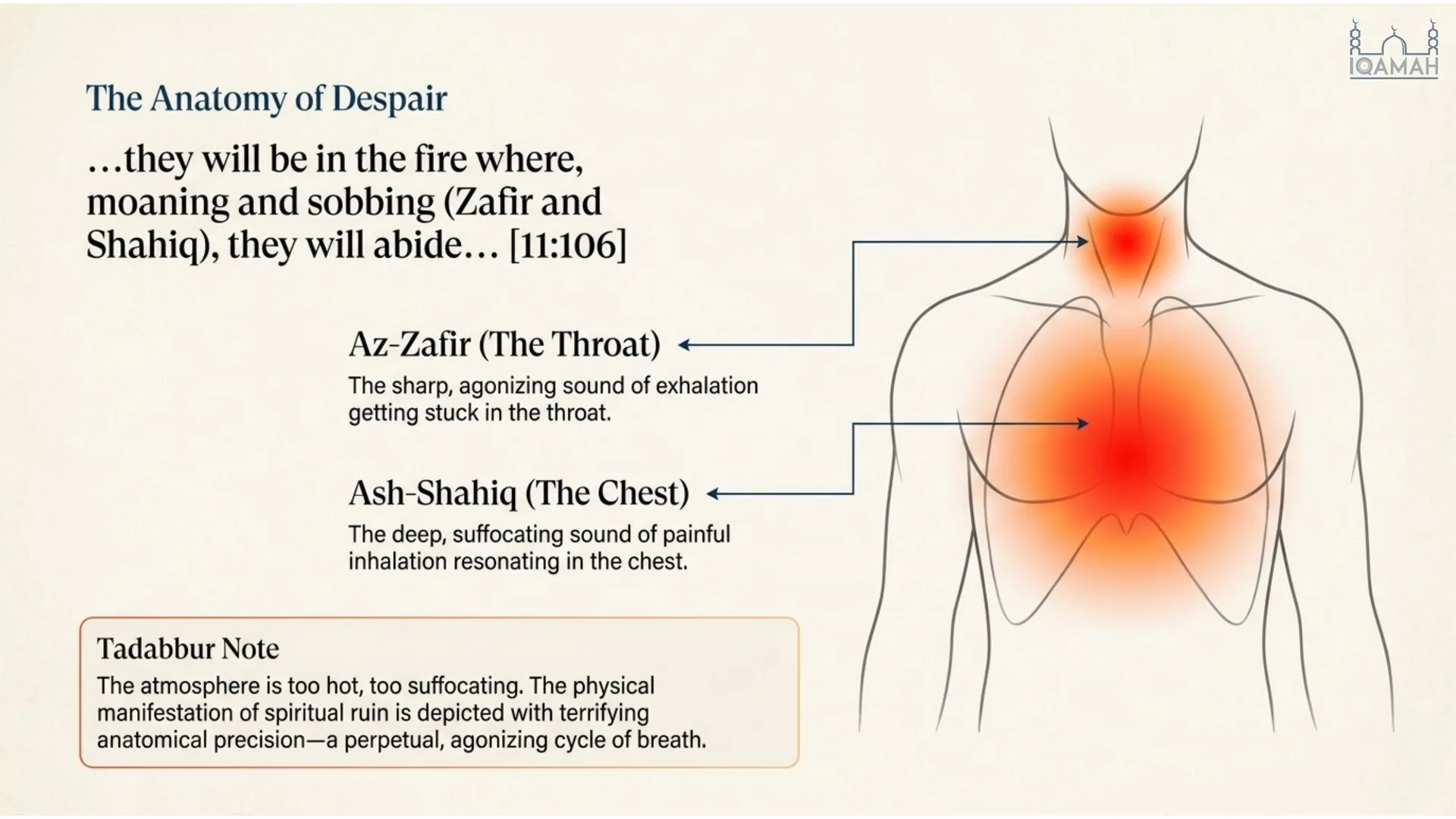
The anatomy of despair (106). “As for the wretched, they will be in the Fire; for them therein is exhaling and inhaling (zafīr and shahīq).” The two words are chosen with terrible precision: az-zafīr is the sharp, agonised exhalation forced up from the throat, and ash-shahīq is the deep, suffocating, sobbing intake drawn into the chest. Together they are the sound of one drowning in grief — a perpetual, involuntary cycle of breath. The physical ruin is the outward image of an inward ruin; the suffering of the spirit is rendered in the very rhythm of breathing.

The metaphor of eternity (107). “Abiding therein as long as the heavens and the earth endure, except what your Lord should will. Indeed, your Lord is an effecter of what He intends.” To the early Arabs, “as long as the heavens and the earth endure” was the ultimate idiom of permanence — a way of saying “forever.” But notice the clause that follows: “except what your Lord should will.” Even when affirming an eternity, the verse refuses to let that eternity stand as a law independent of its Author. Allah remains the absolute Sovereign over it, “doer of what He intends” — never bound, even by His own decree. (The classical exegetes, Ibn Kathīr among them, discuss whether this exception points to the interval before the wretched enter, or to the sinful believers of tawḥīd eventually brought out of the Fire by mercy; but its overriding force is the affirmation of Allah’s untrammelled will.)

Slide 10
Slide 10 of 24 #

And now the destiny of the blessed — the deliberate counterpart to the verse before it:

۞ وَأَمَّا ٱلَّذِينَ سُعِدُوا۟ فَفِى ٱلْجَنَّةِ خَٰلِدِينَ فِيهَا مَا دَامَتِ ٱلسَّمَٰوَٰتُ وَٱلْأَرْضُ إِلَّا مَا شَآءَ رَبُّكَ ۖ عَطَآءً غَيْرَ مَجْذُوذٍۢ

“And as for those who were [destined to be] prosperous, they will be in Paradise, abiding therein as long as the heavens and the earth endure, except what your Lord should will - a bestowal uninterrupted.”

Sūrah Hūd 11:108 — Saheeh International

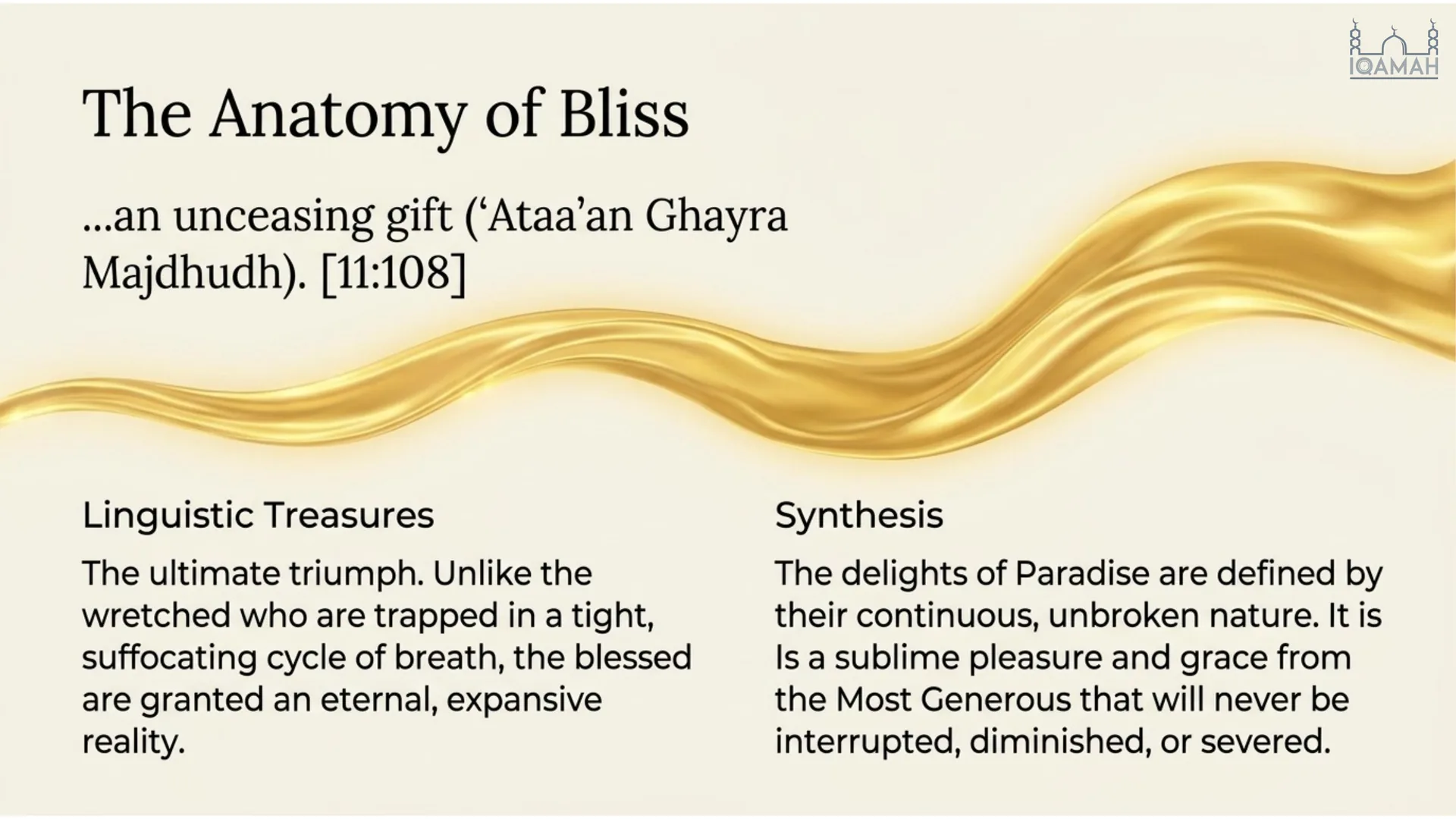
The anatomy of bliss. “As for the prosperous, they will be in Paradise, abiding therein as long as the heavens and the earth endure, except what your Lord should will — a gift uninterrupted (ʿaṭāʼan ghayra majdhūdh).” The linguistic treasure sits in that final phrase: ghayra majdhūdh means never cut off, never severed, never diminished. Set it against the wretched of the previous verse, trapped in a tight, suffocating cycle of breath; the blessed, by contrast, are immersed in an expansive, unbroken grace from the Most Generous that will never be interrupted.

Upheld by His will. The same exception — “except what your Lord should will” — governs Paradise too, and it carries a profound meaning. It does not threaten that Paradise will end; rather, it establishes that even eternal bliss is not self-sustaining. Like everything else in existence, it is upheld moment by moment, entirely by the conscious Will and grace of Allah. He remains the Ultimate Sovereign over eternity itself, and the gift continues only because the Giver continues to give.

Slide 11
Slide 11 of 24 #

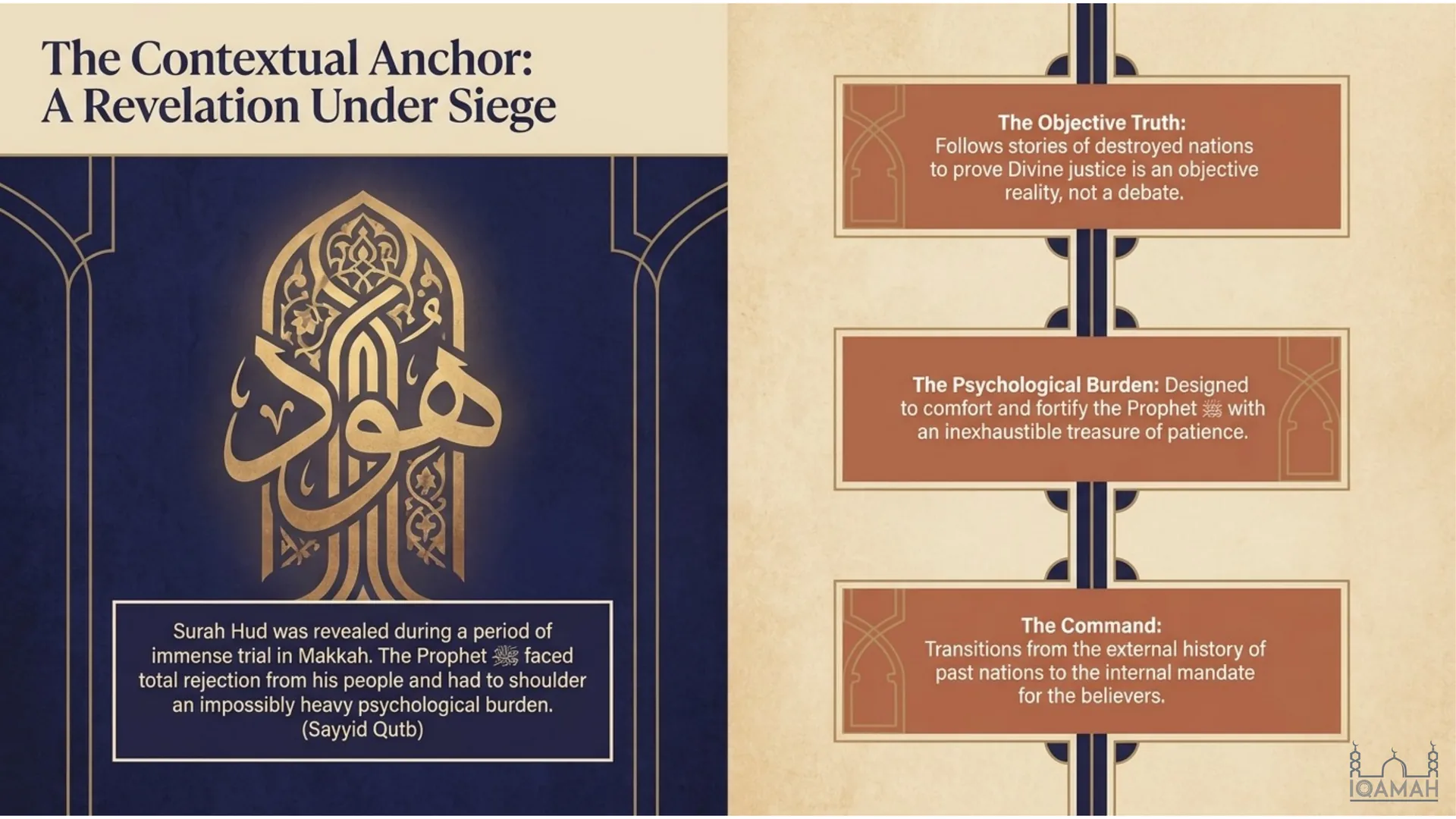
A revelation under siege. We arrive now at the Divine Prescription — the practical commands of verses 109 through 115 — and to read them rightly we must feel the pressure under which they were revealed. Both Sayyid Quṭb and Maʿāriful Qurʼān place us in the hardest phase of Makkah: stubborn, organised hostility to the Prophet ﷺ, the few believers persecuted, Islam making little visible headway, and the promised punishment of the deniers deferred to its appointed hour. Even the strongest hearts, Quṭb notes, can feel lonely and isolated in such a season.

This is the psychological burden the sūrah was carrying — the weight that, in the Prophet’s ﷺ own words, aged him. And it is precisely here that the sūrah pivots. Having recounted the external history of fallen nations, it now turns inward and hands the believer an internal mandate: a set of commands designed to comfort the heart and fortify it against an immovable opposition. What follows is not abstract law; it is armour for a soul under siege.

Slide 12
Slide 12 of 24 #

The prescription opens by steadying the Prophet’s ﷺ own certainty, and the certainty of every believer after him:

فَلَا تَكُ فِى مِرْيَةٍۢ مِّمَّا يَعْبُدُ هَٰٓؤُلَآءِ ۚ مَا يَعْبُدُونَ إِلَّا كَمَا يَعْبُدُ ءَابَآؤُهُم مِّن قَبْلُ ۚ وَإِنَّا لَمُوَفُّوهُمْ نَصِيبَهُمْ غَيْرَ مَنقُوصٍۢ

“So do not be in doubt, [O Muhammad], as to what these [polytheists] are worshipping. They worship not except as their fathers worshipped before. And indeed, We will give them their share undiminished.”

Sūrah Hūd 11:109 — Saheeh International

وَلَقَدْ ءَاتَيْنَا مُوسَى ٱلْكِتَٰبَ فَٱخْتُلِفَ فِيهِ ۚ وَلَوْلَا كَلِمَةٌۭ سَبَقَتْ مِن رَّبِّكَ لَقُضِىَ بَيْنَهُمْ ۚ وَإِنَّهُمْ لَفِى شَكٍّۢ مِّنْهُ مُرِيبٍۢ

“And We had certainly given Moses the Scripture, but it came under disagreement. And if not for a word that preceded from your Lord, it would have been judged between them. And indeed they are, concerning the Qur'an, in disquieting doubt.”

Sūrah Hūd 11:110 — Saheeh International

وَإِنَّ كُلًّۭا لَّمَّا لَيُوَفِّيَنَّهُمْ رَبُّكَ أَعْمَٰلَهُمْ ۚ إِنَّهُۥ بِمَا يَعْمَلُونَ خَبِيرٌۭ

“And indeed, each [of the believers and disbelievers] - your Lord will fully compensate them for their deeds. Indeed, He is Acquainted with what they do.”

Sūrah Hūd 11:111 — Saheeh International

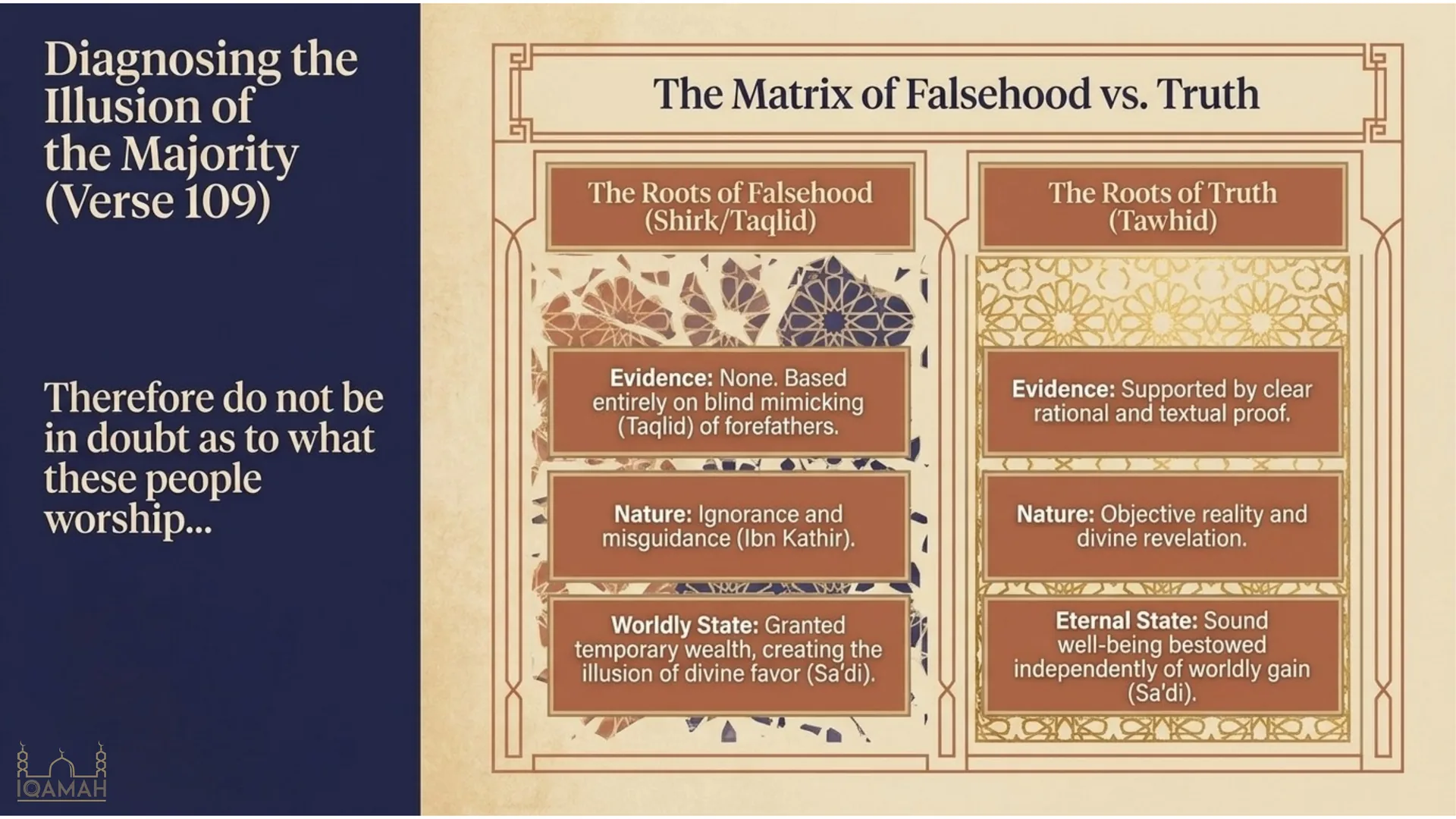
Do not doubt their falsehood (109). “So do not be in doubt as to what these worship; they worship only as their fathers worshipped before.” Sayyid Quṭb makes a fine observation about the address: it is spoken to the Prophet ﷺ, but the real audience is his people — stating the matter as objective truth explained by Allah to His Messenger, which is more devastating than direct argument, because it treats the false worship as beneath debate. Its only foundation is taqlīd, blind imitation of the forefathers, with no rational or revealed proof beneath it — the precise opposite of tawḥīd, which stands on clear evidence. “And indeed, We will give them their share undiminished” — their full recompense will come.

The Scripture and the deferred word (110–111). “We gave Moses the Scripture, but it came under disagreement.” The pattern is ancient: even a revealed Book becomes the object of dispute. “And if not for a word that preceded from your Lord, it would have been judged between them” — Quṭb explains that the bearers of Scripture were not annihilated wholesale precisely because their Books remained as guidance for later generations, and so their final reckoning was deferred to the Day of Judgement. And the section seals itself with certainty (111): “Each — your Lord will fully recompense them for their deeds.” The repeated, emphatic assurance is deliberate, so that the very delay of accountability never becomes, in anyone’s heart, a doubt about its inevitability.

Slide 13
Slide 13 of 24 #

And now the verse that stands at the summit of the whole sūrah — the command that the Prophet ﷺ said had aged him:

فَٱسْتَقِمْ كَمَآ أُمِرْتَ وَمَن تَابَ مَعَكَ وَلَا تَطْغَوْا۟ ۚ إِنَّهُۥ بِمَا تَعْمَلُونَ بَصِيرٌۭ

“So remain on a right course as you have been commanded, [you] and those who have turned back with you [to Allah], and do not transgress. Indeed, He is Seeing of what you do.”

Sūrah Hūd 11:112 — Saheeh International

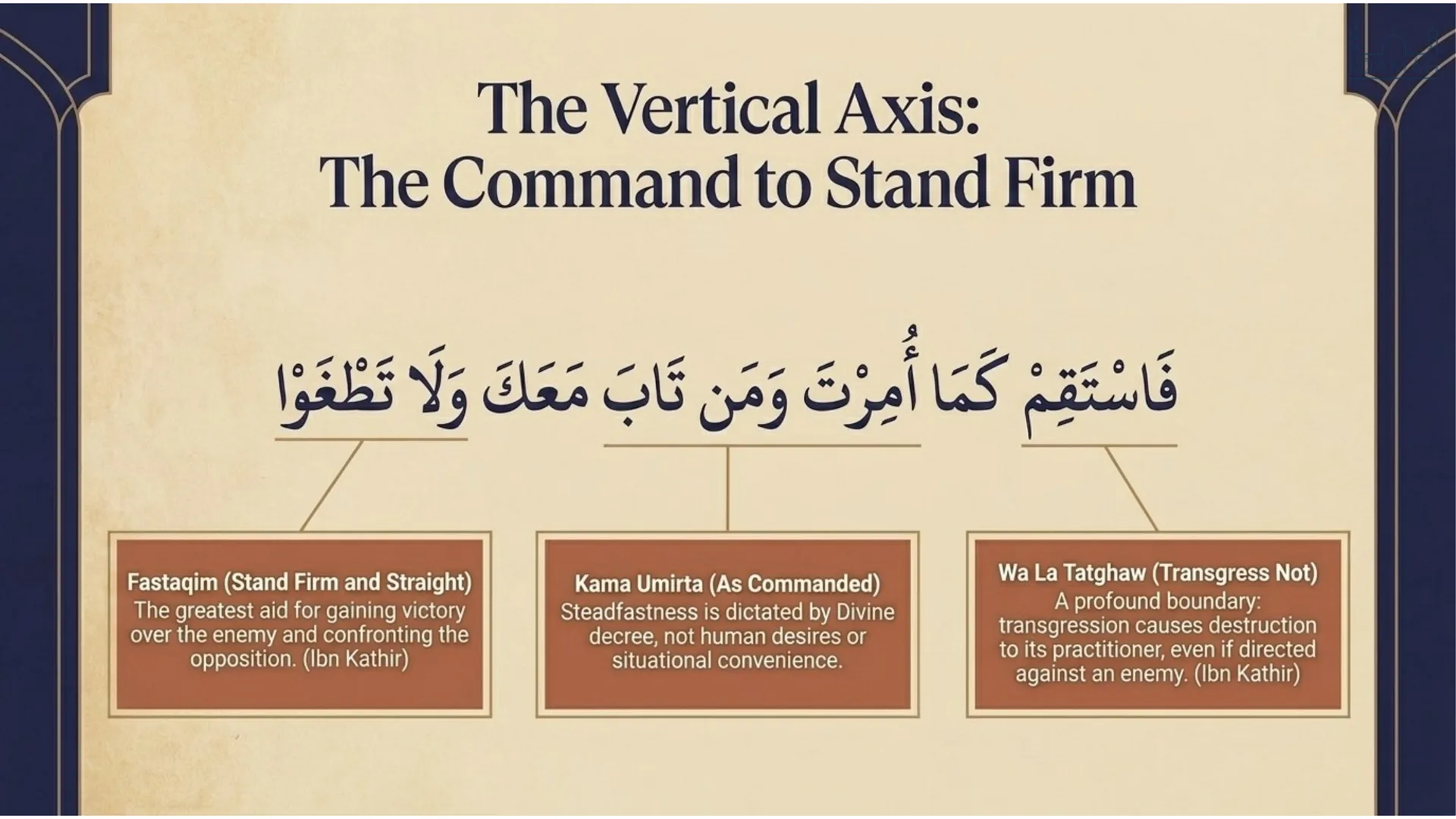
The vertical axis: stand firm. “So remain on a right course (fastaqim) as you have been commanded, you and those who have turned back with you, and do not transgress.” Istiqāmah — to stand firm and straight — is the vertical axis of the believer’s life, and “as you have been commanded” ties that uprightness to divine instruction rather than to personal preference or convenience (Ibn Kathīr). The Prophet ﷺ felt the full weight of this order: to keep to the straight course demands constant alertness, watchfulness, and control of one’s very feelings, for these can pull a person into deviation.

The warning against excess (112b). Here is Sayyid Quṭb’s crucial insight. The command to stand firm is followed not by a warning against laxity, but by a warning against excess — “and do not transgress (wa lā taṭghaw).” Why? Because the very effort to be upright can tip a person into over-rigour and exaggeration, and that transforms this naturally easy religion into a burden it was never meant to be. Allah wants the dīn to remain as He revealed it. So istiqāmah is revealed as the exact centre between two destructive extremes: tafrīṭ, falling short through negligence, and ṭughyān, transgressing through excess. The believer holds the precise middle. And Maʿāriful Qurʼān notes a beauty in the diction: the positive command (“stand firm”) is addressed to the Prophet ﷺ, while the prohibition (“do not transgress”) is directed to the community — a subtle mark of his ﷺ high station, for he never inclined toward what was to be left off.

Slide 14
Slide 14 of 24 #

If verse 112 was the vertical axis — standing straight before Allah — this next command draws the horizontal boundary:

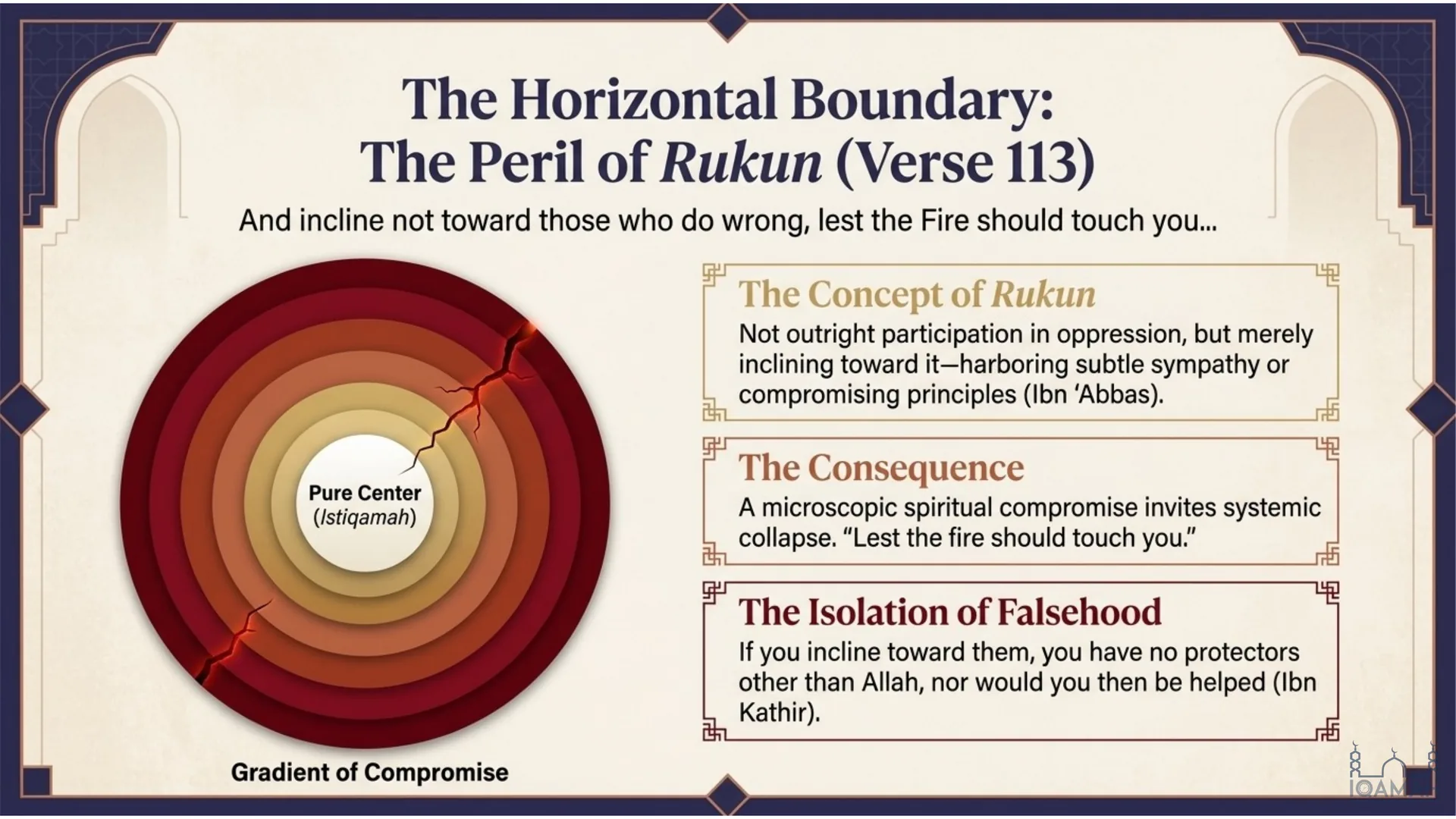
وَلَا تَرْكَنُوٓا۟ إِلَى ٱلَّذِينَ ظَلَمُوا۟ فَتَمَسَّكُمُ ٱلنَّارُ وَمَا لَكُم مِّن دُونِ ٱللَّهِ مِنْ أَوْلِيَآءَ ثُمَّ لَا تُنصَرُونَ

“And do not incline toward those who do wrong, lest you be touched by the Fire, and you would not have other than Allah any protectors; then you would not be helped.”

Sūrah Hūd 11:113 — Saheeh International

The peril of rukun (inclining). “And do not incline (lā tarkanū) toward those who do wrong, lest you be touched by the Fire.” The danger here is subtle, and that is what makes it so grave. Ibn ʿAbbās explains that rukun is not outright participation in oppression; it is the slightest leaning — a quiet sympathy, a softening toward the wrongdoers, a willingness to compromise principle for their favour. Sayyid Quṭb presses it further: to trust or lean toward tyrants who subjugate others is, in effect, to endorse the evil they practise and to become a party to it. The microscopic compromise invites systemic collapse.

The isolation of falsehood. And the consequence the verse names is terrifying in its loneliness: “you would not have other than Allah any protectors; then you would not be helped.” To lean toward the unjust is to step outside the circle of divine protection — and once outside it, there is no other shelter to be found. The vertical axis keeps us upright before Allah; this horizontal boundary keeps us from drifting, by degrees, into the orbit of falsehood.

Slide 15
Slide 15 of 24 #

Having set the axis and the boundary, the prescription now gives the daily means of staying upright:

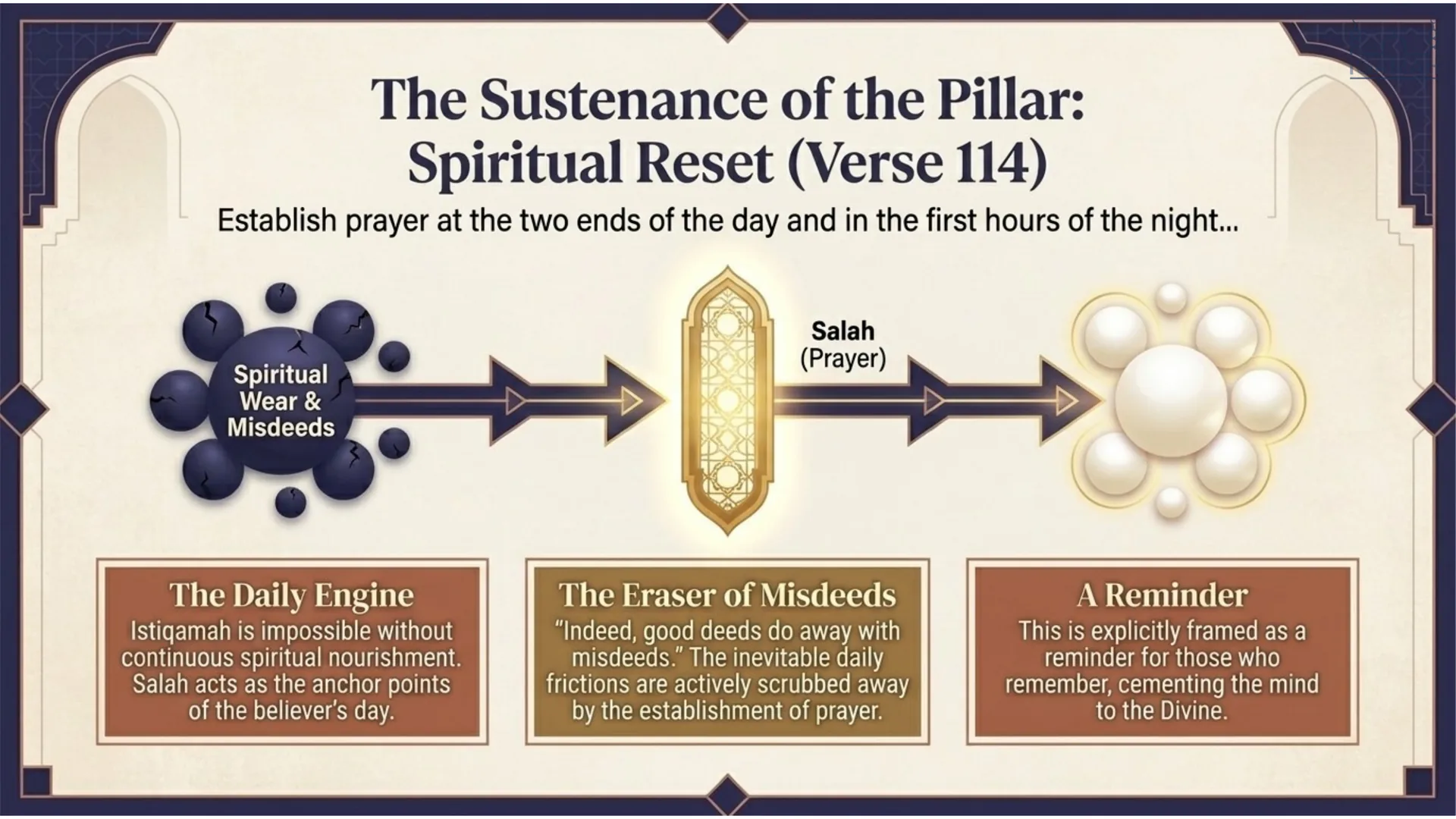
وَأَقِمِ ٱلصَّلَوٰةَ طَرَفَىِ ٱلنَّهَارِ وَزُلَفًۭا مِّنَ ٱلَّيْلِ ۚ إِنَّ ٱلْحَسَنَٰتِ يُذْهِبْنَ ٱلسَّيِّـَٔاتِ ۚ ذَٰلِكَ ذِكْرَىٰ لِلذَّٰكِرِينَ

“And establish prayer at the two ends of the day and at the approach of the night. Indeed, good deeds do away with misdeeds. That is a reminder for those who remember.”

Sūrah Hūd 11:114 — Saheeh International

The spiritual reset (114). “And establish prayer at the two ends of the day and at the approach of the night.” Maʿāriful Qurʼān unpacks the timing: the “two ends of the day” are Fajr and the close of the day (Maghrib, or ʿAṣr), and zulafan — the “parts of the night” — are Maghrib and ʿIshāʼ; together with Zuhr (named elsewhere, 17:78) these are the five daily prayers. Sayyid Quṭb calls prayer the bond between the afflicted heart and its merciful Lord — the very thing that overcomes loneliness and isolation in the face of a hostile, tyrannical society. It is the daily reset of a heart under siege.

Good deeds erase misdeeds. “Indeed, good deeds do away with misdeeds (inna al-ḥasanāt yudhhibna as-sayyiʼāt).” Maʿāriful notes this covers all good deeds, with prayer foremost among them, and that they expiate the minor sins (şaghāʼir) — as confirmed in 4:31 — on the condition that the major sins are avoided and that one is sincerely ashamed and resolved not to return. The Prophet ﷺ gave Abū Dharr the timeless prescription: “when you follow a bad deed with a good one, it will erase it,” and taught that two units of prayer after a slip bring forgiveness. “That is a reminder for those who remember” — the eraser is placed right beside the daily engine of prayer.

Slide 16
Slide 16 of 24 #

And the final pillar of the prescription, the one that holds all the others in place over time:

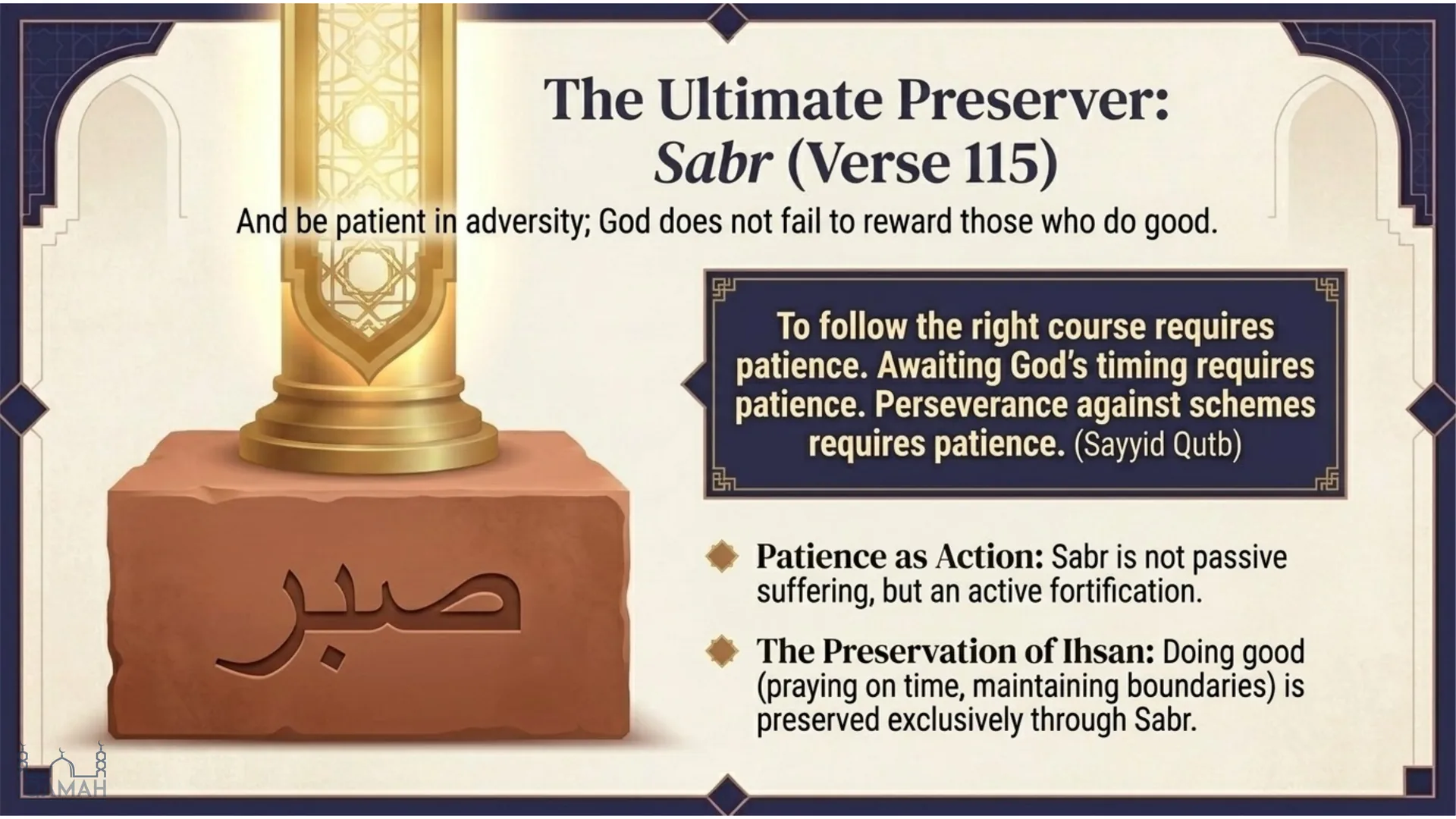
وَٱصْبِرْ فَإِنَّ ٱللَّهَ لَا يُضِيعُ أَجْرَ ٱلْمُحْسِنِينَ

“And be patient, for indeed, Allah does not allow to be lost the reward of those who do good.”

Sūrah Hūd 11:115 — Saheeh International

Sabr: the fuel of the journey. “And be patient, for indeed, Allah does not allow to be lost the reward of those who do good (al-muḥsinīn).” Maʿāriful Qurʼān reminds us that şabr literally means “to tie” — to hold the restless self under control, both holding it firm upon what is good and holding it back from what is evil. So patience here is not passive suffering; it is the active, disciplined work of clinging to everything just commanded — standing firm, refusing to incline, establishing prayer — and of enduring the hostility of enemies without breaking. It is the fuel that keeps the whole engine running.

The reward of the muḥsinīn. And who are these “doers of good” whose reward is never lost? Maʿāriful describes them as those firm in their dīn, faithful to the limits of the Sharīʿah, punctual and excellent in their prayer — in a word, the people of iḥsān, which the Prophet ﷺ defined as “to worship Allah as though you see Him, and if you do not see Him, then [knowing] that He sees you.” With istiqāmah as the direction (112), prayer as the energy (114), and şabr as the resilience (115), the architecture of steadfastness is complete — a fortress for the believer’s heart.

Slide 17
Slide 17 of 24 #

The sūrah now widens its lens from the individual to the whole society, and asks a haunting question about why nations are destroyed:

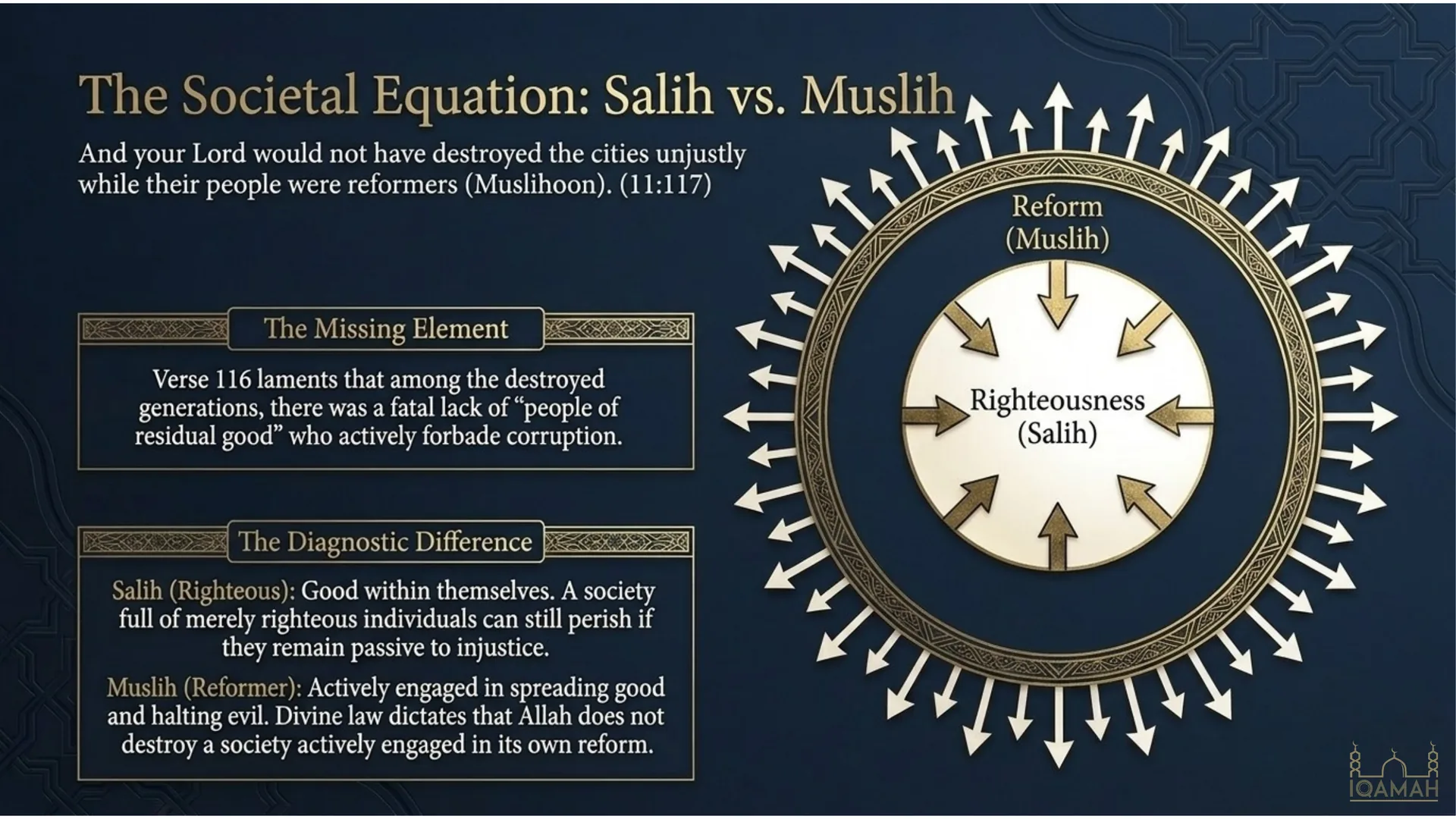
فَلَوْلَا كَانَ مِنَ ٱلْقُرُونِ مِن قَبْلِكُمْ أُو۟لُوا۟ بَقِيَّةٍۢ يَنْهَوْنَ عَنِ ٱلْفَسَادِ فِى ٱلْأَرْضِ إِلَّا قَلِيلًۭا مِّمَّنْ أَنجَيْنَا مِنْهُمْ ۗ وَٱتَّبَعَ ٱلَّذِينَ ظَلَمُوا۟ مَآ أُتْرِفُوا۟ فِيهِ وَكَانُوا۟ مُجْرِمِينَ

“So why were there not among the generations before you those of enduring discrimination forbidding corruption on earth - except a few of those We saved from among them? But those who wronged pursued what luxury they were given therein, and they were criminals.”

Sūrah Hūd 11:116 — Saheeh International

وَمَا كَانَ رَبُّكَ لِيُهْلِكَ ٱلْقُرَىٰ بِظُلْمٍۢ وَأَهْلُهَا مُصْلِحُونَ

“And your Lord would not have destroyed the cities unjustly while their people were reformers.”

Sūrah Hūd 11:117 — Saheeh International

The missing element (116). “So why were there not among the generations before you those of enduring discrimination (ulū baqiyyah) forbidding corruption — except a few of those We saved?” Maʿāriful Qurʼān explains the lovely phrase ulū baqiyyah: baqiyyah is the precious remnant a person guards above all else, the thing he will not part with — and so it comes to mean the remnant of reason, insight, and moral discernment. What was missing in those doomed societies was not private piety but active reformers. Tafsīr al-Saʿdī draws the lesson forward: were it not for the few in every age who call others to guidance and forbid corruption, the teachings of religion would not survive at all — and this is a direct encouragement to this Ummah to have always among it a remnant who put right what people corrupt, who bear with patience the harm they receive.

Reformer, not merely righteous (117). “And your Lord would not have destroyed the cities unjustly while their people were reformers (muşliḥūn).” Here is the diagnostic distinction our slide turns on: it is not enough to be şāliḥ — personally righteous, good in oneself. The verse speaks of the muşliḥ — the one who actively reforms and rectifies the society around him. Maʿāriful adds the sobering maxim drawn from this verse: nations can survive with disbelief and even with shirk, but they cannot survive with injustice and corruption. Destruction comes when disorder is spread, not for bare unbelief alone — and a society is shielded from it by its active reformers, not merely by its quiet saints.

Slide 18
Slide 18 of 24 #

We come now to the deepest wisdom of the whole conclusion — the design behind human difference itself:

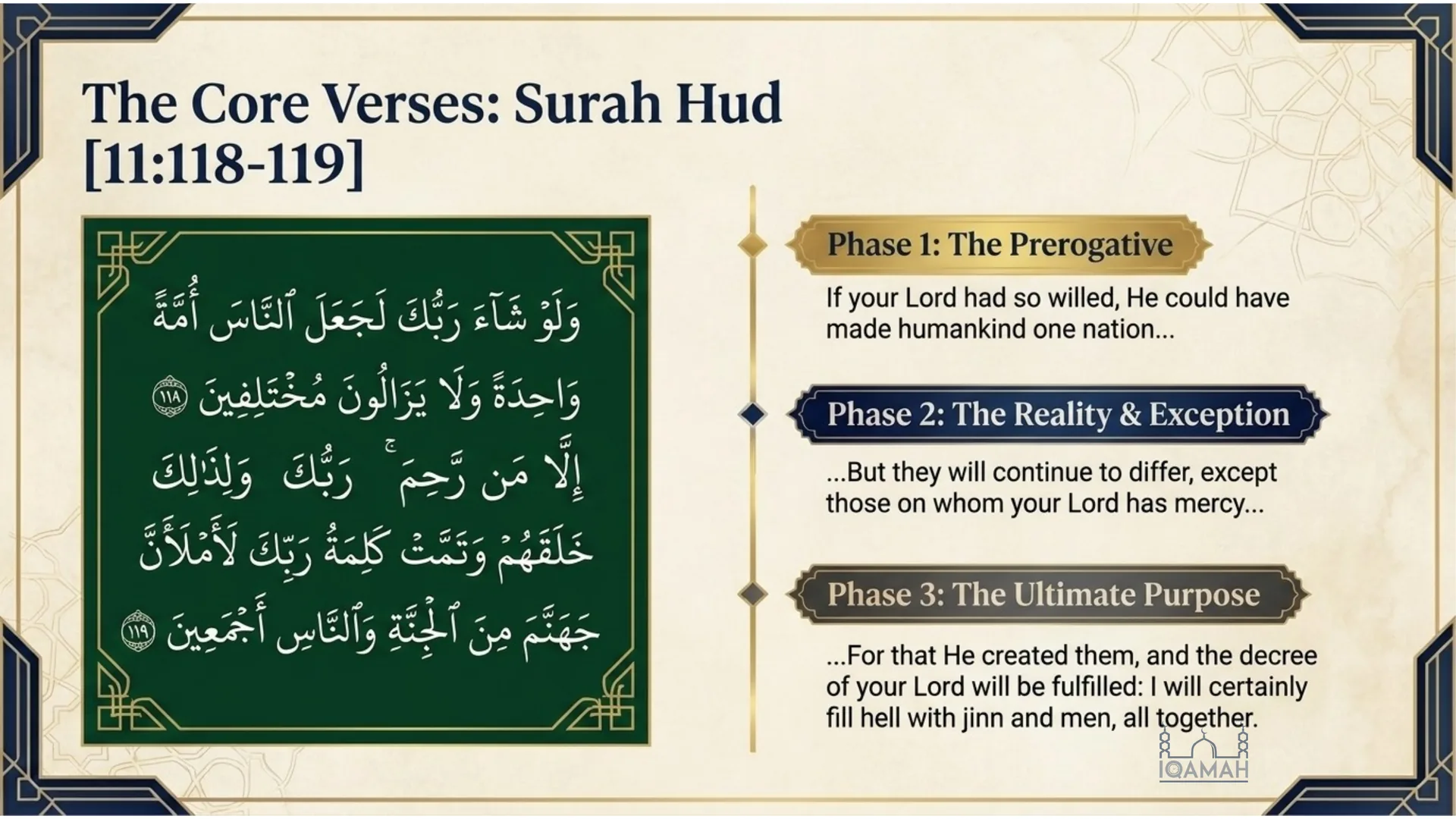
وَلَوْ شَآءَ رَبُّكَ لَجَعَلَ ٱلنَّاسَ أُمَّةًۭ وَٰحِدَةًۭ ۖ وَلَا يَزَالُونَ مُخْتَلِفِينَ

“And if your Lord had willed, He could have made mankind one community; but they will not cease to differ.”

Sūrah Hūd 11:118 — Saheeh International

إِلَّا مَن رَّحِمَ رَبُّكَ ۚ وَلِذَٰلِكَ خَلَقَهُمْ ۗ وَتَمَّتْ كَلِمَةُ رَبِّكَ لَأَمْلَأَنَّ جَهَنَّمَ مِنَ ٱلْجِنَّةِ وَٱلنَّاسِ أَجْمَعِينَ

“Except whom your Lord has given mercy, and for that He created them. But the word of your Lord is to be fulfilled that, "I will surely fill Hell with jinn and men all together."”

Sūrah Hūd 11:119 — Saheeh International

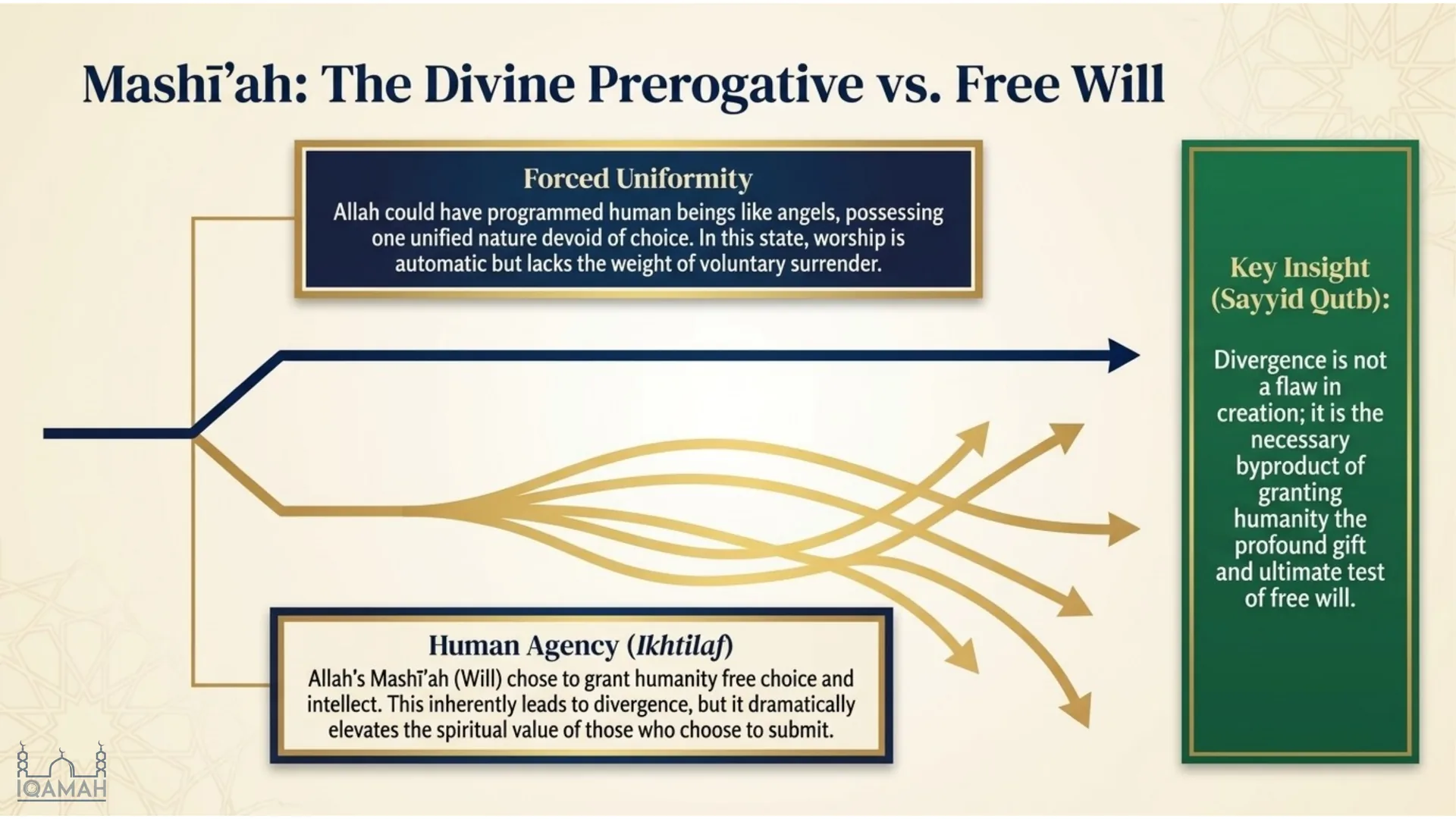
Three movements of the verse. First, the Prerogative: “Had your Lord willed, He could have made mankind one community.” He could have programmed humanity into a single, uniform nature, like the angels — worship automatic, devoid of the weight of voluntary surrender. Then, the Reality and the Exception: “but they will not cease to differ — except whom your Lord has given mercy.” And finally, the Purpose: “and for that He created them,” followed by the fulfilment of His word, “I will surely fill Hell with jinn and men all together.”

Which “difference” is meant. This is the place to be precise, and Maʿāriful Qurʼān is careful here. The “difference” the verse laments is hostility and opposition to the true faith and the teaching of the prophets — not the honest, ijtihād-based differences among the Mujtahid Imams, which have existed since the Companions and which fall entirely within Allah’s mercy as a dictate of His wisdom. To brand the scholarly differences of the Imams as the blameworthy divergence of this verse, Maʿāriful warns, is itself a departure from the verse’s context. Sayyid Quṭb frames the matter at the level of creation: Allah willed human beings to be creatures of varying inclinations and free choice. Divergence, then, is not a flaw in creation — it is the necessary by-product of the profound gift, and test, of free will.

Slide 19
Slide 19 of 24 #

Mashīʼah: the prerogative and the gift. Let us dwell on the choice the verse reveals, because so much of our creed rests on it. Allah’s mashīʼah — His sovereign Will — could easily have produced forced uniformity: a humanity made into copies of one original, compelled to belief, every soul identical, like programmed beings whose obedience carries no weight because it was never chosen. Sayyid Quṭb reminds us that this was entirely within His power; nothing is beyond Him.

But He willed otherwise. He entrusted to the human being — the creature assigned to build up the earth — the burden and dignity of ikhtiyār, genuine choice between good and evil. And it is exactly this freedom that gives the believer’s surrender its immense value: a worship offered freely, against the pull of other paths, is worth infinitely more than one that could never have been withheld. Divergence is simply the unavoidable cost of that gift. To wish it away is to wish away the freedom that makes faith meaningful in the first place.

Slide 20
Slide 20 of 24 #

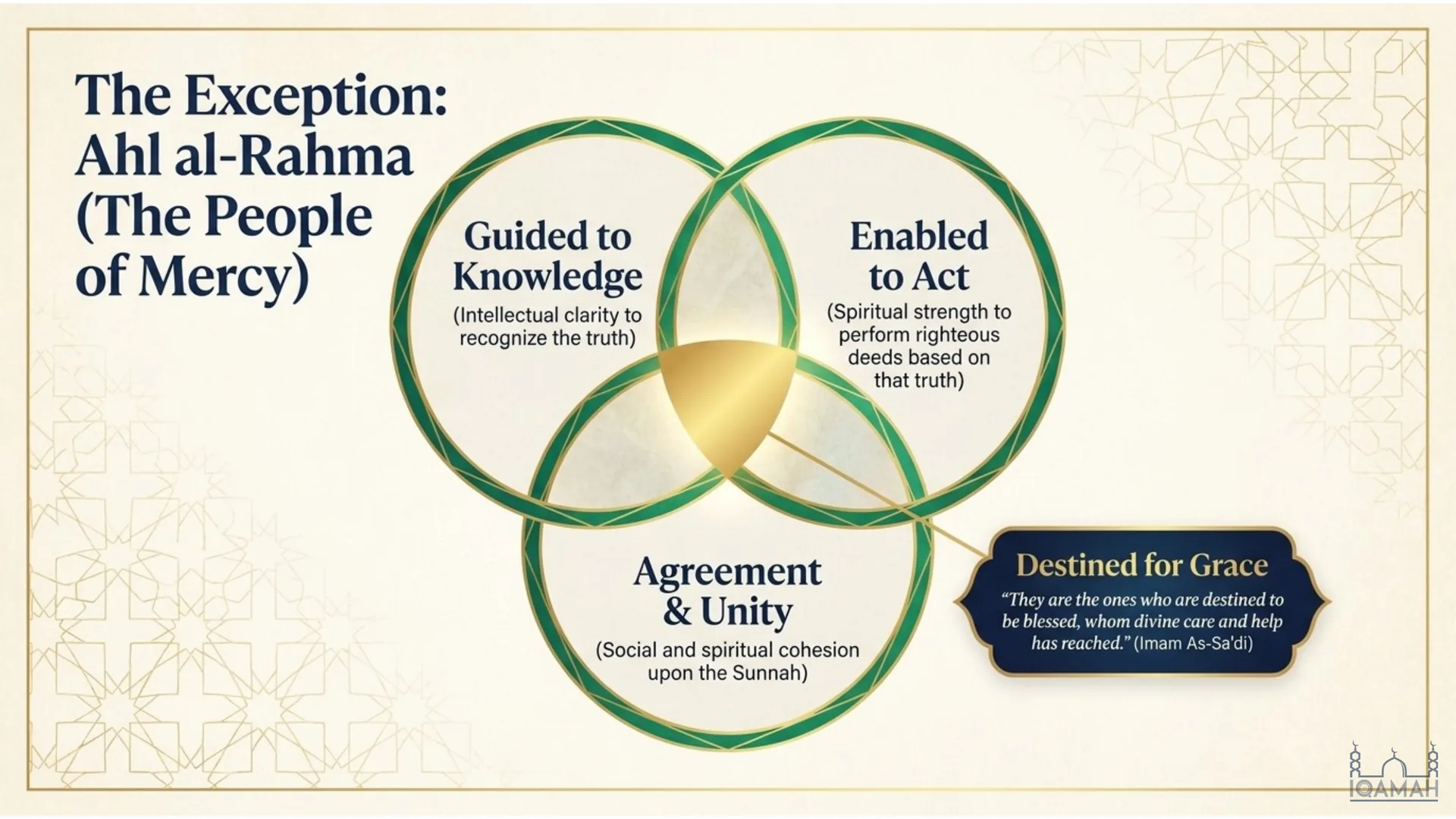
The exception: the people of mercy. “Except whom your Lord has given mercy.” Who are they — the ones lifted out of the endless human divergence? Tafsīr al-Saʿdī describes them along four lines, and our slide follows him: they are guided to knowledge — given the clarity to recognise the truth; enabled to act — given the strength to perform righteous deeds upon it; brought to agreement and unity — the social and spiritual cohesion of those who hold to the one path; and so destined for grace, reached and enveloped by divine care. Mercy, here, is not a feeling; it is guidance, enabling, unity, and grace, woven together.

“And for that He created them.” Saʿdī unfolds the grand wisdom of this final clause. Allah’s wisdom dictated that He create people who would diverge — some destined for blessing and some for ruin, some agreeing and some differing — in order to make manifest His justice, to bring out into the open what is hidden in human nature of good and evil, and to create the very conditions in which striving (jihād) and the deeds of worship become possible. For acts of worship, he notes, cannot be perfected or proven except through the crucible of tests and trials. A world without divergence would be a world without struggle — and therefore a world in which faith could never be refined.

Slide 21
Slide 21 of 24 #

And now, at the very end, the sūrah reveals the reason it has told us all of these stories in the first place:

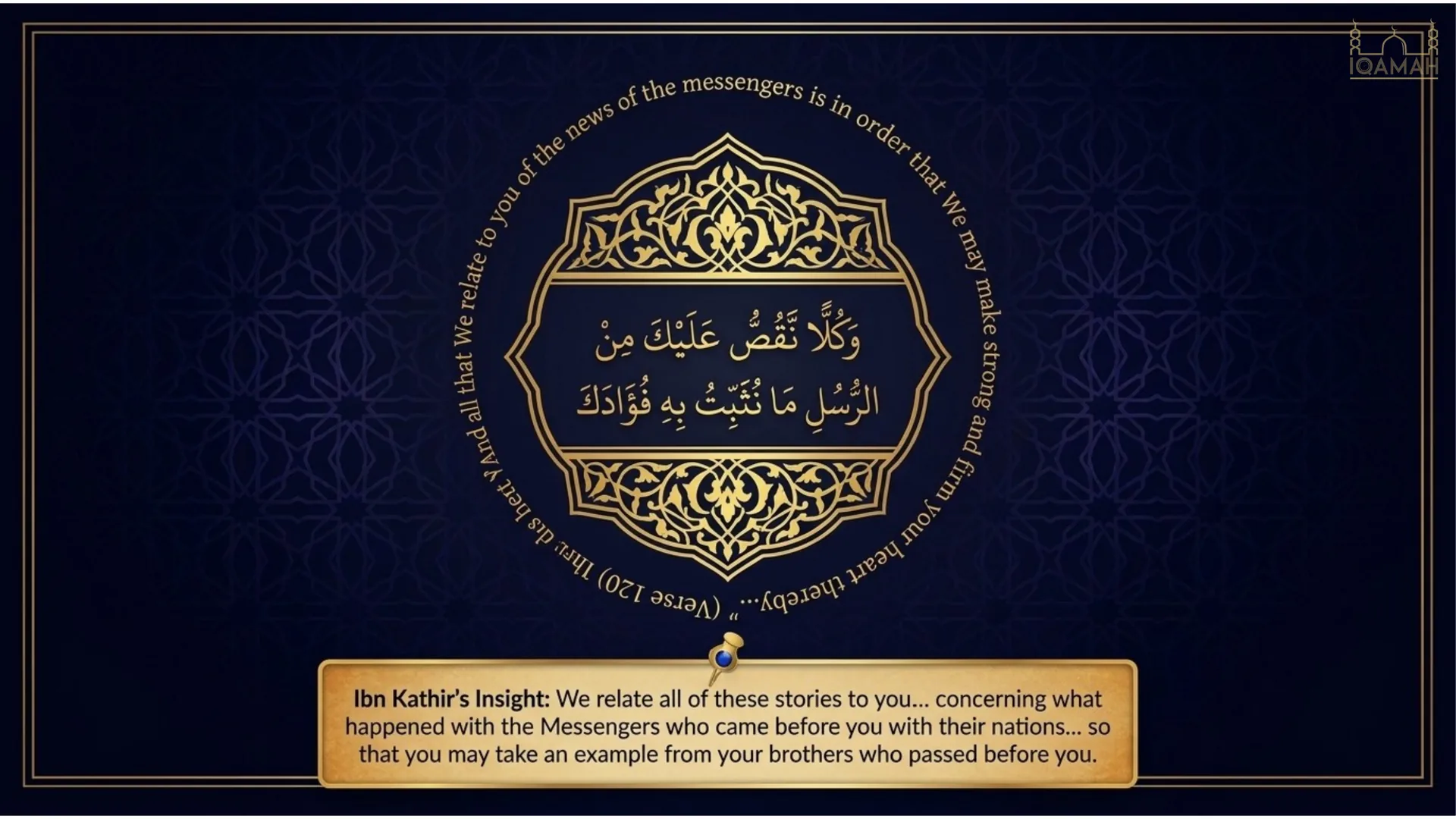
وَكُلًّۭا نَّقُصُّ عَلَيْكَ مِنْ أَنۢبَآءِ ٱلرُّسُلِ مَا نُثَبِّتُ بِهِۦ فُؤَادَكَ ۚ وَجَآءَكَ فِى هَٰذِهِ ٱلْحَقُّ وَمَوْعِظَةٌۭ وَذِكْرَىٰ لِلْمُؤْمِنِينَ

“And each [story] We relate to you from the news of the messengers is that by which We make firm your heart. And there has come to you, in this, the truth and an instruction and a reminder for the believers.”

Sūrah Hūd 11:120 — Saheeh International

Anchoring the heart (tathbīt al-fuʼād). “And each account We relate to you of the news of the messengers is that by which We make firm your heart (mā nuthabbitu bihi fuʼādak).” So this was the purpose all along. The root th-b-t (ث-ب-ت) means to be firm, fixed, anchored — and al-Zamakhsharī and the classical linguists note that this tathbīt does not imply the Prophet’s ﷺ heart was ever empty of faith; rather, the stories provide the heavy anchor a heart needs when the turbulent waves of this world — rejection, isolation, grief — threaten to drive it toward anxiety. Tafsīr al-Saʿdī adds that the heart is steadied and made patient by these accounts just as the Messengers of firm resolve (ulū al-ʿazm) were patient — for hearts find ease in an example to follow, and are energised to do righteous deeds when they see those who walked the path before them.

“And there has come to you, in this, the truth, an admonition, and a reminder for the believers.” Ibn Kathīr captures the spirit: We relate to you the stories of those who came before, so that you may take from your brethren who have passed an example, and a comfort. The history was never merely information; it was medicine for the heart.

Slide 22
Slide 22 of 24 #

With the heart now anchored, the Prophet ﷺ is given his final word to those who refuse to believe:

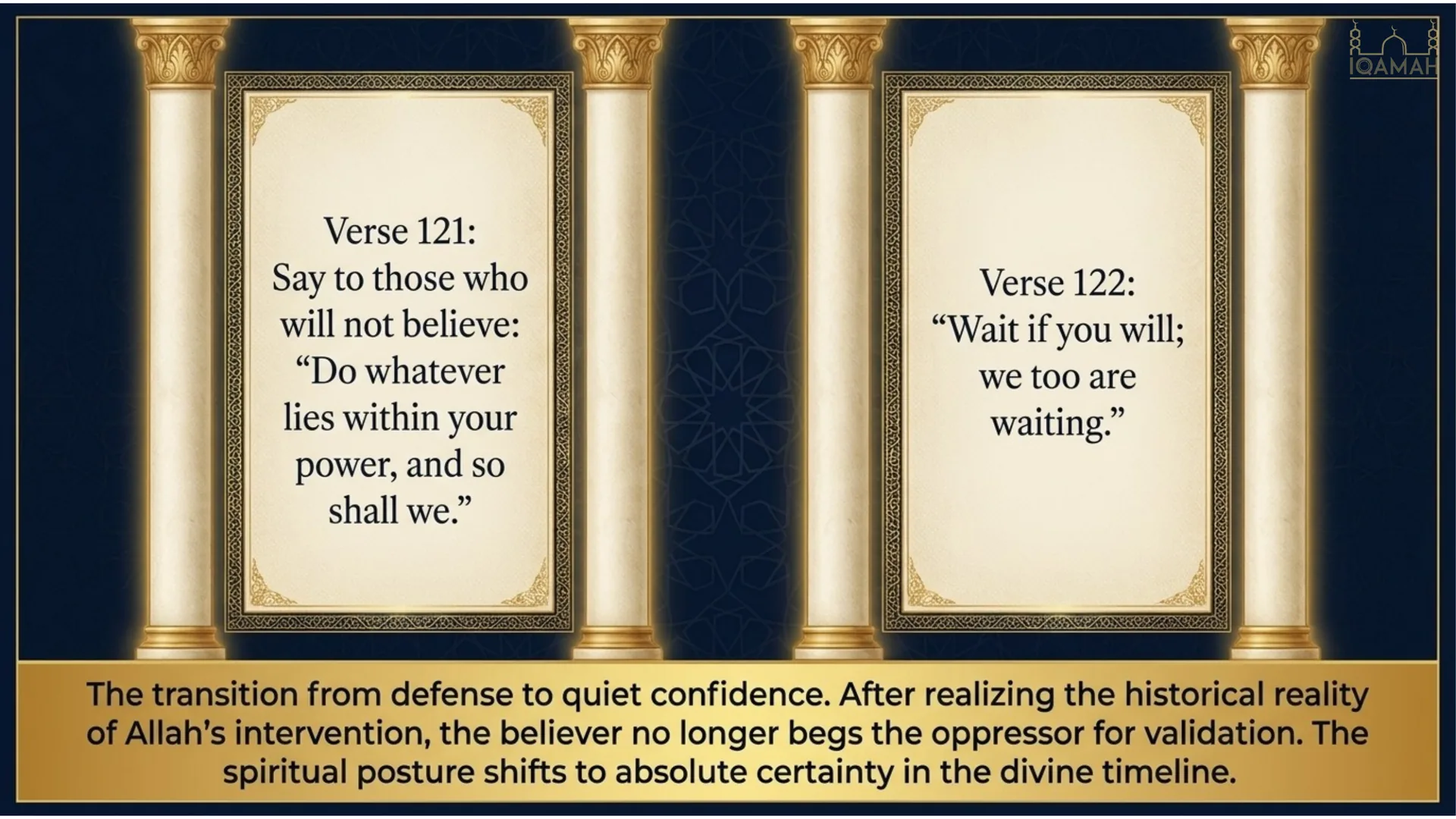
وَقُل لِّلَّذِينَ لَا يُؤْمِنُونَ ٱعْمَلُوا۟ عَلَىٰ مَكَانَتِكُمْ إِنَّا عَٰمِلُونَ

“And say to those who do not believe, "Work according to your position; indeed, we are working.”

Sūrah Hūd 11:121 — Saheeh International

وَٱنتَظِرُوٓا۟ إِنَّا مُنتَظِرُونَ

“And wait, indeed, we are waiting."”

Sūrah Hūd 11:122 — Saheeh International

From argument to quiet confidence. “And say to those who do not believe: Work according to your position; indeed, we are working. And wait; indeed, we are waiting.” Tafsīr al-Saʿdī notes that this comes after the proof has been fully established — so it is not a plea but a parting: carry on as you are, and we shall carry on as we are; wait and see what befalls us, and we too are waiting to see what befalls you. The posture has changed entirely. The believer no longer argues on the opponent’s terms or begs the powerful for validation; he turns, with quiet certainty, to the unfolding of Allah’s timing. Sayyid Quṭb notes that this is the very word a prophet of this sūrah — Shuʿayb عليه السلام — said to his people before leaving them to their fate (11:93).

This is the diagnostic difference between a defeated heart and a firm one. The defeated heart is reactive, demands immediate results, and seeks approval from the crowd; the firm heart is patient, aligned with Allah’s deliberate timing — “we too are waiting” — and seeks validation from the Owner of the Unseen alone.

Slide 23
Slide 23 of 24 #

And so the sūrah closes — the entire Islamic worldview distilled into a single verse:

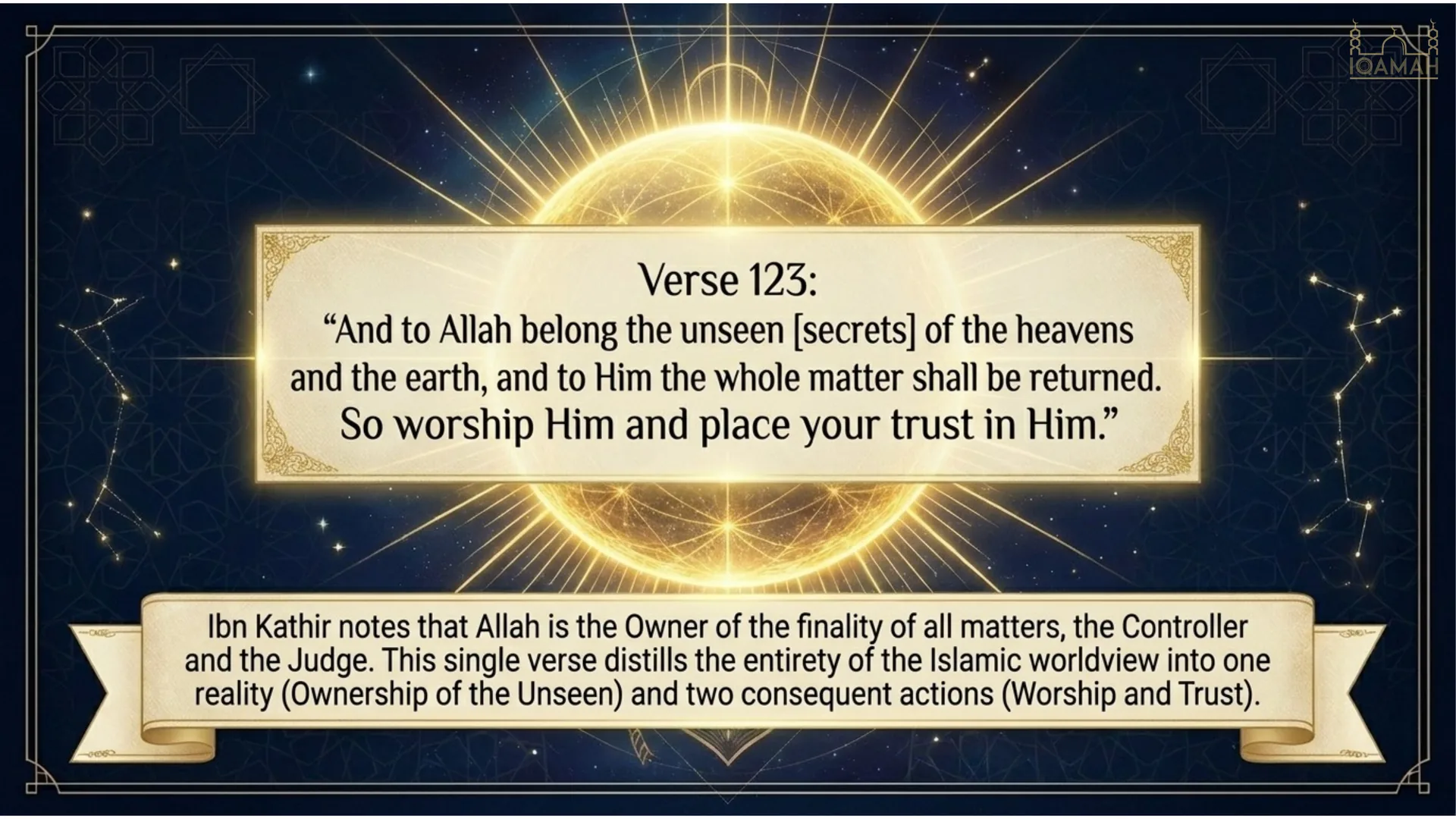
وَلِلَّهِ غَيْبُ ٱلسَّمَٰوَٰتِ وَٱلْأَرْضِ وَإِلَيْهِ يُرْجَعُ ٱلْأَمْرُ كُلُّهُۥ فَٱعْبُدْهُ وَتَوَكَّلْ عَلَيْهِ ۚ وَمَا رَبُّكَ بِغَٰفِلٍ عَمَّا تَعْمَلُونَ

“And to Allah belong the unseen [aspects] of the heavens and the earth and to Him will be returned the matter, all of it, so worship Him and rely upon Him. And your Lord is not unaware of that which you do.”

Sūrah Hūd 11:123 — Saheeh International

One reality, two actions. “And to Allah belong the unseen (ghayb) of the heavens and the earth, and to Him the whole matter will be returned.” Ibn Kathīr notes that Allah here declares Himself the Owner of all that is hidden and the One to whom the finality of every matter returns — the Controller and the Judge. From that one reality flow two commands: “so worship Him and rely upon Him (faʿbudhu wa tawakkal ʿalayhi).” Tafsīr al-Saʿdī glosses worship as doing all that Allah has enjoined, and tawakkul as relying upon Him for the doing of it. And note the meaning of the root w-k-l (و-ك-ل): tawakkul is not passivity — it is the active delegation of the unseen to its rightful Owner, entrusting to Him what lies beyond our power while we do what lies within it.

“Your Lord is not unaware.” “And your Lord is not unaware of that which you do.” After commanding the heart to stand firm and weather the storms of history, the sūrah ends on the warmest note of intimacy: He is not blind to the believer’s struggle or to the tears pressed back in the night. Saʿdī: He is aware of all you do, good and evil; His knowledge encompasses it, His pen records it, and He will requite it in full. And so the conclusion answers the opening: the sūrah began by calling us to worship Allah alone and to turn to Him, and it ends with that same call — worship Him, and trust Him. That, Sayyid Quṭb reminds us, is the artistic coordination of the beginning and the end, and the whole message of Sūrah Hūd in a single breath.

Slide 24
Slide 24 of 24 #

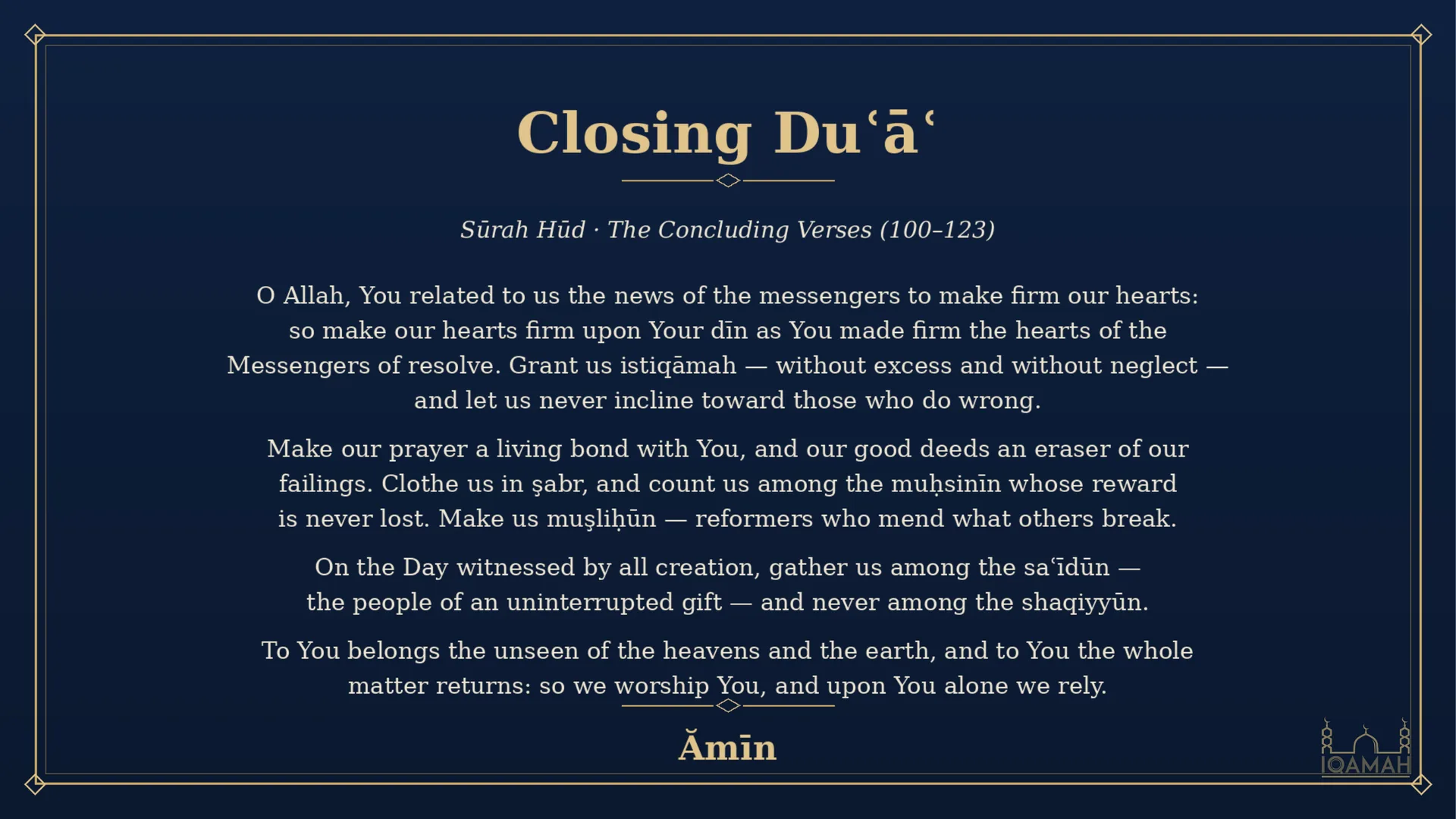
As is our custom, we close with duʿāʼ — and our supplication simply gathers up everything this concluding movement has placed in our hands. We have seen the ruins that diagnose the soul, the Witnessed Day that sorts the wretched from the blessed, the command of istiqāmah held between excess and neglect, and the final anchor of worship and trust in the Owner of the Unseen.

So we ask Allah ﷻ to make our hearts firm (thabbit qulūbanā) upon His dīn as He made firm the hearts of the Messengers of resolve; to grant us istiqāmah without excess and without falling short; to keep us from ever inclining toward those who do wrong; to make our prayer a living bond with Him and our good deeds an eraser of our failings; to clothe us with şabr, and to count us among the muḥsinīn whose reward is never lost. We ask Him to make us muşliḥūn — reformers who mend what others break — and to gather us, on the Day witnessed by all creation, among the saʿīdūn, the people of an uninterrupted gift, and never among the shaqiyyūn.

O Allah, to You belongs the unseen of the heavens and the earth, and to You the whole matter returns: so we worship You and we rely upon You alone. Make this gathering a proof for us and not against us, anchor our hearts in Your truth, and let us depart upon the straight path. Āmīn.

About this series

This is the sixth and final session in a six-part series walking through the tafsir of Sūrah Hūd. Parts 1–5 established the framework (vv. 1–24), walked the Nūḥ narrative (vv. 25–49), read the matched ruin of ʿĀd and Thamūd (vv. 50–68), took the angelic guests of Ibrāhīm and the people of Lūṭ (vv. 69–83), and paired Shuʿayb to Madyan with Mūsā before Firʿawn (vv. 84–99). Part 6 (this session) reads the sūrah's concluding movement (vv. 100–123): the ruins as diagnosis, the Witnessed Day and the two destinies, the prescription of istiqāmah, prayer and patience, and the closing command to worship and rely upon the Owner of the Unseen — faʿbudhu wa tawakkal ʿalayhi. To be notified about future sessions, drop a line to admin@iqamah.org — we'll keep a list and reach out as new material publishes.

  1. 1
    An Illuminated Framework vv. 1–24 — Doctrinal core, cosmic context, prophetic challenge
  2. 2
    The Ark and the Oven vv. 25–49 — Nūḥ's daʿwah, the Ark, and the boiling oven
  3. 3
    Blueprints of Faith and Ruin vv. 50–68 — Hūd and ʿĀd, Ṣāliḥ and Thamūd, and the polished heart
  4. 4
    The Heavenly Guests vv. 69–83 — Ibrāhīm's guests, the glad tidings of Isḥāq, and the overturning of Lūṭ's people
  5. 5
    The Scales and The Scepter vv. 84–99 — Shuʿayb and Madyan, Mūsā and Firʿawn, and the question of the grave
  6. 6
    The Anchored Heart vv. 100–123 — the ruins as diagnosis, the Witnessed Day, istiqāmah, and the command to worship and trust
    You are here