Iqamah

Resources · Surah Hud Tafsir Series

Part 5 of 6

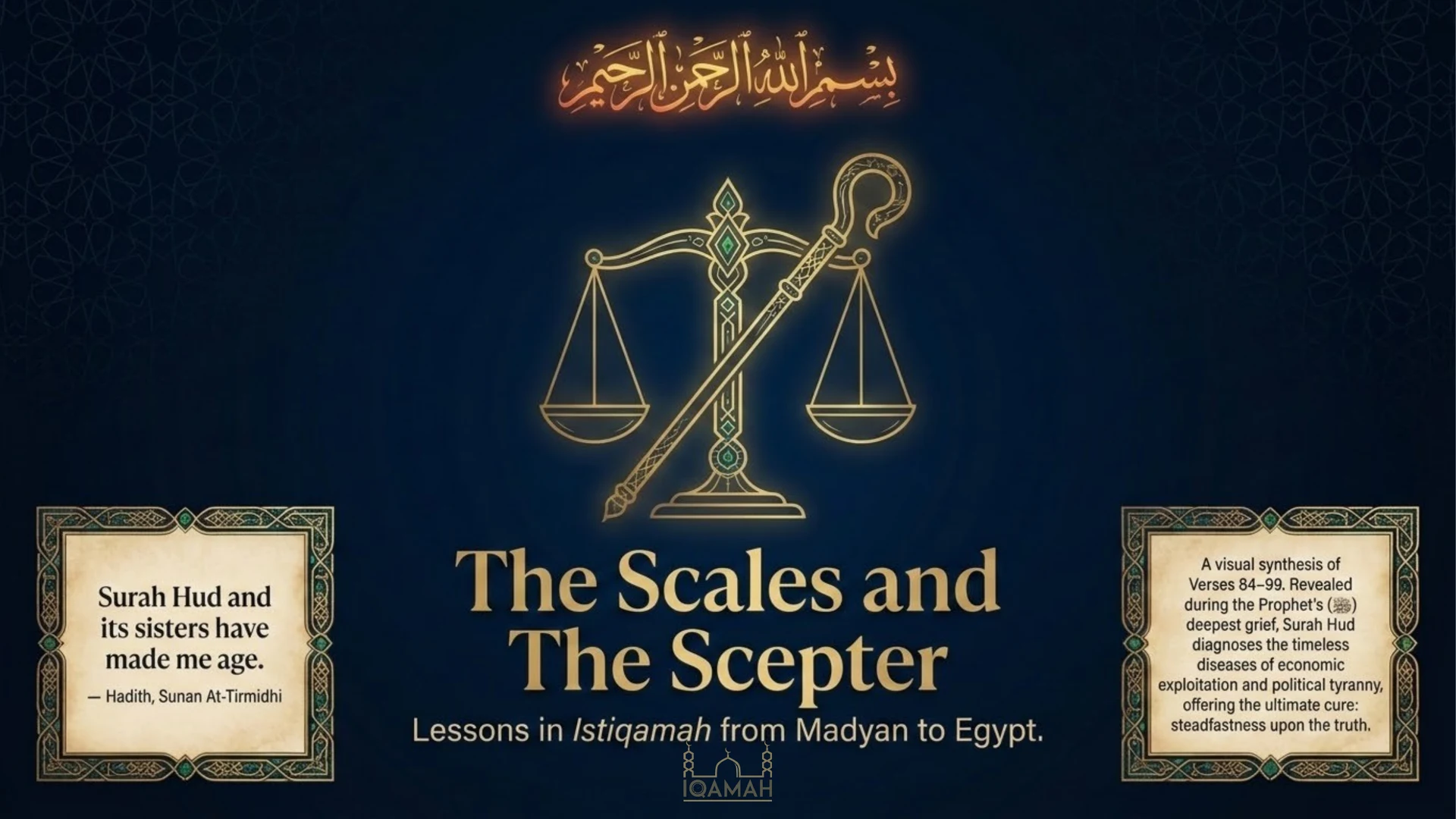
The Scales and The Scepter — Surah Hud, Part 5

Lessons in Istiqāmah from Madyan to Egypt — Shuʿayb and Madyan, Mūsā and Firʿawn

Sūrah Hūd, Part 5 — two emblems of ruin and one cure. The session reads Shuʿayb's daʿwah to the merchant city of Madyan (vv. 84–95, the disease of the scales — economic fraud) alongside Mūsā before Firʿawn's Egypt (vv. 96–99, the disease of the scepter — blind obedience to a tyrant), bound together by the one remedy Sūrah Hūd will name: istiqāmah. It closes with an epilogue on the barzakh — can the dead hear? — reconciling the prophetic addresses to the dead with Fāṭir 35:22, after Ibn Kathīr and the mufassirūn.

Slides 27
Format Slides + notes
Series Surah Hud Tafsir Series
Cover slide: The Scales and The Scepter — Surah Hud, Part 5
Slide 1
Slide 1 of 27 #

Welcome to the fifth session of our journey through Sūrah Hūd. We have walked with Nūḥ, Hūd, Ṣāliḥ, Ibrāhīm and Lūṭ — today we arrive at Madyan and then at Egypt, and we close on a question that the grave itself raises. Remember the atmosphere of this sūrah: it was revealed in the depths of the Prophet’s ﷺ grief, and it is the sūrah of which he ﷺ said that it and its sisters had aged him (Sunan al-Tirmidhī). The weight is the weight of istiqāmah — of standing firm upon the truth when the world tilts.

Our title names two emblems. The Scales (al-mīzān) are the disease of Madyan: a wealthy merchant society that severed worship from the marketplace and made fraud a way of life. The Scepter is the disease of Egypt: a people who made a tyrant’s command their religion. Two nations, two maladies — yet one cure, which Sūrah Hūd will name a few verses later: “fastaqim kamā umirta” — stand firm as you have been commanded (11:112). As Maʿāriful Qurʾān reminds us, istiqāmah is not a single act but a straightness that must run through belief, worship, dealings, and trade alike. That is the thread we follow from Madyan to Egypt.

Slide 2
Slide 2 of 27 #

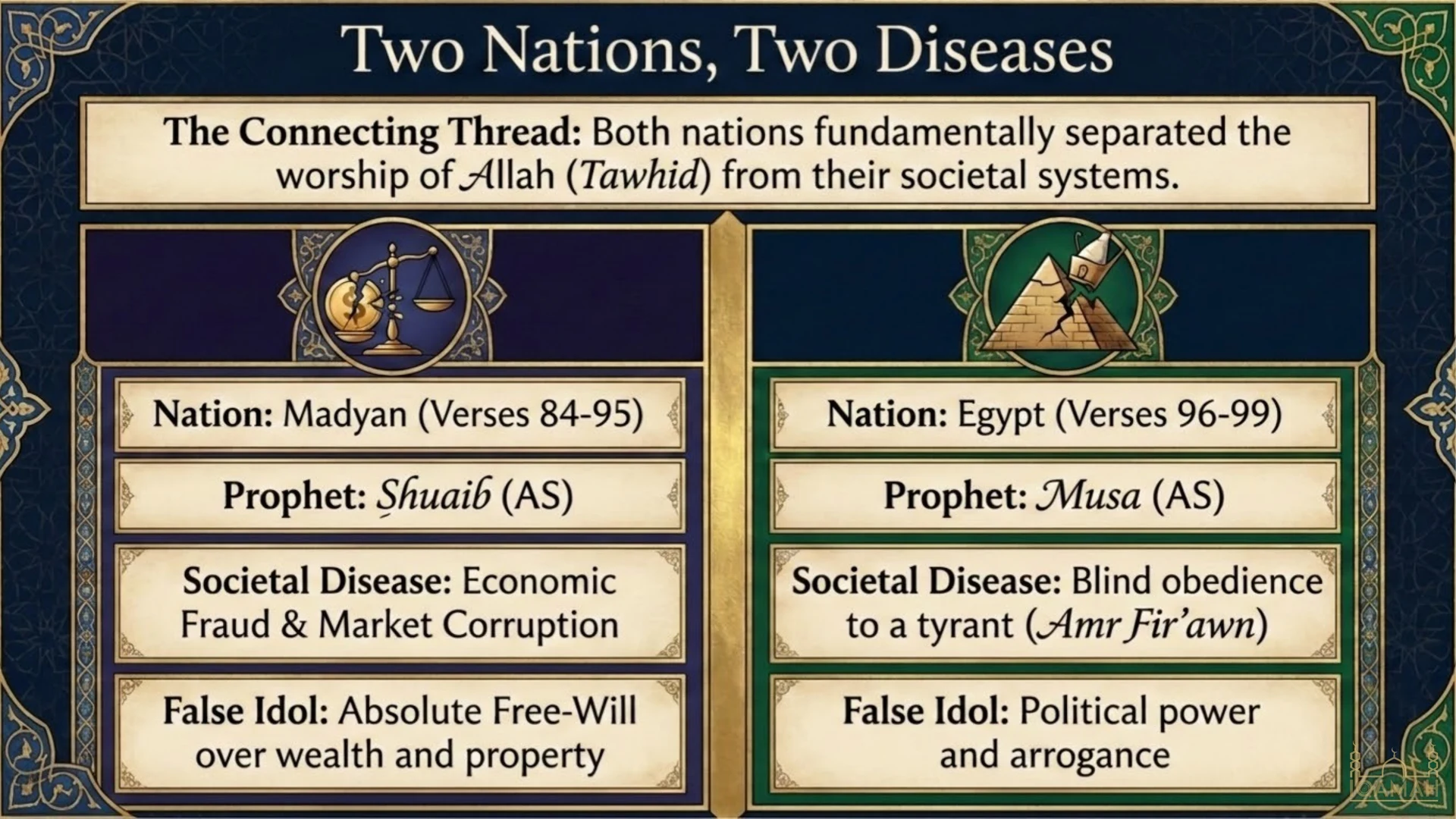
The connecting thread. Before we enter either story, hold the two side by side, because the Qurʾān means us to read these stories together. Sayyid Quṭb, in Fī Ẓilāl al-Qurʾān, draws out what binds Madyan and Egypt: each nation fundamentally separated the worship of Allah (tawḥīd) from the system by which it actually lived. Madyan kept its prayer in one hand and its crooked scales in the other; Egypt kept its gods in name while surrendering every decision to Firʿawn.

Madyan (verses 84–95), under the daʿwah of Shuʿayb عليه السلام, suffered the malady of economic fraud and market corruption, and bowed before a false idol that is very modern: the claim of absolute free-will over one’s wealth and property — “our money, our business, no religion may touch it.” Egypt (verses 96–99), facing Mūsā عليه السلام, suffered the malady of blind obedience to a tyrant — amr Firʿawn — and bowed before the idol of political power and arrogance.

Quṭb’s sharpest point, which we will return to at verse 87, is that this very partition — “faith belongs to God, but law and money belong to someone else” — is itself a form of shirk. Tafsīr al-Saʿdī makes the complementary point: a people may be summoned both to the foundations of faith and to its detailed laws at once, for Shuʿayb called Madyan to tawḥīd and to honest weights in a single breath, and warned them on both counts together.

Slide 3
Slide 3 of 27 #

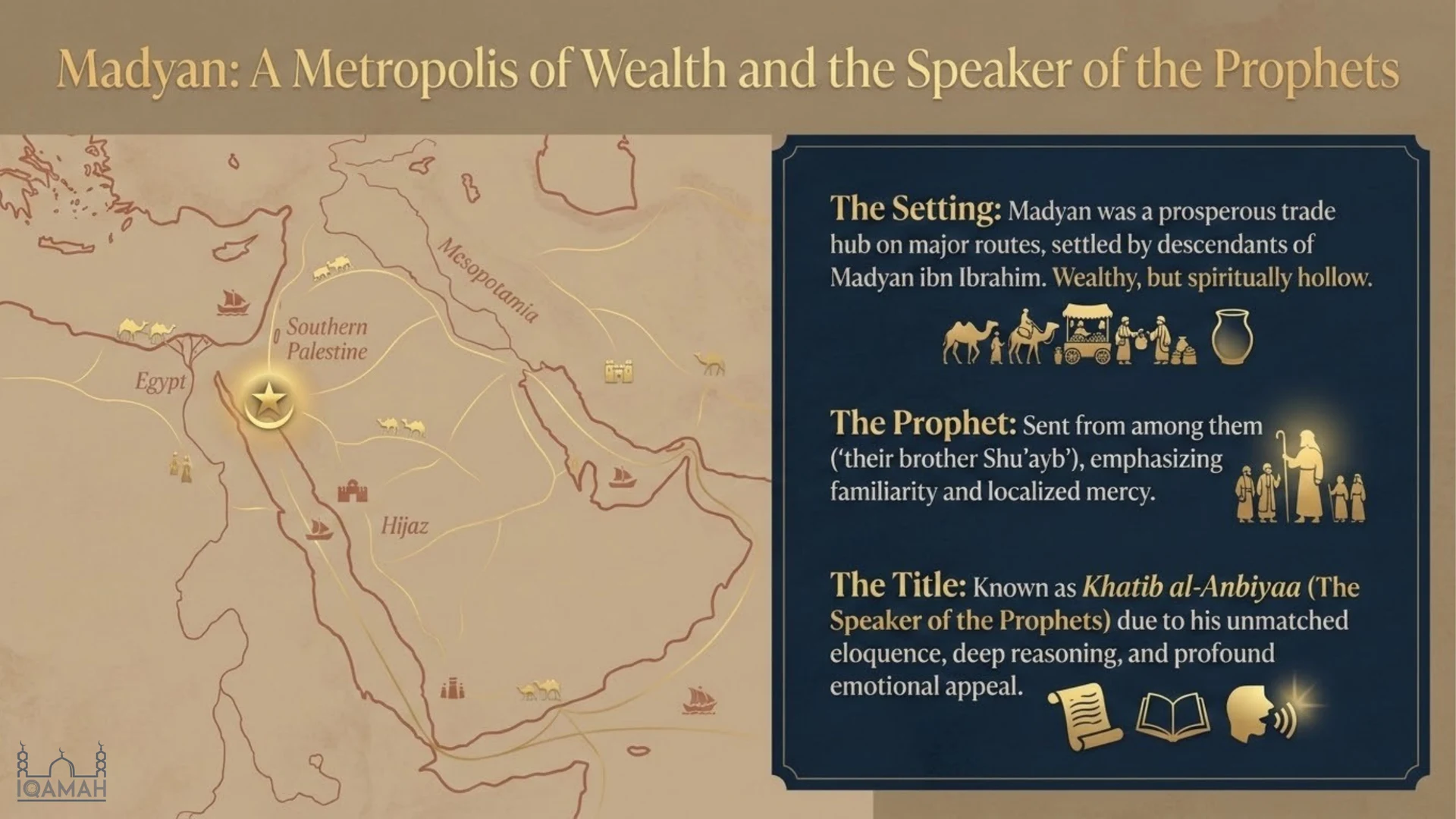
Let us set the stage. Madyan was a prosperous caravan city, settled by the descendants of Madyan ibn Ibrāhīm; the commentators place it near Maʿān in present-day Jordan, in the region of southern Palestine (Maʿāriful Qurʾān; Tafsīr al-Saʿdī). Sayyid Quṭb notes its strategic wealth: it sat astride the trade routes running between the Ḥijāz and Syria, which let it dictate terms to the caravans passing through. Wealthy, then — but spiritually hollow.

Allah sent to them “their brother Shuʿayb” — a messenger from among themselves, so that familiarity would soften their hearts and make his counsel easier to receive (Maʿāriful; al-Saʿdī). Alongside their fraud they were idolaters (Maʿāriful).

And Shuʿayb عليه السلام carries a title of his own. The Prophet ﷺ described him as the orator among the prophets — Khaṭīb al-Anbiyāʾ — for the unmatched eloquence, deep reasoning, and emotional appeal of his daʿwah (Maʿāriful; al-Saʿdī). As we read his speeches in these verses, listen for that artistry: he is the Speaker of the Prophets, and every turn of his argument pays close attention.

Slide 4
Slide 4 of 27 #

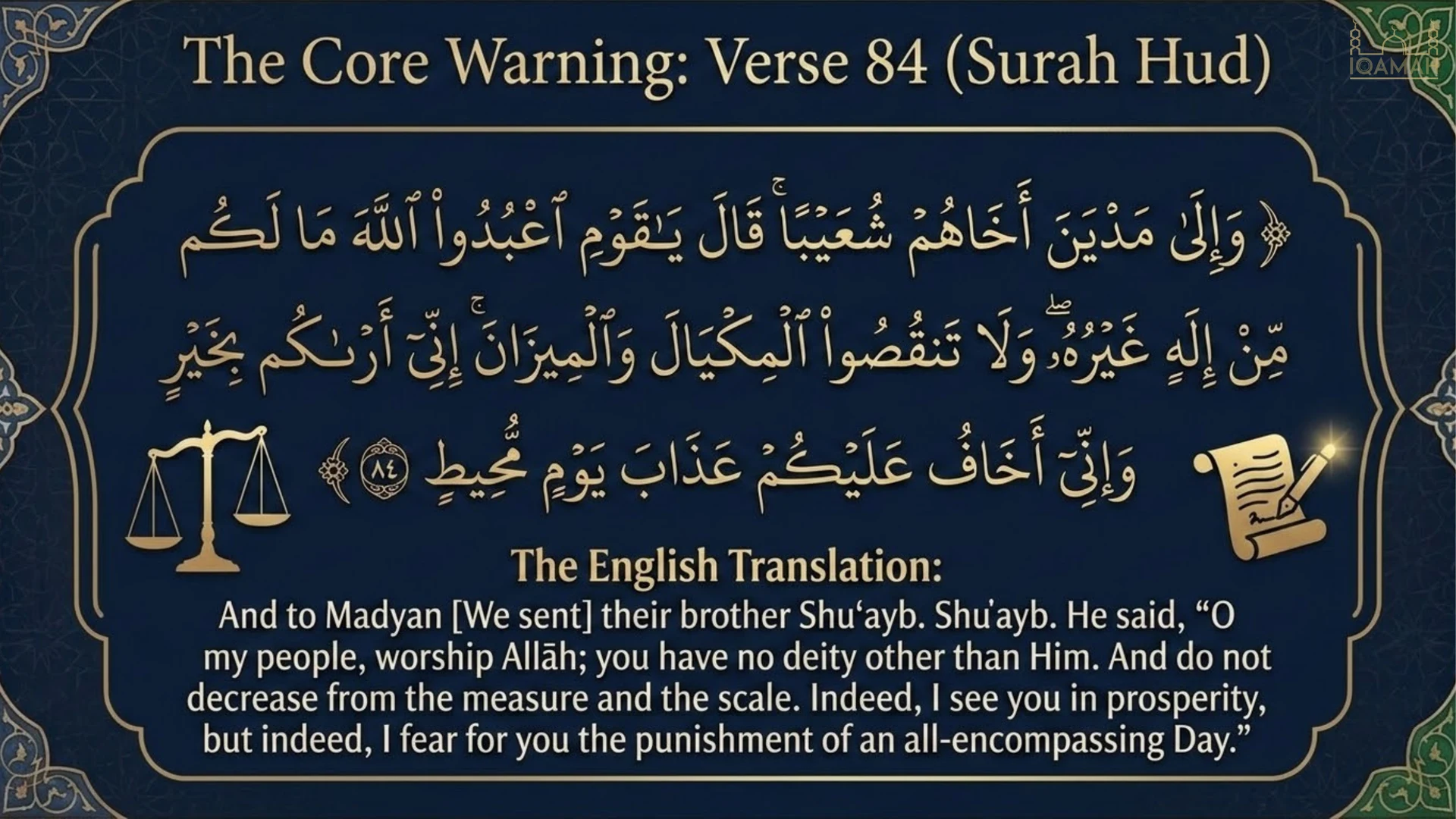
Here is the verse that opens the whole episode — the core warning of Shuʿayb عليه السلام to Madyan:

۞ وَإِلَىٰ مَدْيَنَ أَخَاهُمْ شُعَيْبًۭا ۚ قَالَ يَٰقَوْمِ ٱعْبُدُوا۟ ٱللَّهَ مَا لَكُم مِّنْ إِلَٰهٍ غَيْرُهُۥ ۖ وَلَا تَنقُصُوا۟ ٱلْمِكْيَالَ وَٱلْمِيزَانَ ۚ إِنِّىٓ أَرَىٰكُم بِخَيْرٍۢ وَإِنِّىٓ أَخَافُ عَلَيْكُمْ عَذَابَ يَوْمٍۢ مُّحِيطٍۢ

“And to Madyan [We sent] their brother Shu'ayb. He said, "O my people, worship Allah; you have no deity other than Him. And do not decrease from the measure and the scale. Indeed, I see you in prosperity, but indeed, I fear for you the punishment of an all-encompassing Day.”

Sūrah Hūd 11:84 — Saheeh International

Notice the order, because it is the architecture of his entire mission: first tawḥīd — “worship Allah; you have no deity other than Him” — and then, in the very same breath, the marketplace — “do not decrease from the measure and the scale.” Faith and the scales are joined from the first word. The people of Madyan were idolaters and short-changers both, and Shuʿayb treats these not as two problems but as one.

Then a piercing observation: “I see you in prosperity” — innī arākum bi-khayr. Ibn al-Jawzī, in Zād al-Masīr, records two readings of this “good” from the early authorities: cheap, easy prices (so reported from Ibn ʿAbbās, al-Ḥasan and Mujāhid) and abundance of wealth (from Qatādah and Ibn Zayd). Al-Farrāʾ captures the rebuke beneath it: your wealth is plentiful and your prices low — what need could possibly drive you to cheat? Their fraud, in other words, was never born of poverty; it was born of greed. Tafsīr al-Saʿdī adds the warning folded inside the blessing: be grateful for this bounty, lest ingratitude cause it to be stripped away.

And the threat: “I fear for you the punishment of an all-encompassing Day” — yawmin muḥīṭ. Ibn al-Jawzī again surveys the classical opinions: it may mean ruinous inflation and famine (Ibn ʿAbbās; Mujāhid: qaḥṭ, drought and soaring prices), or the worldly destruction that in fact overtook them (Muqātil), or the Fire of the Hereafter (al-Māwardī). On the word muḥīṭ itself, al-Zamakhsharī notes in al-Kashshāf — and we take him here purely for his mastery of the language — that the Day is called “encompassing” because the day is the vessel that holds its events: when the punishment that fills it encircles, nothing slips out of its reach.

Slide 5
Slide 5 of 27 #

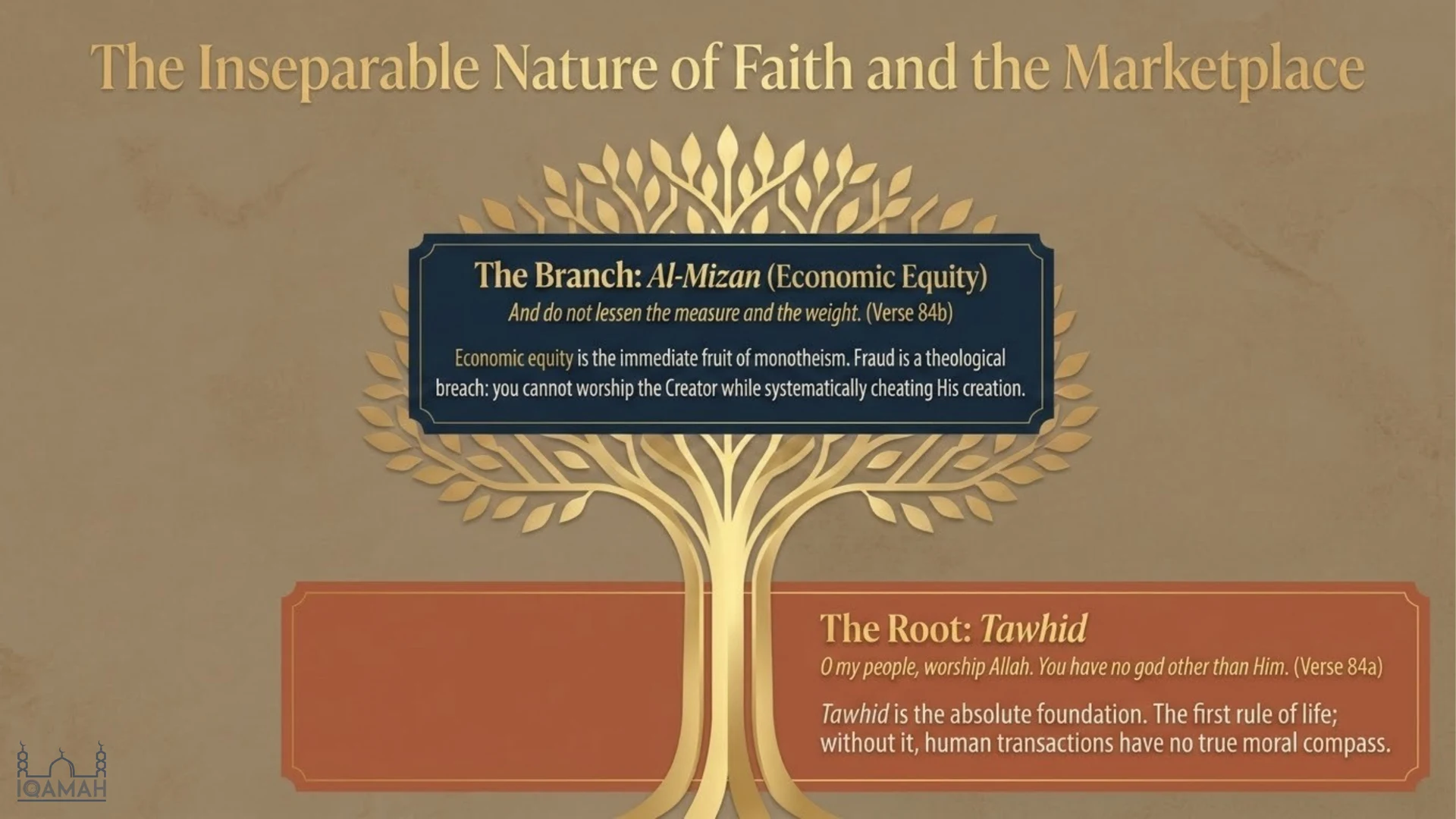
Pause on the relationship the verse just drew, because it is the spine of this entire session. Picture it as a single living tree. The root is tawḥīd — “O my people, worship Allah; you have no god other than Him” (84a). Sayyid Quṭb calls submission to Allah alone the first article of faith and, at the same time, the first rule of life and of law: without it, human dealings have no true moral compass that special interests cannot bend.

The branch that grows directly from that root is al-mīzān — economic equity — “and do not decrease from the measure and the scale” (84b). Economic justice is the immediate fruit of monotheism. Fraud is therefore not merely a commercial lapse; it is a breach in one’s very tawḥīd, for one cannot sincerely worship the Creator while systematically cheating His creation.

Tafsīr al-Saʿdī states it plainly as a lesson of the passage: honesty in weight and measure is among the fruits of faith, because Shuʿayb tied the two together — so where righteous dealings are absent, faith itself is deficient or absent. The scales in the marketplace are, in the end, a reading of the state of the heart. (For our Urdu-speaking circle: the very word mīzān is the tarāzū we know, and the Qurʾān makes that everyday balance a mirror of īmān.)

Slide 6
Slide 6 of 27 #

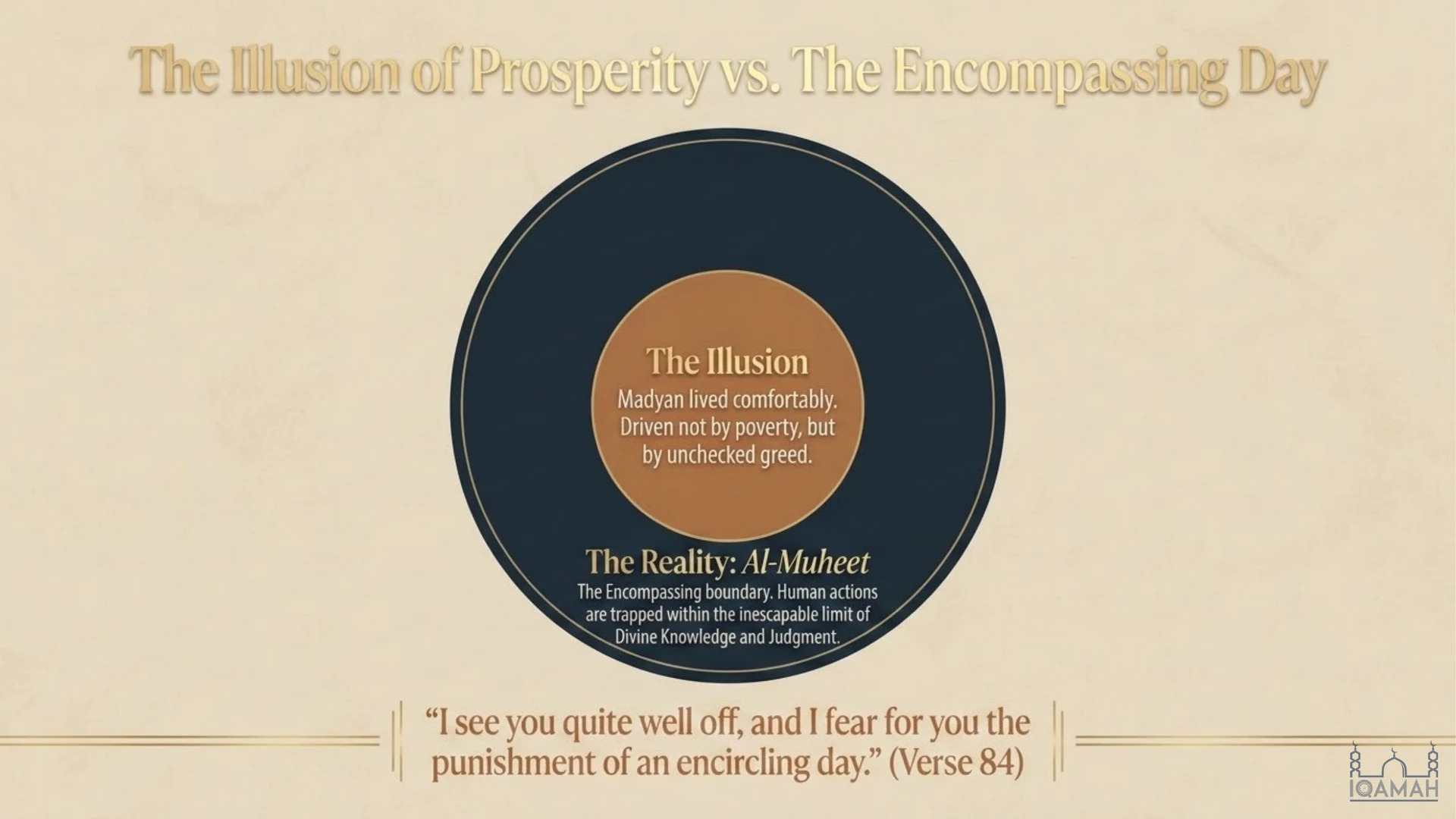
Madyan lived inside a comfortable illusion. They were not poor, hungry, or financially pressed — nothing forced their hand (Maʿāriful Qurʾān). They cheated from a position of plenty, driven not by need but by unchecked greed. That is the inner circle of our picture: a prosperity that felt total and self-justifying.

Around that illusion, however, sits a reality they could not see: al-Muḥīṭ — the Encompassing. Their actions were enclosed within the inescapable boundary of Allah’s knowledge and judgement (we will hear Shuʿayb name it again at verse 92: “inna rabbī bimā taʿmalūna muḥīṭ”). The fateful Day they were warned of, ʿadhāba yawmin muḥīṭ, is simply that boundary closing in.

And there is a frightening mechanism here that Maʿāriful Qurʾān draws from the Sunnah: the Prophet ﷺ said that when a people begin to give short measure and weight, Allah seizes them with famine and the crushing of prices. The disease, in other words, secretes its own punishment; the very fraud that promises more wealth is what dries the barakah out of a society’s trade. The illusion and the encompassing reality are two faces of one moment.

Slide 7
Slide 7 of 27 #

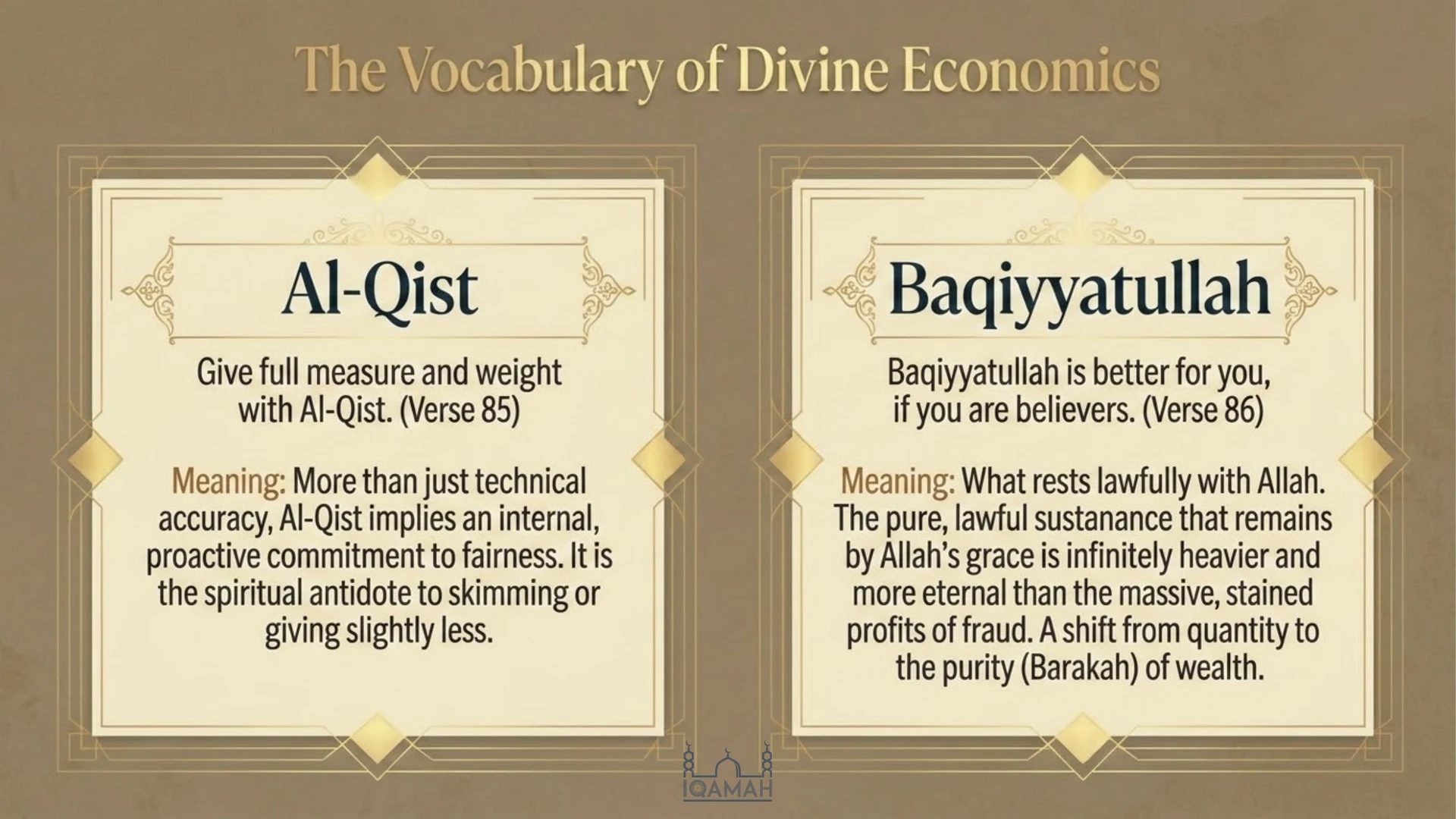
Shuʿayb عليه السلام now gives Madyan the precise vocabulary of a God-centred economy. Two verses, two key terms:

وَيَٰقَوْمِ أَوْفُوا۟ ٱلْمِكْيَالَ وَٱلْمِيزَانَ بِٱلْقِسْطِ ۖ وَلَا تَبْخَسُوا۟ ٱلنَّاسَ أَشْيَآءَهُمْ وَلَا تَعْثَوْا۟ فِى ٱلْأَرْضِ مُفْسِدِينَ

“And O my people, give full measure and weight in justice and do not deprive the people of their due and do not commit abuse on the earth, spreading corruption.”

Sūrah Hūd 11:85 — Saheeh International

بَقِيَّتُ ٱللَّهِ خَيْرٌۭ لَّكُمْ إِن كُنتُم مُّؤْمِنِينَ ۚ وَمَآ أَنَا۠ عَلَيْكُم بِحَفِيظٍۢ

“What remains [lawful] from Allah is best for you, if you would be believers. But I am not a guardian over you."”

Sūrah Hūd 11:86 — Saheeh International

Al-Qisṭ (verse 85). “Give full measure and weight in justice (bi’l-qisṭ).” Al-Zamakhsharī notes the careful sequence of the language: having first forbidden deficiency (“do not decrease,” 84), the verse now positively commands iīfāʾ — the giving of full measure — and then restricts even that with “bi’l-qisṭ,” so that the fullness is rendered upon the path of justice and exact equality, neither short nor padded. Al-Qisṭ is thus more than technical accuracy; it is an inward, proactive commitment to fairness. Tafsīr al-Saʿdī puts it as a moral mirror: be fair to others exactly as you would wish to be dealt with fairly yourself. Then the verse widens: “do not deprive people of their due” — which Quṭb observes is broader than scales and weights, covering the fair valuation of everything that belongs to others, the material and the moral alike — and “do not spread corruption in the land,” which Ibn al-Jawzī reads here as precisely this short-changing carried out in the open.

Baqiyyatullah (verse 86). “What remains [lawful] from Allah is better for you, if you would be believers.” This is the great reframing. Al-Zamakhsharī and al-Saʿdī both read baqiyyatullah as the lawful remnant that stays with you by Allah’s leave — the pure, ḥalāl sustenance that endures — set against the swollen but stained profits of fraud. It is a shift from sheer quantity to barakah: al-Saʿdī notes that contentment with the lawful draws increase and blessing, while persistence in the unlawful quietly drains a person’s provision. Then Shuʿayb steps back: “I am not a guardian over you” — I am no registrar of your deeds and no one to compel you; that reckoning belongs to Allah, and my task is only to convey (al-Saʿdī; al-Zamakhsharī).

Slide 8
Slide 8 of 27 #

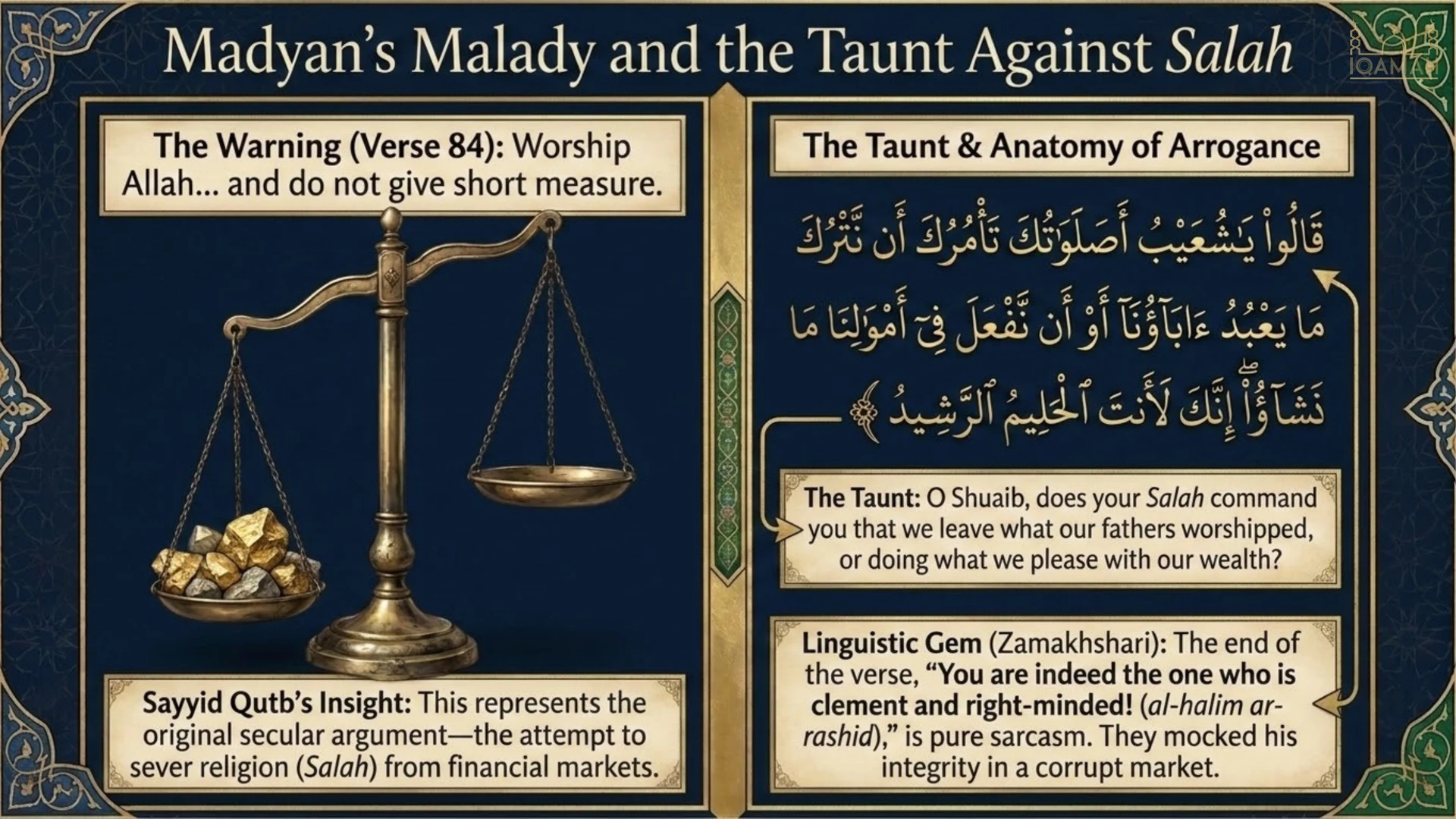
We come to the mockery — and to one of the most quoted exchanges in the sūrah. After the warning of verse 84, Madyan answers not with argument but with a sneer:

قَالُوا۟ يَٰشُعَيْبُ أَصَلَوٰتُكَ تَأْمُرُكَ أَن نَّتْرُكَ مَا يَعْبُدُ ءَابَآؤُنَآ أَوْ أَن نَّفْعَلَ فِىٓ أَمْوَٰلِنَا مَا نَشَٰٓؤُا۟ ۖ إِنَّكَ لَأَنتَ ٱلْحَلِيمُ ٱلرَّشِيدُ

“They said, "O Shu'ayb, does your prayer command you that we should leave what our fathers worship or not do with our wealth what we please? Indeed, you are the forbearing, the discerning!"”

Sūrah Hūd 11:87 — Saheeh International

The taunt. “Does your ṣalāh command you that we leave what our fathers worship, or that we not do with our wealth what we please?” Shuʿayb عليه السلام was constant in prayer, and his people had seen him at it; so they threw his ṣalāh back at him in ridicule (al-Zamakhsharī). Sayyid Quṭb names this for what it is: the original secular argument — the attempt to sever religion from the marketplace, to keep worship in the mosque and let money run by its own godless rules. Quṭb presses the point into our own age, observing that the very same objection — “what has religion to do with our economy?” — is still raised today by those who would partition faith off from finance.

The answer beneath the insult. Tafsīr al-Saʿdī turns their taunt against them with beautiful irony. Yes — his prayer truly did command him to forbid them, for the Qurʾān itself says that ṣalāh restrains from faḥshāʾ and munkar (29:45); and what could be more shameful or more wrong than worshipping other than Allah, withholding people’s dues, and stealing through short measure? So the very thing they mocked was the very thing that made him their sincere counsellor.

“The forbearing, the discerning” (al-ḥalīm al-rashīd). Their closing line drips with sarcasm. Here we lean on al-Zamakhsharī for the balāghah: this is pure mockery (tahakkum). By calling him “the forbearing, the right-minded one,” they meant to assign him the very opposite — the utmost of foolishness (safah) and error (ghayy) — inverting the words to jeer at him. Al-Saʿdī agrees they intended the reverse, and then notes the irony that closes the circle: he genuinely was the forbearing and right-minded one. (Al-Zamakhsharī also records that Shuʿayb had forbidden them from clipping the edges of their gold and silver coins — a detail Maʿāriful Qurʾān relays from al-Qurṭubī as well.)

Slide 9
Slide 9 of 27 #

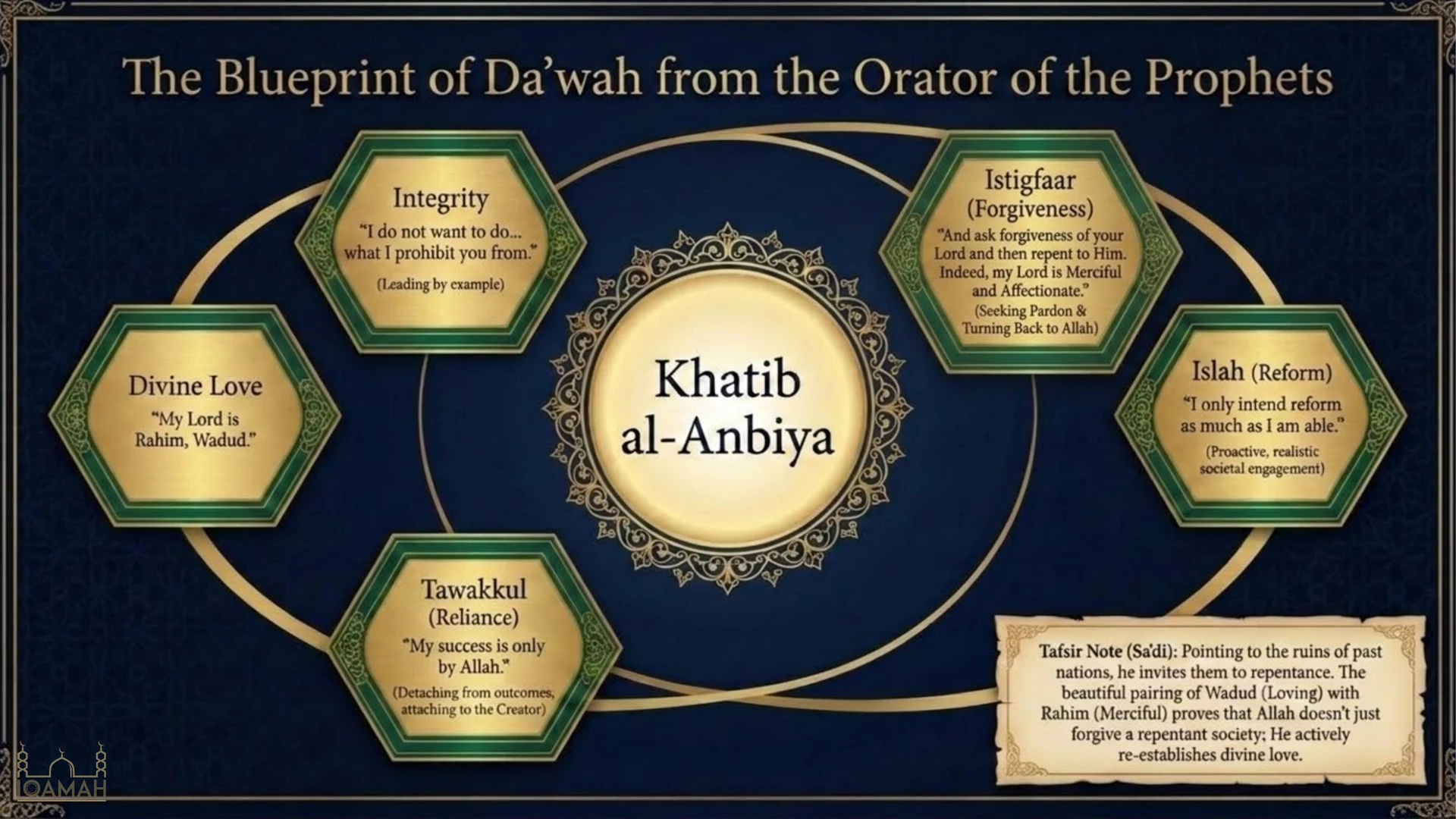
If verse 87 was their taunt, verses 88–90 are Shuʿayb’s reply — and they read like a complete blueprint for daʿwah from the Orator of the Prophets. Let us take the three verses together:

قَالَ يَٰقَوْمِ أَرَءَيْتُمْ إِن كُنتُ عَلَىٰ بَيِّنَةٍۢ مِّن رَّبِّى وَرَزَقَنِى مِنْهُ رِزْقًا حَسَنًۭا ۚ وَمَآ أُرِيدُ أَنْ أُخَالِفَكُمْ إِلَىٰ مَآ أَنْهَىٰكُمْ عَنْهُ ۚ إِنْ أُرِيدُ إِلَّا ٱلْإِصْلَٰحَ مَا ٱسْتَطَعْتُ ۚ وَمَا تَوْفِيقِىٓ إِلَّا بِٱللَّهِ ۚ عَلَيْهِ تَوَكَّلْتُ وَإِلَيْهِ أُنِيبُ

“He said, "O my people, have you considered: if I am upon clear evidence from my Lord and He has provided me with a good provision from Him...? And I do not intend to differ from you in that which I have forbidden you; I only intend reform as much as I am able. And my success is not but through Allah. Upon him I have relied, and to Him I return.”

Sūrah Hūd 11:88 — Saheeh International

وَيَٰقَوْمِ لَا يَجْرِمَنَّكُمْ شِقَاقِىٓ أَن يُصِيبَكُم مِّثْلُ مَآ أَصَابَ قَوْمَ نُوحٍ أَوْ قَوْمَ هُودٍ أَوْ قَوْمَ صَٰلِحٍۢ ۚ وَمَا قَوْمُ لُوطٍۢ مِّنكُم بِبَعِيدٍۢ

“And O my people, let not [your] dissension from me cause you to be struck by that similar to what struck the people of Noah or the people of Hud or the people of Salih. And the people of Lot are not from you far away.”

Sūrah Hūd 11:89 — Saheeh International

وَٱسْتَغْفِرُوا۟ رَبَّكُمْ ثُمَّ تُوبُوٓا۟ إِلَيْهِ ۚ إِنَّ رَبِّى رَحِيمٌۭ وَدُودٌۭ

“And ask forgiveness of your Lord and then repent to Him. Indeed, my Lord is Merciful and Affectionate."”

Sūrah Hūd 11:90 — Saheeh International

His foundation and his integrity (88). He grounds everything in “clear evidence from my Lord” and a “good provision” He has given him — both the light of revelation and lawful sustenance (al-Zamakhsharī). Then the cornerstone of his credibility: “I do not intend to differ from you in that which I forbid you.” Tafsīr al-Saʿdī renders the spirit exactly: if I forbid you short measure, I will be the first to refrain from it — I will never do behind your backs what I tell you not to do. A caller’s own conduct is his loudest sermon.

His aim and his reliance (88). “I only intend reform (al-iṣlāḥ) as much as I am able.” No private agenda, no market cleared of competitors for his own gain — Quṭb stresses that this is a reform that includes Shuʿayb himself, the honest businessman. And then the detachment that completes it: “my success is only through Allah; upon Him I rely (tawakkaltu) and to Him I turn (unīb).” Al-Saʿdī notes that a servant’s whole well-being rests on these two pillars together — seeking Allah’s help and turning back to Him — the very meaning of “You alone we worship, and You alone we ask for help” (al-Fātiḥah 1:5).

His warning (89). Now the note of fear (tarhīb): let not your breach with me earn you the fate of the peoples of Nūḥ, Hūd or Ṣāliḥ — “and the people of Lūṭ are not far from you.” Maʿāriful Qurʾān and al-Saʿdī note the double nearness: near in place, for the overturned cities of Lūṭ’s people lay close by, and near in time, for their ruin was recent. The lesson sat just over the horizon, had they cared to look.

His invitation home (90). He ends not with threat but with an open door: “Ask forgiveness of your Lord, then turn to Him in repentance” — istighfār for what is past, al-Saʿdī notes, then tawbah for the life that remains. And he seals it with two of the most tender Names: “Indeed my Lord is Raḥīm — Merciful — Wadūd — Loving.” This is the note our slide rests on, drawn from al-Saʿdī: al-Wadūd means that Allah loves His believing servants and they love Him — a love that runs both ways; al-Zamakhsharī adds that He acts toward the repentant as the deeply loving one acts, with active kindness and beneficence. The pairing is the wonder of it: Allah does not merely pardon a society that returns to Him — He re-establishes love with it.

Slide 10
Slide 10 of 27 #

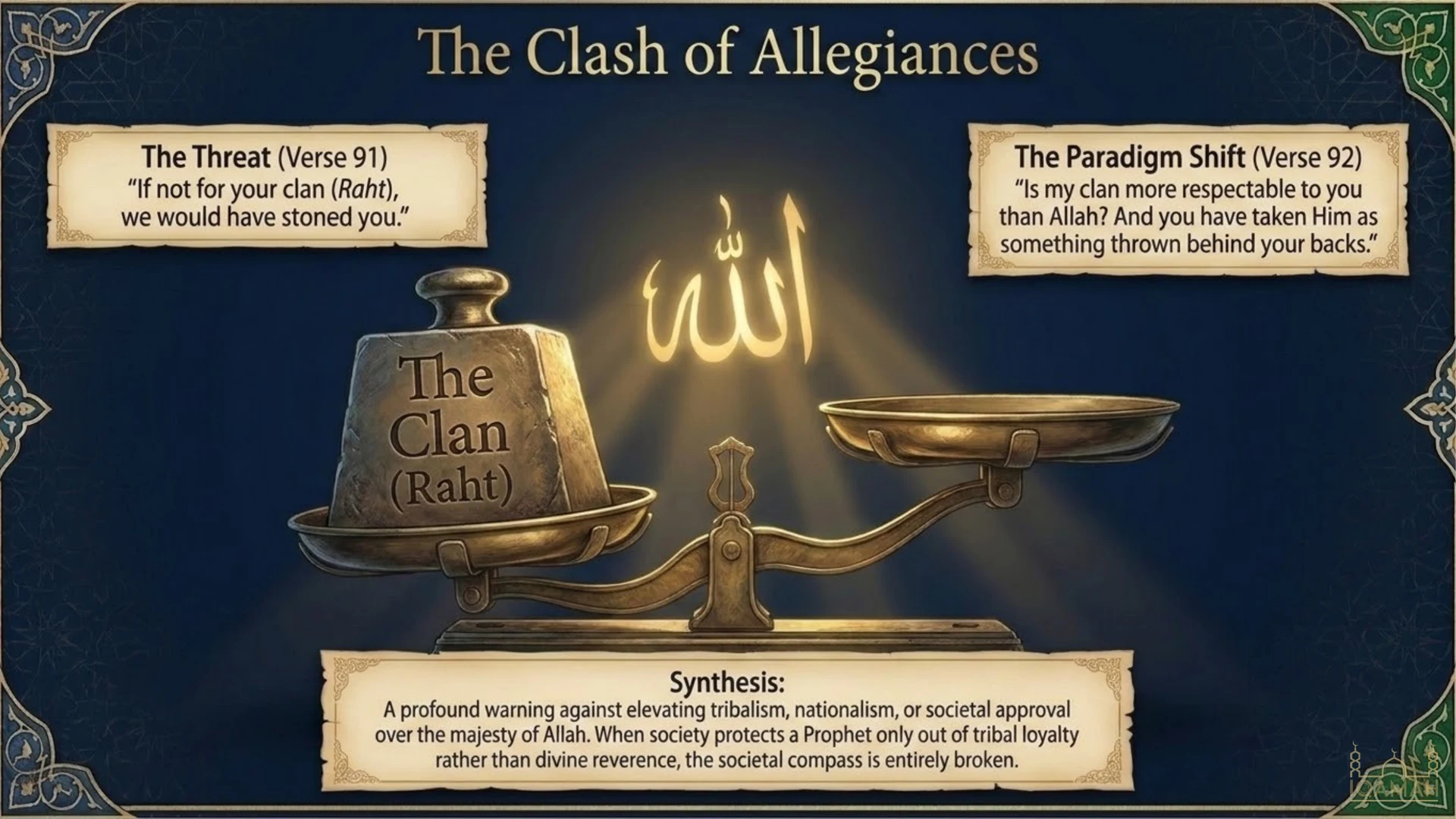
Shuʿayb has offered them evidence, integrity, reform, reliance, warning, and an open door. Their response in verses 91–93 is the clash of allegiances at the heart of this slide — a society weighing its prophet against its tribe, and its tribe against its Lord.

قَالُوا۟ يَٰشُعَيْبُ مَا نَفْقَهُ كَثِيرًۭا مِّمَّا تَقُولُ وَإِنَّا لَنَرَىٰكَ فِينَا ضَعِيفًۭا ۖ وَلَوْلَا رَهْطُكَ لَرَجَمْنَٰكَ ۖ وَمَآ أَنتَ عَلَيْنَا بِعَزِيزٍۢ

“They said, "O Shu'ayb, we do not understand much of what you say, and indeed, we consider you among us as weak. And if not for your family, we would have stoned you [to death]; and you are not to us one respected."”

Sūrah Hūd 11:91 — Saheeh International

قَالَ يَٰقَوْمِ أَرَهْطِىٓ أَعَزُّ عَلَيْكُم مِّنَ ٱللَّهِ وَٱتَّخَذْتُمُوهُ وَرَآءَكُمْ ظِهْرِيًّا ۖ إِنَّ رَبِّى بِمَا تَعْمَلُونَ مُحِيطٌۭ

“He said, "O my people, is my family more respected for power by you than Allah? But you put Him behind your backs [in neglect]. Indeed, my Lord is encompassing of what you do.”

Sūrah Hūd 11:92 — Saheeh International

وَيَٰقَوْمِ ٱعْمَلُوا۟ عَلَىٰ مَكَانَتِكُمْ إِنِّى عَٰمِلٌۭ ۖ سَوْفَ تَعْلَمُونَ مَن يَأْتِيهِ عَذَابٌۭ يُخْزِيهِ وَمَنْ هُوَ كَٰذِبٌۭ ۖ وَٱرْتَقِبُوٓا۟ إِنِّى مَعَكُمْ رَقِيبٌۭ

“And O my people, work according to your position; indeed, I am working. You are going to know to whom will come a punishment that will disgrace him and who is a liar. So watch; indeed, I am with you a watcher, [awaiting the outcome]."”

Sūrah Hūd 11:93 — Saheeh International

The threat (91). “We do not understand much of what you say, and we see you as weak among us; were it not for your clan (rahṭ), we would have stoned you; you are not mighty in our eyes.” Tafsīr al-Saʿdī reads their “we do not understand” as aversion, not incapacity — they had no wish to understand. And notice the moral inversion they confess: they spared him only out of respect for his tribe, not out of any regard for him or for the truth. To them, only physical strength was real.

The paradigm shift (92). Shuʿayb seizes exactly that confession and turns it into a mirror: “Is my clan more honourable to you than Allah, whom you have cast behind your backs?” Al-Zamakhsharī notes the image in ittakhadhtumūhu warāʾakum ẓihriyyā: the ẓihriyy is the thing flung behind the back and forgotten, the discarded object no one bothers with — that is how they treated the command of Allah, fearing the clan but not its Lord. And he reminds them: “inna rabbī bimā taʿmalūna muḥīṭ” — my Lord encompasses all that you do, the same Encompassing we met at verse 84. Sayyid Quṭb marks this as the dividing line between the Islamic conception of loyalty and every other: the believer’s true allegiance is to Allah, not to clan or nation; a society that shields even a prophet only out of tribal solidarity, and not out of reverence for Allah, has a compass that is wholly broken.

The ultimatum (93). When every argument had failed, al-Saʿdī notes, and he saw no fruit in them, Shuʿayb left the matter to its outcome: “Work according to your station; I too am working. You will come to know who will be visited by a disgracing punishment and who is the liar. Watch — I am watching with you.” As Quṭb observes, the very way he throws down the challenge and invites them to wait is the mark of his absolute trust in Allah.

Slide 11
Slide 11 of 27 #

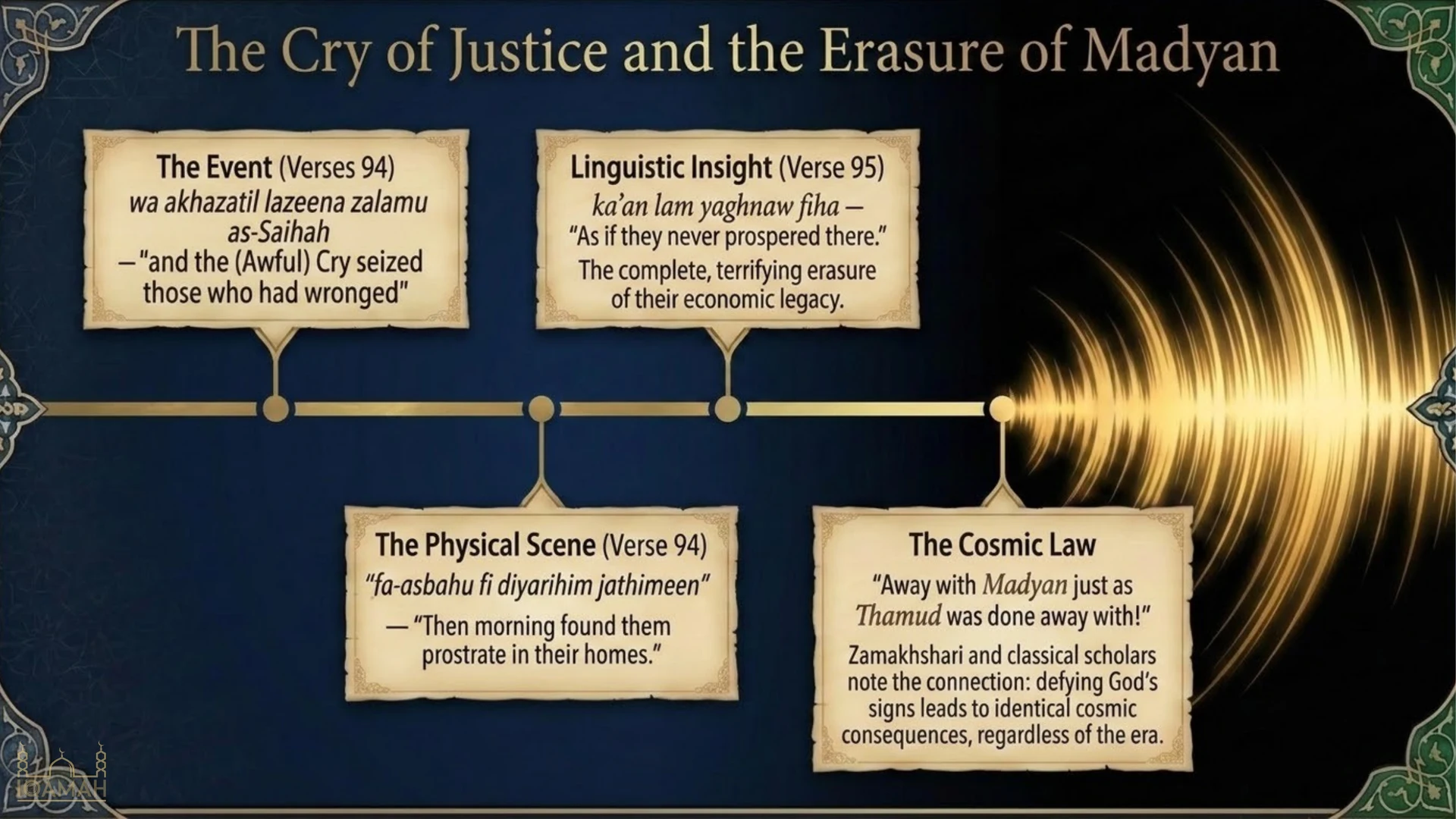
The curtain falls on the dialogue and rises on the verdict. Verses 94–95 give us the Cry and the complete erasure of Madyan:

وَلَمَّا جَآءَ أَمْرُنَا نَجَّيْنَا شُعَيْبًۭا وَٱلَّذِينَ ءَامَنُوا۟ مَعَهُۥ بِرَحْمَةٍۢ مِّنَّا وَأَخَذَتِ ٱلَّذِينَ ظَلَمُوا۟ ٱلصَّيْحَةُ فَأَصْبَحُوا۟ فِى دِيَٰرِهِمْ جَٰثِمِينَ

“And when Our command came, We saved Shu'ayb and those who believed with him, by mercy from Us. And the shriek seized those who had wronged, and they became within their homes [corpses] fallen prone”

Sūrah Hūd 11:94 — Saheeh International

كَأَن لَّمْ يَغْنَوْا۟ فِيهَآ ۗ أَلَا بُعْدًۭا لِّمَدْيَنَ كَمَا بَعِدَتْ ثَمُودُ

“As if they had never prospered therein. Then, away with Madyan as Thamud was taken away.”

Sūrah Hūd 11:95 — Saheeh International

The Cry (94). “The Ṣayḥah seized those who had wronged” — the harsh, single Blast (Maʿāriful Qurʾān associates it with the cry of Jibrīl عليه السلام) — “and morning found them jāthimīn in their homes,” fallen prone upon their knees. Tafsīr al-Saʿdī captures the stillness: no sound was heard from them, no movement seen. Note the mercy that preceded it in the same verse: Allah first saved Shuʿayb and the believers — deliverance and destruction in a single decree.

The erasure (95). “Ka’an lam yaghnaw fīhā” — as if they had never prospered there. Al-Zamakhsharī unfolds the force of it: as though they had never once dwelt there alive, never moved about and traded and came and went — the total, terrifying wiping-away of an entire economic legacy. The merchant capital that had dictated terms to the caravans is simply gone, as if it had never been.

The cosmic law (95). “Away with Madyan, as Thamūd was done away with.” Al-Zamakhsharī notes that buʿd here carries both meanings at once — destruction, and banishment from the mercy of Allah — and that the verse deliberately couples Madyan with Thamūd so that the two peoples share a single fate. The parallel is the point: defiance of Allah’s signs draws down the same end across the eras, regardless of which prophet was rejected or in which century. Sayyid Quṭb observes how closely this whole account mirrors the account of Ṣāliḥ and Thamūd — the same kind of suffering, described in the same kind of terms.

Slide 12
Slide 12 of 27 #

From the scales we turn to the scepter. The sūrah now moves, in a deliberately brief and concentrated passage, to Mūsā عليه السلام and Firʿawn — and to an anatomy of what happens when a whole people surrenders its judgement to a tyrant. Two verses set the scene:

وَلَقَدْ أَرْسَلْنَا مُوسَىٰ بِـَٔايَٰتِنَا وَسُلْطَٰنٍۢ مُّبِينٍ

“And We did certainly send Moses with Our signs and a clear authority”

Sūrah Hūd 11:96 — Saheeh International

إِلَىٰ فِرْعَوْنَ وَمَلَإِي۟هِۦ فَٱتَّبَعُوٓا۟ أَمْرَ فِرْعَوْنَ ۖ وَمَآ أَمْرُ فِرْعَوْنَ بِرَشِيدٍۢ

“To Pharaoh and his establishment, but they followed the command of Pharaoh, and the command of Pharaoh was not [at all] discerning.”

Sūrah Hūd 11:97 — Saheeh International

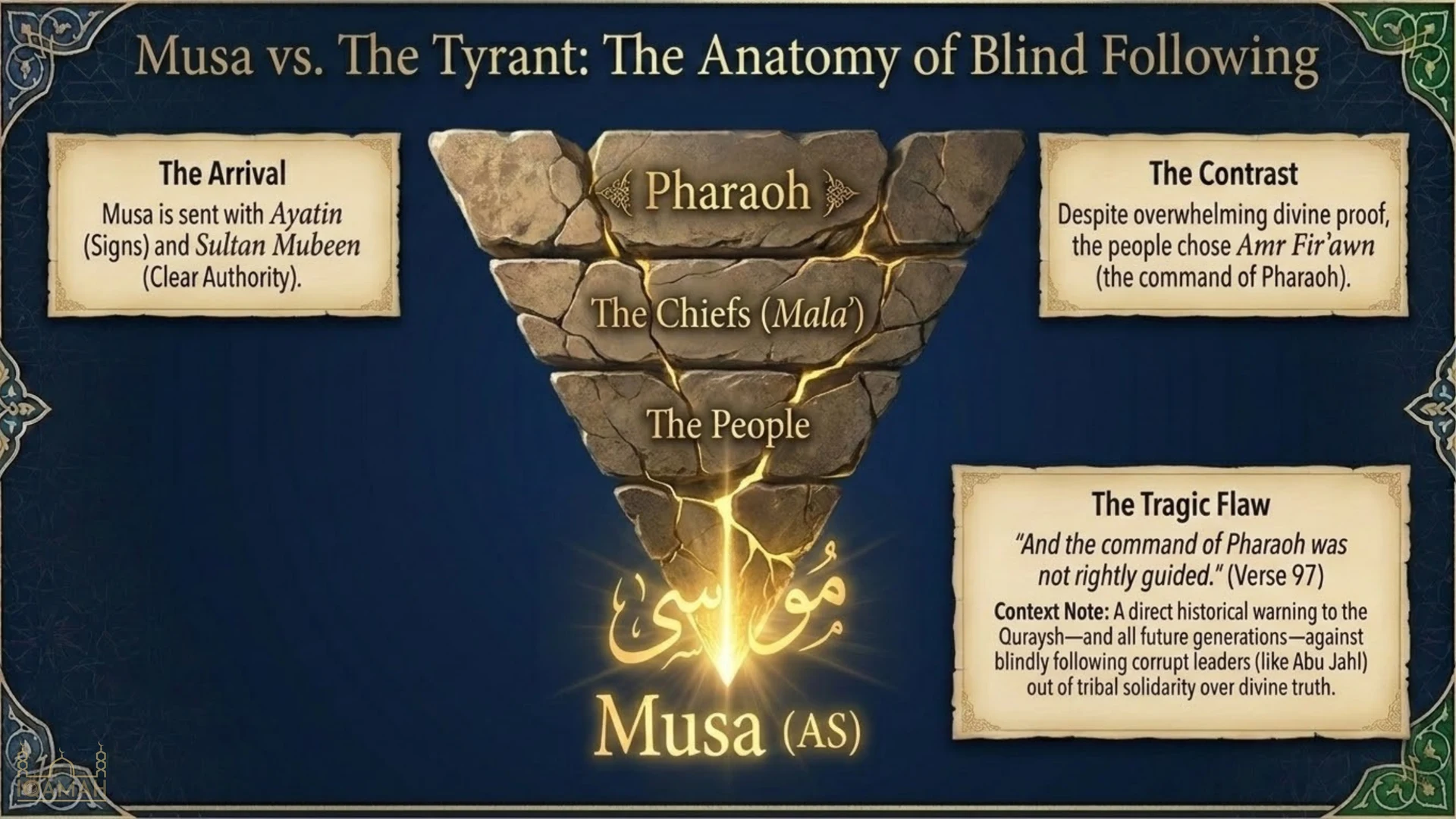
The arrival (96). Mūsā is sent with “Our signs and a clear authority” — āyāt and sulṭān mubīn. Al-Zamakhsharī offers two readings of the phrase: either the signs themselves are the clear authority that proves his truthfulness, or al-sulṭān al-mubīn is specifically the staff, al-ʿaṣā, the most manifest of his miracles. Either way, the proof was overwhelming.

The tragic flaw (97). “To Firʿawn and his chiefs (malaʾ), but they followed the command of Firʿawn — and the command of Firʿawn was not rightly guided (rashīd).” Here is the hierarchy our slide traces: Pharaoh at the top, the chiefs beneath him, the people beneath them — and the whole structure pointed the wrong way. Al-Zamakhsharī states the irrationality of it bluntly: the sensible follow the one whose command carries guidance, not the one who leads them astray; yet seeing the signs and the clear authority with Mūsā, they turned from the guided one to the one whose command held no rushd at all. This is a direct warning to the Quraysh — and to every generation — against blindly following a corrupt leader, an Abū Jahl, out of tribal solidarity rather than divine truth. Sayyid Quṭb draws the principle the passage exists to teach: a person’s individual responsibility is never dissolved by the plea that he merely followed his master or his ruler; in surrendering their judgement, Firʿawn’s people trampled the very freedom of choice with which Allah had honoured them.

Slide 13
Slide 13 of 27 #

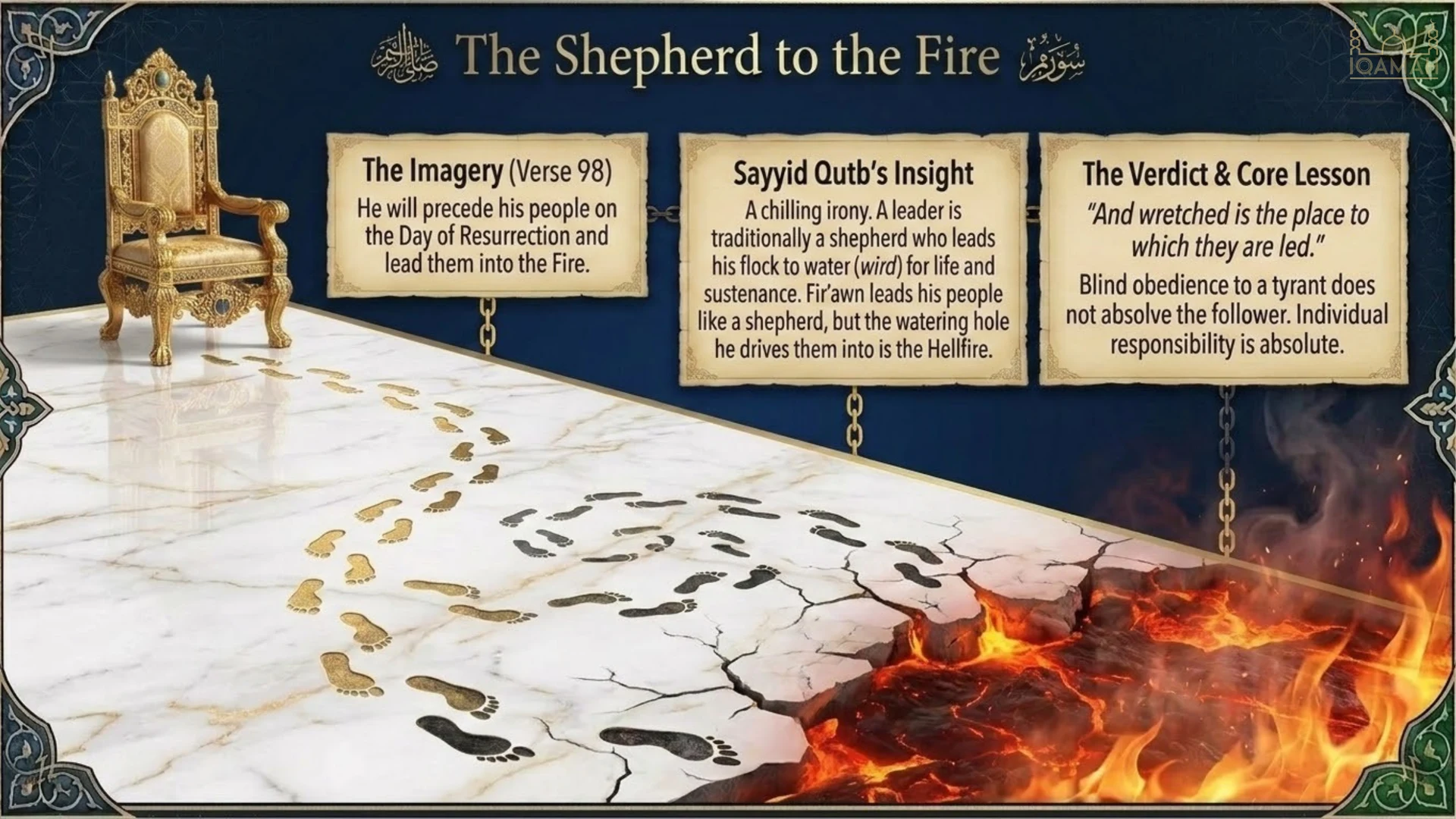
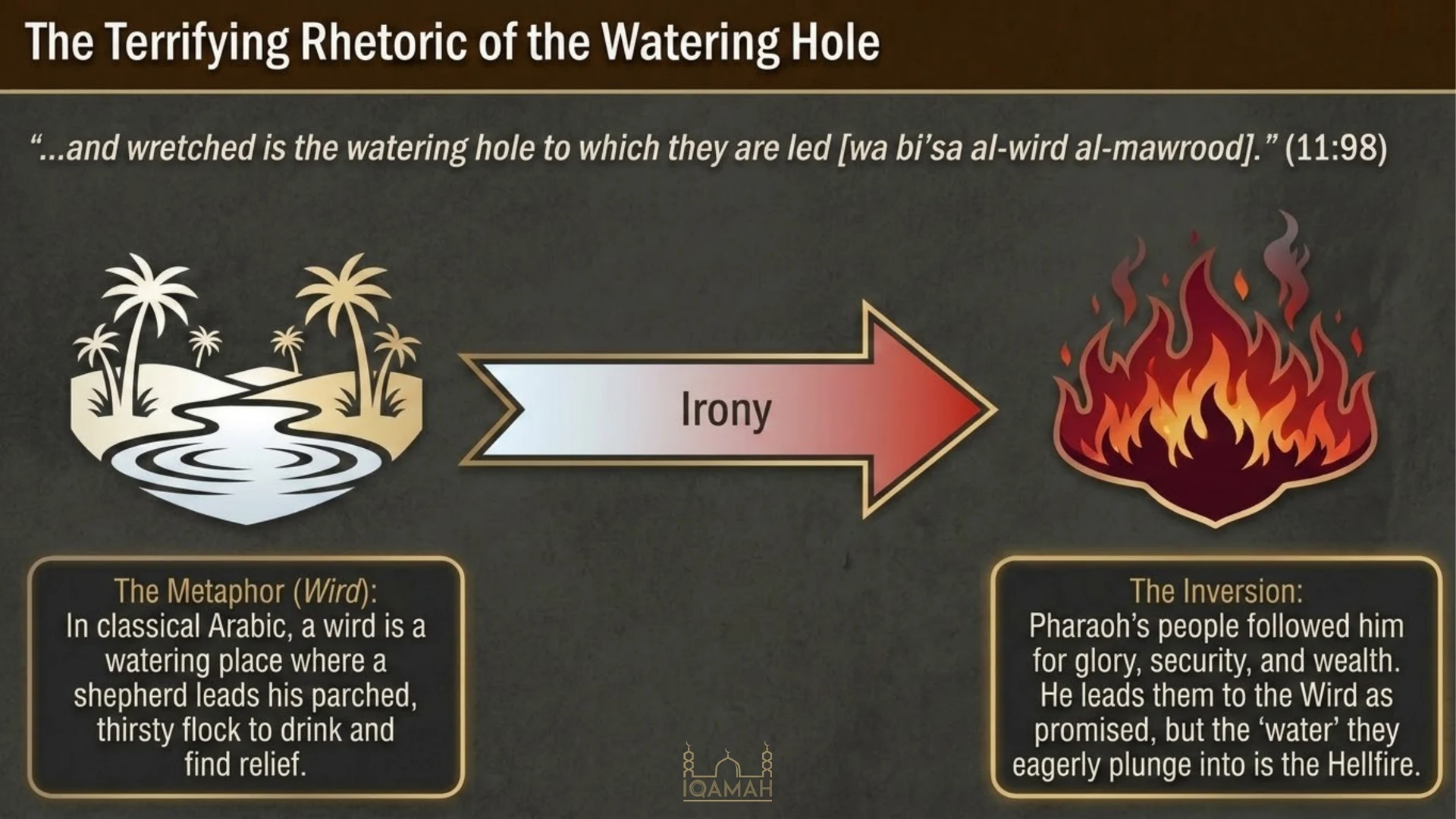
Verse 98 gives one of the most chilling images in the Qurʾān — the tyrant as a shepherd, and where his flock is led:

يَقْدُمُ قَوْمَهُۥ يَوْمَ ٱلْقِيَٰمَةِ فَأَوْرَدَهُمُ ٱلنَّارَ ۖ وَبِئْسَ ٱلْوِرْدُ ٱلْمَوْرُودُ

“He will precede his people on the Day of Resurrection and lead them into the Fire; and wretched is the place to which they are led.”

Sūrah Hūd 11:98 — Saheeh International

“He will precede his people on the Day of Resurrection and lead them down into the Fire.” Sayyid Quṭb draws out the dreadful irony, which is the heart of this slide: a leader is, by his very nature, a shepherd who goes ahead of his flock to bring them to water — to a wird — for life and relief. Firʿawn does lead his people exactly so, at their head, as a shepherd leads; but the watering-place into which he drives them is the Fire.

Al-Zamakhsharī adds two notes from the language. First, yaqdumu means precisely to go ahead, to be the vanguard — the same root as the muqaddimah, the leading edge of an army. Second, and more sobering: the verse uses the past tense “fa-awradahum,” “he led them down,” although the event is still to come — because the matter is so utterly decreed and certain that it is spoken of as already done.

And so the core lesson the slide leaves us with: blind obedience to a tyrant does not absolve the follower. The shepherd answers for where he led, but the flock answers for having followed him into the Fire. Individual responsibility is absolute.

Slide 14
Slide 14 of 27 #

Let us linger one more moment on the single word at the centre of that verse, because its balāghah is the whole terror of the image. We are still on verse 98 — “wa bi’sa al-wirdu al-mawrūd” — “and wretched is the watering-place to which they are led.”

Al-Zamakhsharī, whom we follow here for his unrivalled command of the language, unfolds the metaphor. In classical Arabic a wird is a watering-place, and the one who goes ahead to it — leads the parched, thirsty flock down to drink and find relief; those who follow him are al-wāridah, the ones brought to water. Every fibre of the word promises the cooling of thirst and the easing of the burning innards.

That is exactly why the verse is so devastating. “Wretched is the watering-place to which they are led” — because a wird is sought to quench thirst and cool the body, and this wird is its very opposite: it is the Fire. The image of relief is inverted into the image of torment. Firʿawn’s people followed him for glory, security, and wealth; he leads them to the “water” he promised — and the “water” they plunge into so eagerly is Hell. That single inverted word carries the whole lesson of following the wrong shepherd.

Slide 15
Slide 15 of 27 #

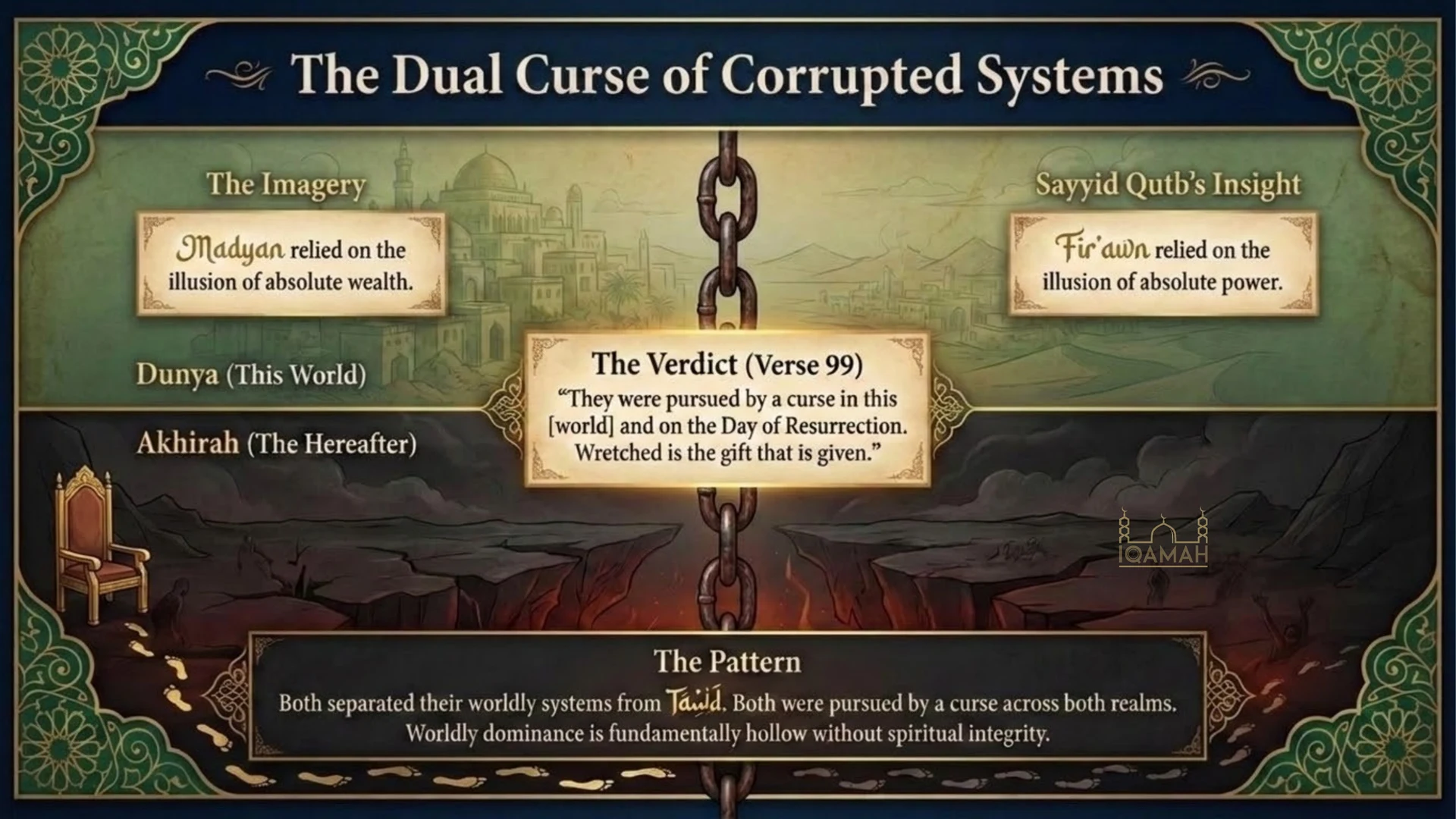
The Madyan account closed with a curse; so does the account of Firʿawn. Verse 99 seals it and, with it, this half of our session:

وَأُتْبِعُوا۟ فِى هَٰذِهِۦ لَعْنَةًۭ وَيَوْمَ ٱلْقِيَٰمَةِ ۚ بِئْسَ ٱلرِّفْدُ ٱلْمَرْفُودُ

“And they were followed in this [world] with a curse and on the Day of Resurrection. And wretched is the gift which is given.”

Sūrah Hūd 11:99 — Saheeh International

“And they were followed in this [world] with a curse, and on the Day of Resurrection.” Two realms, one curse — the dual curse our slide names. Then the closing irony, which al-Zamakhsharī draws from the word rifd: “wretched is the gift (al-rifd al-marfūd) that is given.” A rifd is normally a gift, an aid, a thing one supplies to help another — yet here the “gift” is the curse itself, for the curse in this world is precisely the supply that reinforces and feeds the punishment of the next. Sayyid Quṭb adds the bitter echo: Firʿawn had once promised his sorcerers generous gifts — now everyone sees at last what kind of “gift” Firʿawn actually gives.

Stand the two systems side by side, as our slide does. Madyan leaned on the illusion of absolute wealth; Firʿawn on the illusion of absolute power. Both severed their worldly order from tawḥīd; both were pursued by a curse across both realms. The pattern is the verdict of the whole session: worldly dominance, whether of the scales or of the scepter, is fundamentally hollow without spiritual integrity. And the cure remains the single word Sūrah Hūd will give us — istiqāmah.

Slide 16
Slide 16 of 27 #

Before we close, one thread in these stories deserves a session of its own. Have you noticed how, more than once, a prophet speaks to his people after they have already been destroyed? Ṣāliḥ addresses the lifeless Thamūd; Shuʿayb addresses the lifeless Madyan; and, in our own Prophet’s ﷺ life, he stands at the well of Badr and calls the slain Quraysh by name. The question rises on its own: can the dead hear?

This is a genuine creedal question about the realm of barzakh, and it deserves to be handled with care, because the Qurʾān seems, at first glance, to pull in two directions. On one side stand these prophetic addresses to the dead; on the other stand verses that appear to deny outright that the dead can hear. In this epilogue we will set the texts honestly side by side and then present the reconciliation of the mufassirūn — Ibn Kathīr foremost among them. Our aim is not to dilute any text, but to let every text stand.

Slide 17
Slide 17 of 27 #

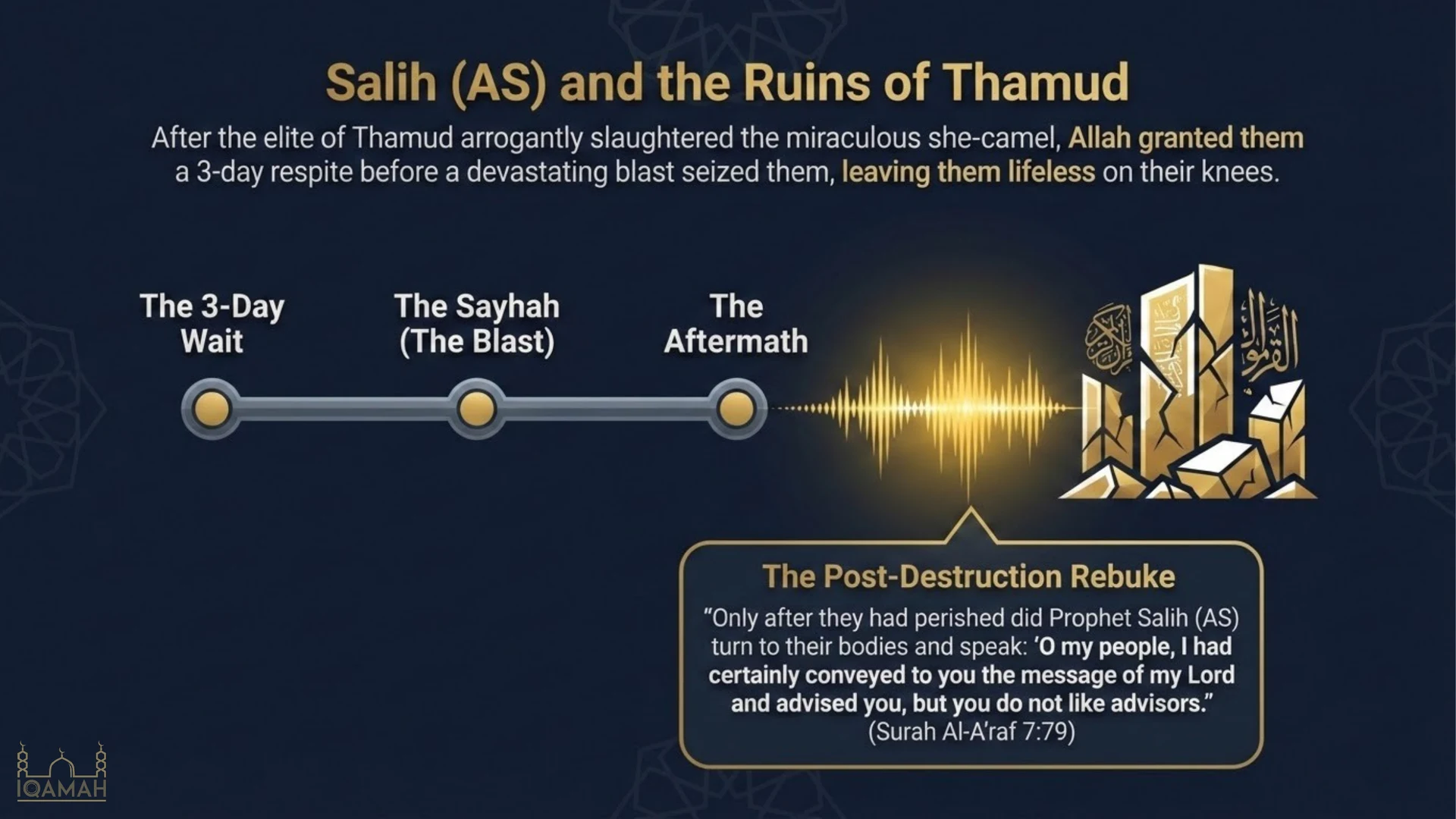
Our first case comes from Sūrat al-Aʿrāf, in the account of Ṣāliḥ عليه السلام and Thamūd. The elite of Thamūd had arrogantly slaughtered the miraculous she-camel; they were granted a respite of three days, and then the rajfah — the earthquake — left them lifeless, jāthimīn, fallen upon their knees (al-Aʿrāf 7:77–78). Only after they had perished did Ṣāliḥ turn to their bodies and speak:

فَتَوَلَّىٰ عَنْهُمْ وَقَالَ يَٰقَوْمِ لَقَدْ أَبْلَغْتُكُمْ رِسَالَةَ رَبِّى وَنَصَحْتُ لَكُمْ وَلَٰكِن لَّا تُحِبُّونَ ٱلنَّٰصِحِينَ

“And he turned away from them and said, “O my people, I had certainly conveyed to you the message of my Lord and advised you, but you do not like advisors.””

Sūrah al-Aʿrāf 7:79 — Saheeh International

This is the same Ṣayḥah-and-stillness motif we just witnessed at Madyan, and the same striking gesture: a prophet addressing those who can no longer, by any ordinary reckoning, hear him. Hold the scene in mind — it is the first of three witnesses we will gather.

Slide 18
Slide 18 of 27 #

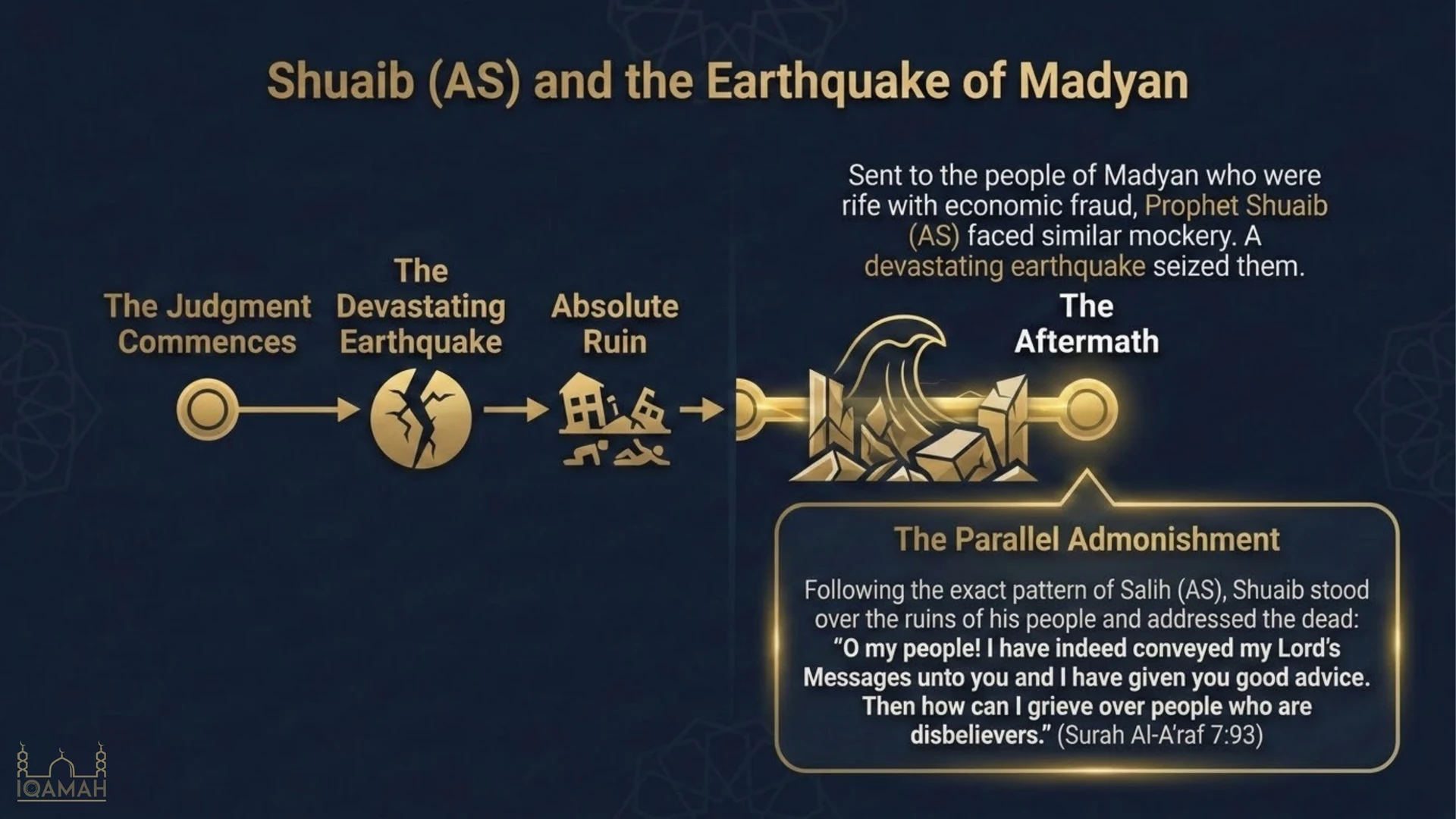
Our second case is Shuʿayb عليه السلام himself, in the parallel telling in Sūrat al-Aʿrāf. There the destruction of Madyan is described as a rajfah, an earthquake, that left them jāthimīn in their homes — the same event we read in Sūrah Hūd as the Ṣayḥah, viewed from another angle. Following the very pattern of Ṣāliḥ, Shuʿayb stood over the ruins of his people and addressed the dead:

فَتَوَلَّىٰ عَنْهُمْ وَقَالَ يَٰقَوْمِ لَقَدْ أَبْلَغْتُكُمْ رِسَٰلَٰتِ رَبِّى وَنَصَحْتُ لَكُمْ ۖ فَكَيْفَ ءَاسَىٰ عَلَىٰ قَوْمٍۢ كَٰفِرِينَ

“And he turned away from them and said, “O my people, I had certainly conveyed to you the messages of my Lord and advised you, so how could I grieve for a disbelieving people?””

Sūrah al-Aʿrāf 7:93 — Saheeh International

Two prophets, two destroyed nations, the same post-destruction address. It is worth noting honestly that the two sūrahs name the agent of ruin differently — al-Ṣayḥah in Hūd, al-rajfah in al-Aʿrāf — two true descriptions of one overwhelming event, the blast and the convulsion of the earth it brought. With these two prophetic witnesses in hand, we turn to the third.

Slide 19
Slide 19 of 27 #

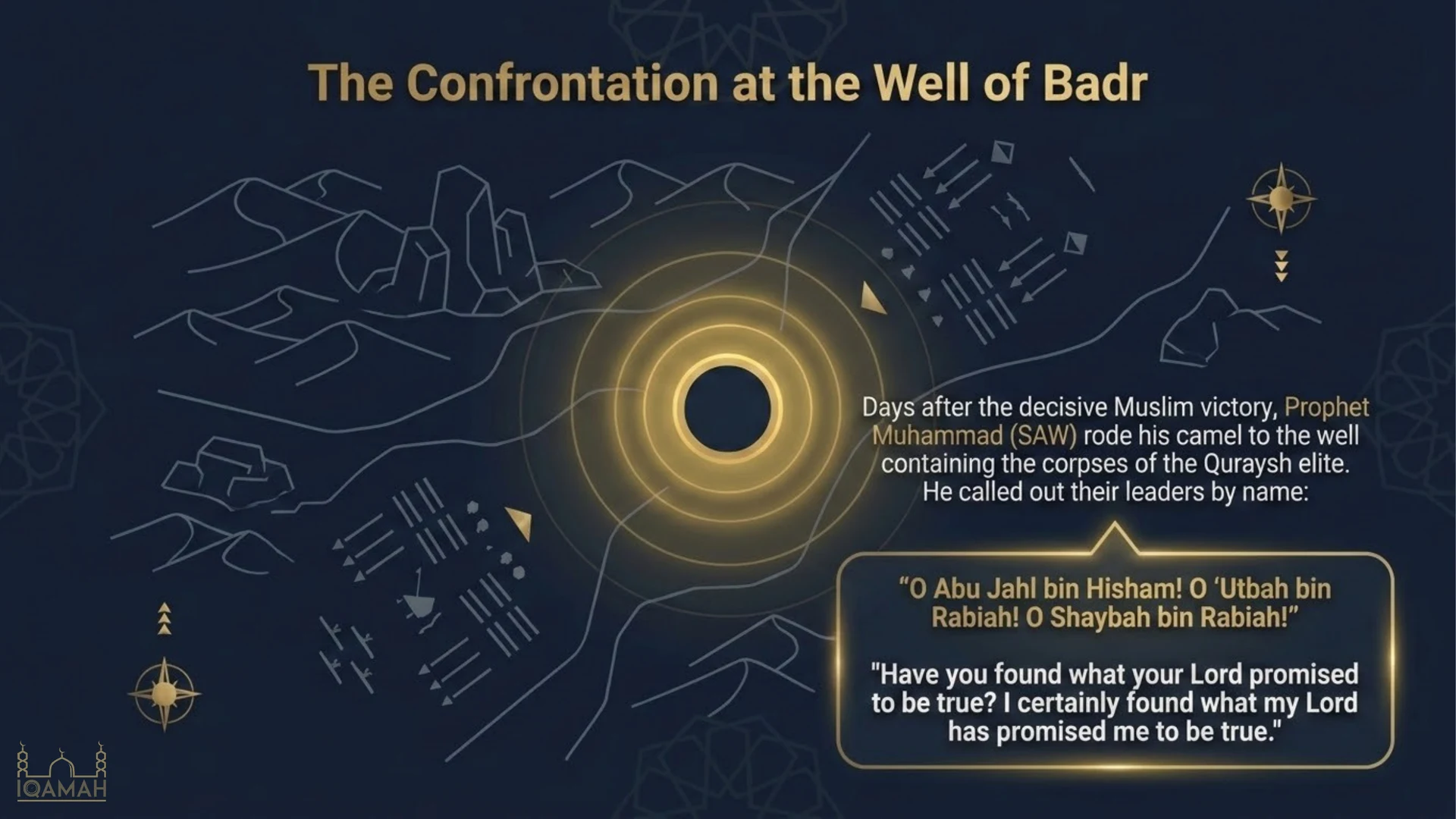
Our third witness is not from the nations of old but from the life of our own Prophet ﷺ — the confrontation at the well of Badr (Qalīb Badr). Three days after the decisive victory, as he ﷺ was departing, he turned his mount aside to the well into which the bodies of the Quraysh leaders had been cast, and he called them by their names:

“O Abū Jahl ibn Hishām! O ʿUtbah ibn Rabīʿah! O Shaybah ibn Rabīʿah! Have you found what your Lord promised you to be true? I have indeed found what my Lord promised me to be true.”

When ʿUmar رضي الله عنه asked, “O Messenger of Allah, do you speak to bodies that have no souls?” he ﷺ replied: “By Him in Whose Hand is my soul, you do not hear what I say any better than they do” — that is, they too hear. The narration is agreed upon, recorded by both al-Bukhārī and Muslim. Qatādah, the great Successor, comments in al-Bukhārī’s transmission that Allah restored to them perception so that they might hear him — as a reproach, a humiliation, and a cause of remorse.

So now we have three clear instances in which the dead were addressed and, it seems, perceived. The question becomes sharper, not easier: is this perception the rule of barzakh, or its exception?

Slide 20
Slide 20 of 27 #

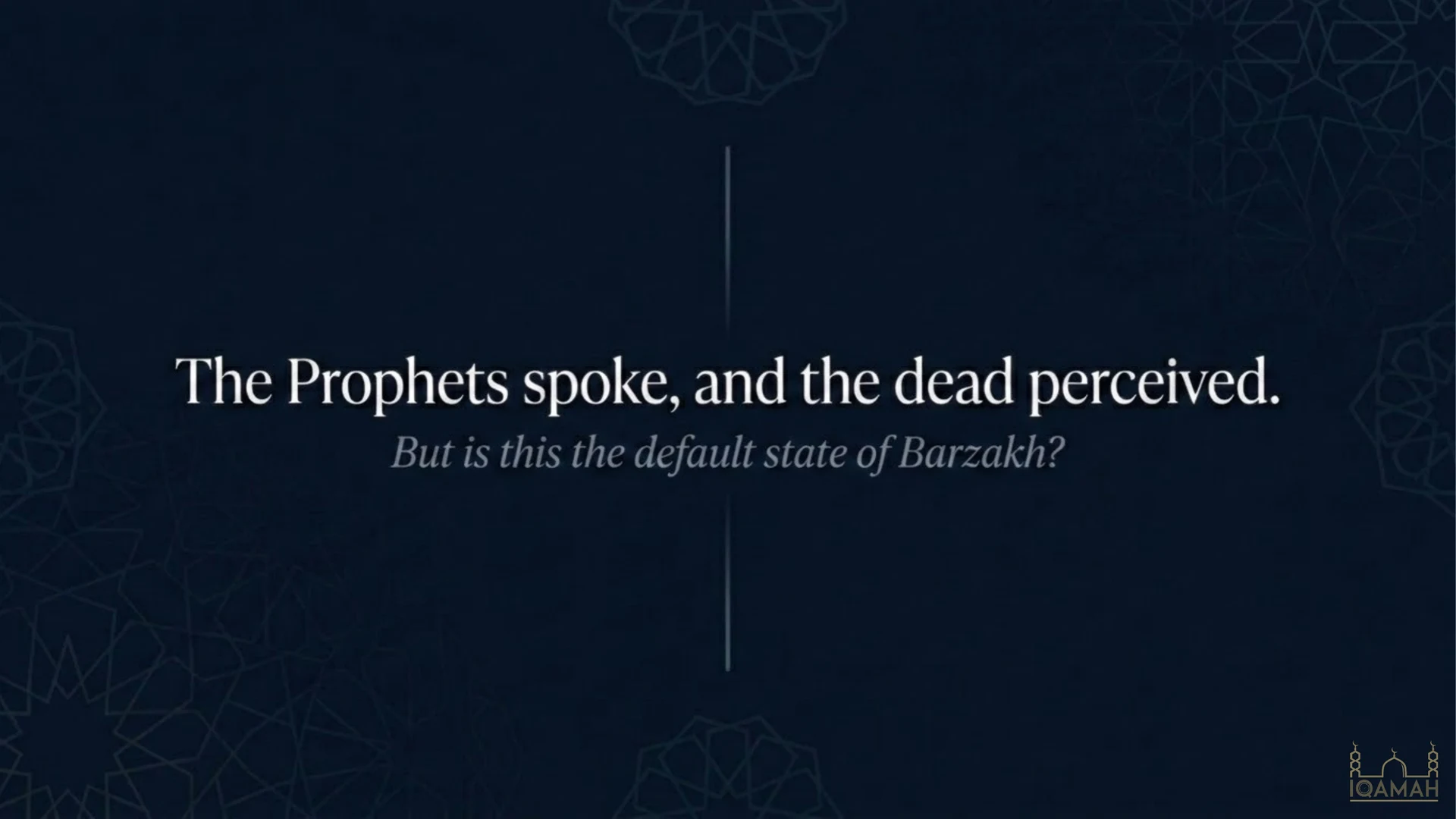
Let us state plainly where the evidence has brought us. The prophets spoke, and the dead perceived — at Thamūd, at Madyan, and at the well of Badr. These are not doubtful reports; the last is in the two most rigorous collections.

And yet we cannot stop here, because the Qurʾān itself raises a counter-question we are bound to honour: is this the default state of barzakh — or is it something extraordinary, granted only at particular moments and for a particular purpose? To answer faithfully, we must now turn to the verses that establish the general law of the barrier between the living and the dead.

Slide 21
Slide 21 of 27 #

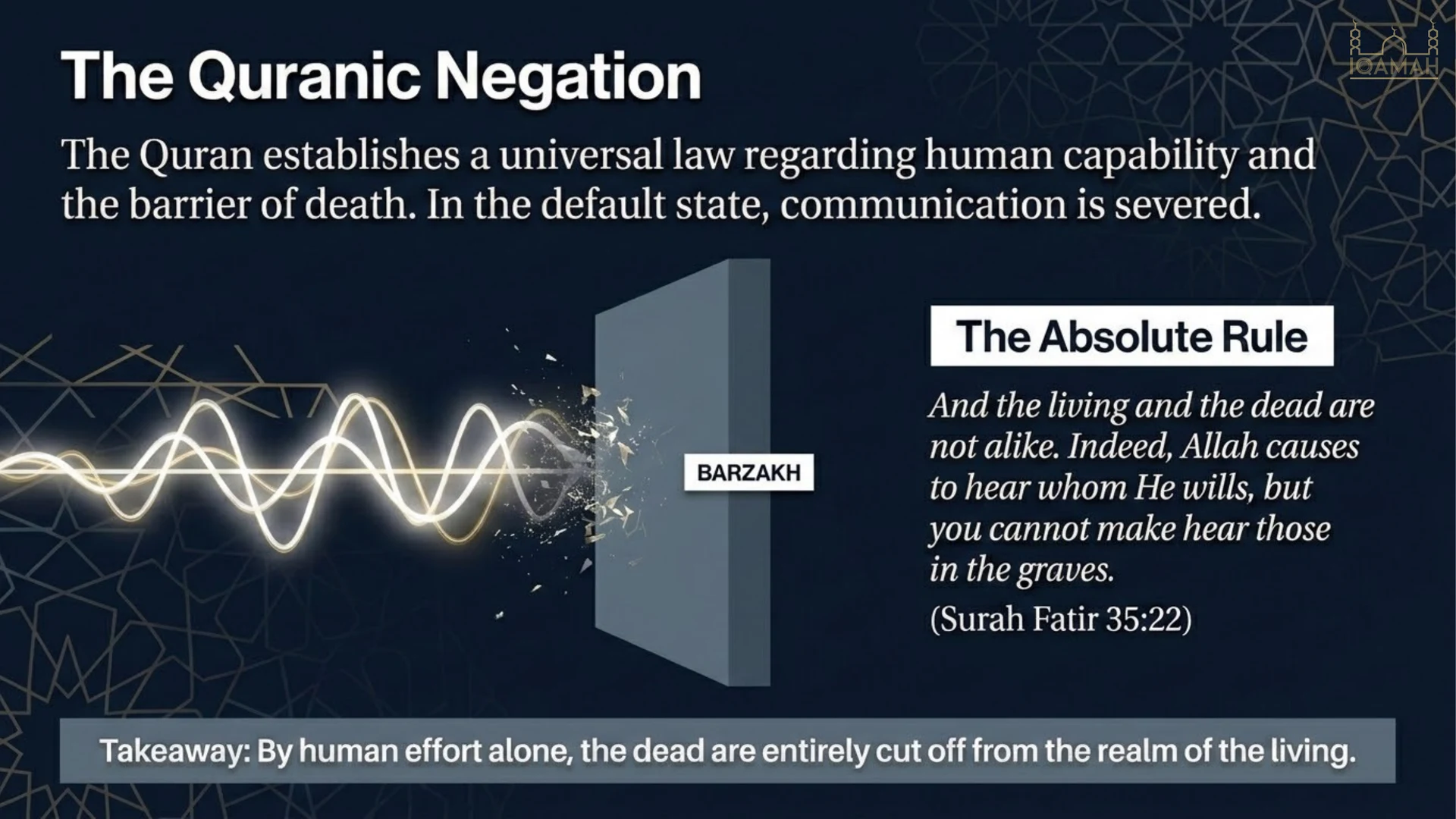
Here is the verse that lays down the general law — the Qurʾanic negation:

وَمَا يَسْتَوِى ٱلْأَحْيَآءُ وَلَا ٱلْأَمْوَٰتُ ۚ إِنَّ ٱللَّهَ يُسْمِعُ مَن يَشَآءُ ۖ وَمَآ أَنتَ بِمُسْمِعٍۢ مَّن فِى ٱلْقُبُورِ

“And not equal are the living and the dead. Indeed, Allah causes to hear whom He wills, but you cannot make hear those in the graves.”

Sūrah Fāṭir 35:22 — Saheeh International

Read carefully, the verse is doing two things at once. It establishes a universal law about human capability and the barrier of death: in the ordinary state, by your own power, you cannot make those in the graves hear — communication is severed. By human effort alone, the dead are entirely cut off from the realm of the living.

But notice the clause that sits right in the middle, which we must not rush past: “Indeed, Allah causes to hear whom He wills.” The verse denies the power to us — it does not deny it to Allah. That single clause is the hinge on which the whole reconciliation will turn. Keep it in view as we read the next verse.

Slide 22
Slide 22 of 27 #

The Qurʾān states the negation a second time, and now turns it into a metaphor of staggering force:

إِنَّكَ لَا تُسْمِعُ ٱلْمَوْتَىٰ وَلَا تُسْمِعُ ٱلصُّمَّ ٱلدُّعَآءَ إِذَا وَلَّوْا۟ مُدْبِرِينَ

“Indeed, you will not make the dead hear, nor will you make the deaf hear the call when they have turned their backs retreating.”

Sūrah al-Naml 27:80 — Saheeh International

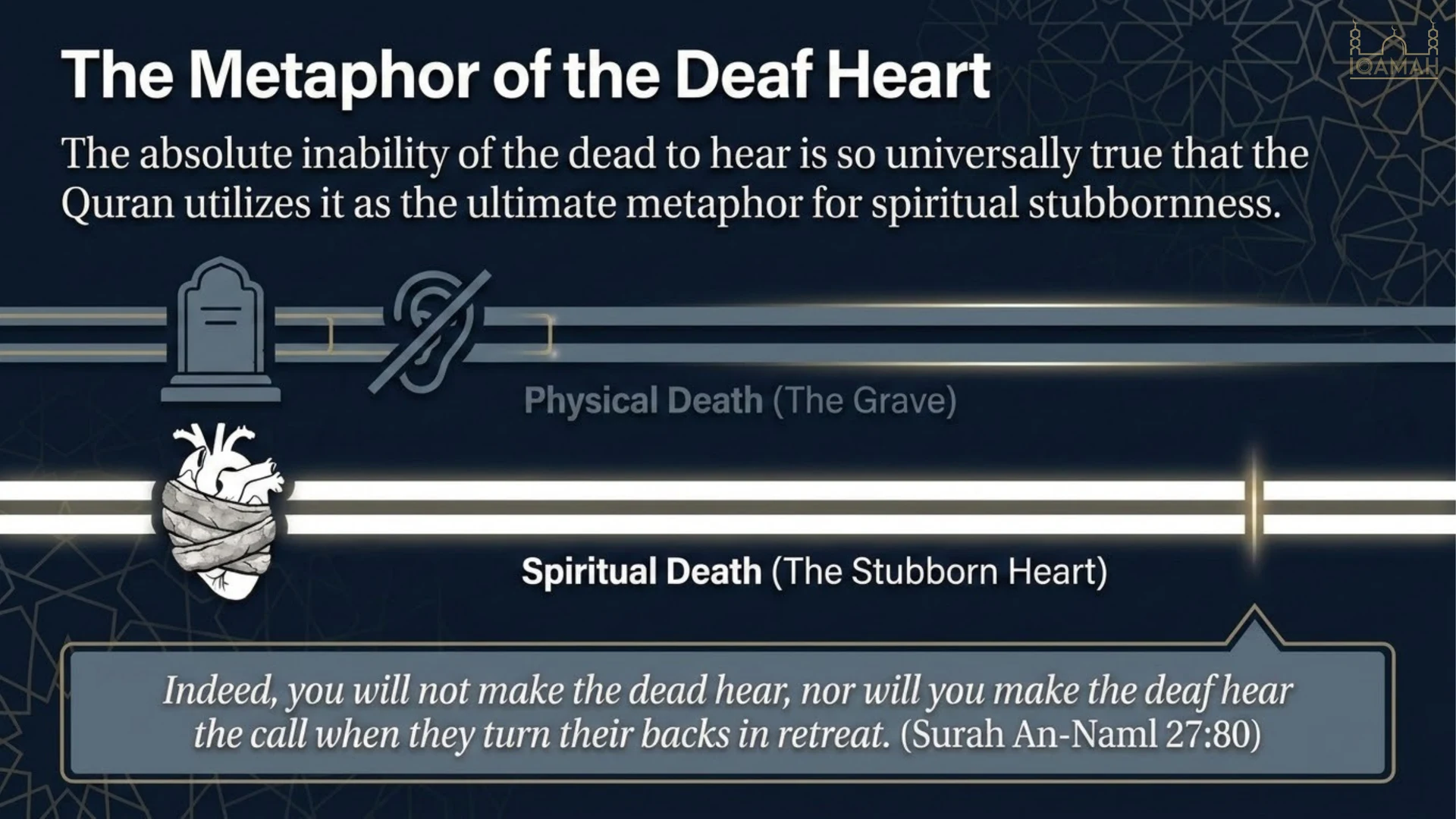
Here is the measure of just how absolute the dead’s inability to hear is in the ordinary course of things: it is so universally accepted a truth that the Qurʾān reaches for it as the ultimate image of spiritual stubbornness. The living whose hearts have hardened are likened to the dead in the grave — there is the physical death of the body, and there is the spiritual death of the obstinate heart, and the call of guidance reaches neither. (The identical wording recurs in Sūrah al-Rūm 30:52, underscoring that this is settled Qurʾanic usage, not a passing turn of phrase.)

So the texts now sit fully before us: three reports in which the dead perceived, and two — indeed three — verses declaring that the dead cannot be made to hear. The believing mind does not choose one set and discard the other. It reconciles.

Slide 23
Slide 23 of 27 #

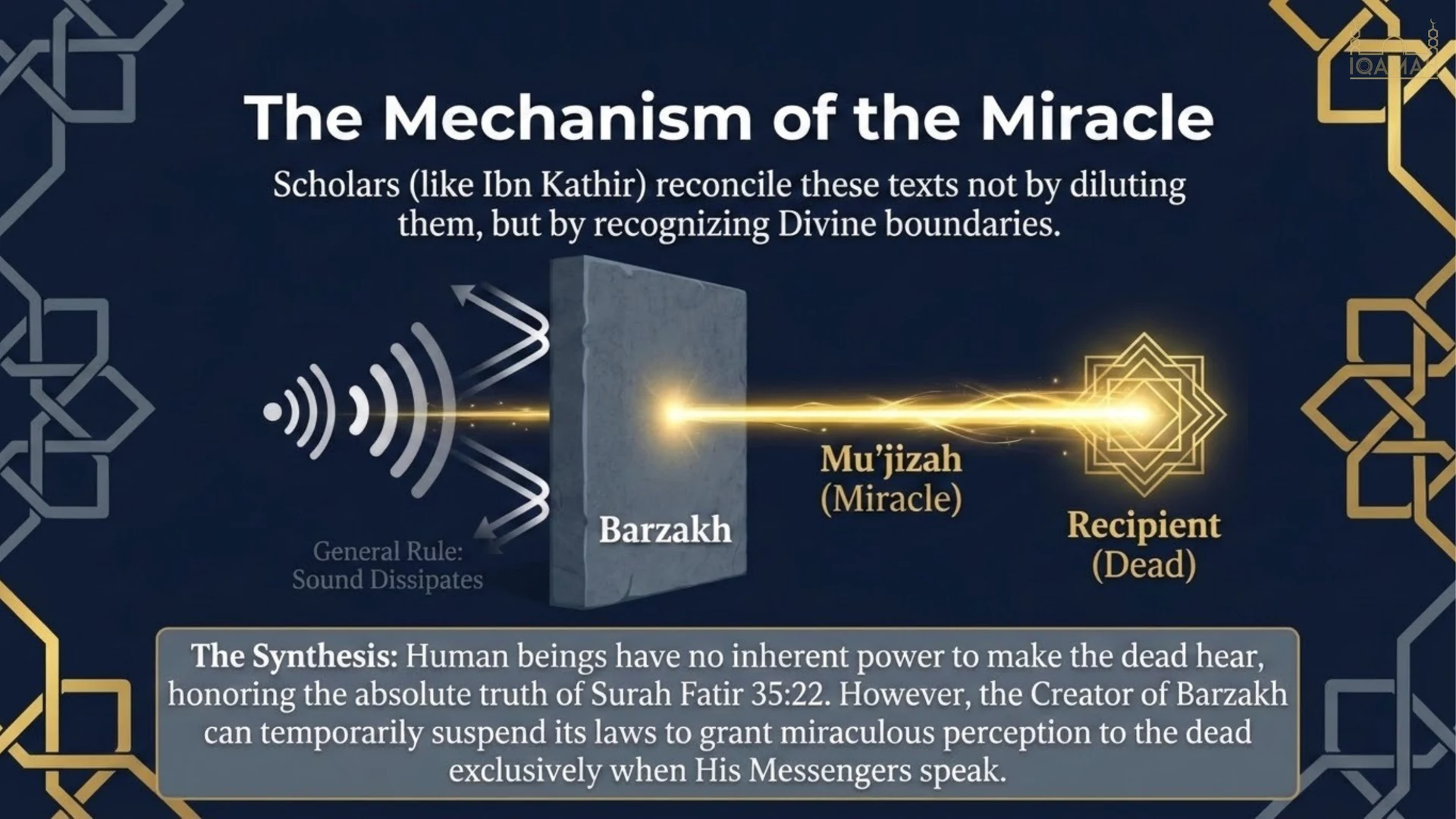
Here is the reconciliation, and it is the work of the mufassirūn — Ibn Kathīr foremost among them — who resolve these texts not by diluting any of them, but by recognising the divine boundaries that govern barzakh.

The general rule is exactly what Sūrah Fāṭir states: a human being has no inherent power to make the dead hear — “wa mā anta bi-musmiʿin man fī al-qubūr.” That absolute truth stands, untouched. But the very same verse affirms, in its central clause, “inna Allāha yusmiʿu man yashāʾ” — Allah causes to hear whom He wills. And there is the key. The One who created barzakh and set its laws can suspend those laws when He wills, and grant perception (samāʿ) to the dead — a muʿjizah, a miracle — particularly when His Messengers speak. The sound does not cross the barrier by any human power; it is Allah who carries it across, exclusively, by His will.

So there is no contradiction at all. The verses negate the human faculty; the authentic reports affirm an Allah-granted perception. As Ibn Kathīr notes in his commentary on Sūrat al-Rūm, the stronger view among the scholars is that of ʿAbdullāh ibn ʿUmar — that the slain of Badr truly heard — supported by many corroborating paths; while ʿĀʾishah رضي الله عنها read the Badr report in the light of Fāṭir 35:22, holding that the Prophet ﷺ meant they had now come to know the truth. Both readings dwell within the Sunnī tradition, and the synthesis honours every text. The everyday practice of the Sunnah points the same way: we are taught to greet the people of the graves with the address given to one who hears — “peace be upon you, O abode of a believing people” — and it is established that the deceased hears the very footsteps of those who turn and leave his grave (al-Bukhārī).

Slide 24
Slide 24 of 27 #

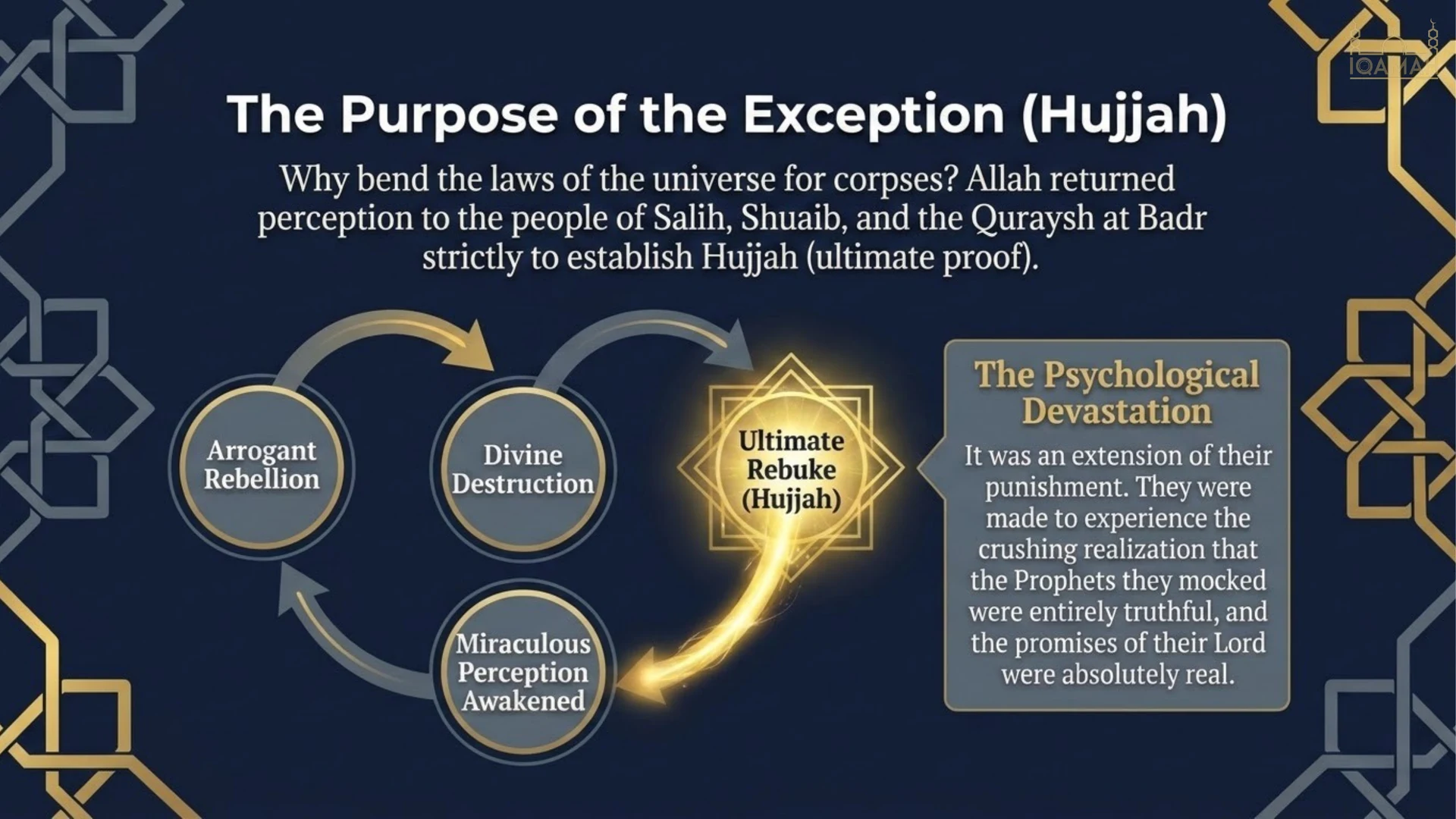
A natural question follows: why? Why would Allah bend the settled laws of His own creation to return perception to corpses? The answer is given in a single word — ḥujjah, the establishing of conclusive proof — and the slide traces its cycle: arrogant rebellion, then divine destruction, then the ultimate rebuke, then miraculous perception awakened for that rebuke alone.

Allah returned perception to the people of Ṣāliḥ, to the people of Shuʿayb, and to the Quraysh at Badr strictly to establish ḥujjah upon them — the final, unanswerable proof. And there is a second dimension, which Qatādah named in the narration we read: it was an extension of their very punishment. They were made to experience the crushing realisation that the prophets they had mocked were entirely truthful, and that the promises of their Lord, which they had laughed off, were absolutely real. The address at the well was not idle speech over the dead; it was the last turn of the screw of their own punishment — a reproach, a humiliation, and a flood of remorse, exactly as Qatādah said.

Slide 25
Slide 25 of 27 #

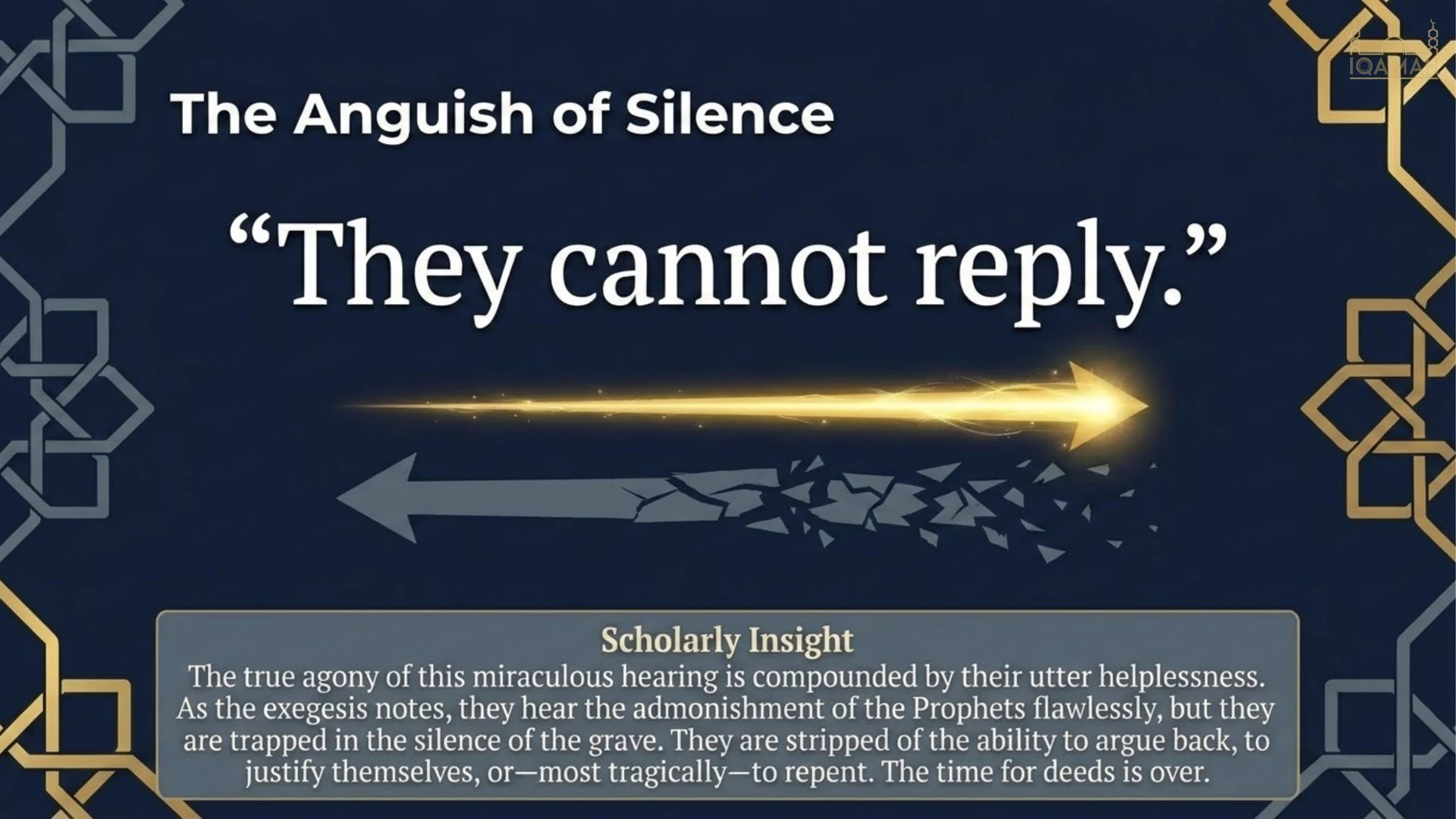
And here is the sharpest edge of that miraculous hearing — the anguish that the slide captures in three words: “They cannot reply.”

Consider their state precisely. They hear the admonition of the prophets flawlessly; Allah grants them that perception in full. But they are trapped in the silence of the grave. They are stripped of the ability to argue back, to defend themselves, to offer any justification — and, most tragically of all, to repent. The Prophet ﷺ told us they hear, yet they cannot return an answer. The hearing is total; the helplessness is total. The time for deeds, for words, for turning back, is over.

There is a mercy hidden in this for the living, and it is the whole reason we paused on this question. The door that was sealed shut for them — the door of reply, of repentance, of putting things right — is, for us, still wide open. Every moment in which we can still speak, still amend, still turn back, is the very moment the people of the well would give anything to have.

Slide 26
Slide 26 of 27 #

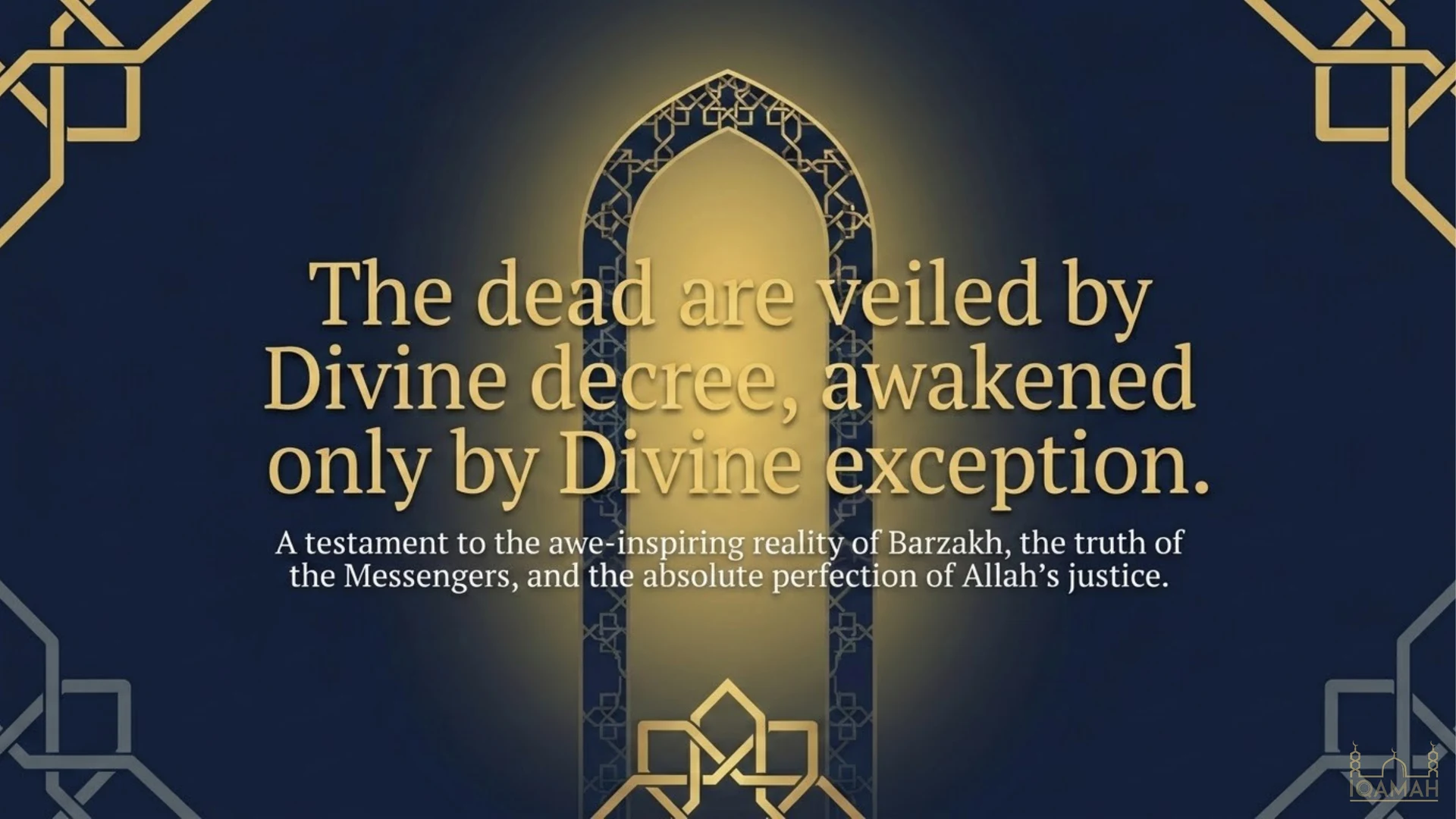
So we close the question where the evidence leaves us: the dead are veiled from us by Divine decree, and awakened only by Divine exception. The general law of Fāṭir 35:22 holds — by our own power we reach no one in the graves; and the exception, “Allah causes to hear whom He wills,” holds equally, granted at His command, for His Messengers, to establish His proof.

It is a testament, in the end, to three things at once: the awe-inspiring reality of barzakh, the absolute truth of the Messengers whom these nations mocked, and the perfect, exacting justice of Allah. And it brings our whole session full circle. The same Lord who is al-Muḥīṭ — the Encompassing — over Madyan’s scales and over Firʿawn’s scepter is al-Muḥīṭ over the silence of the grave. Nothing of the scales, nothing of the scepter, and nothing beyond the threshold of death escapes Him.

Slide 27
Slide 27 of 27 #

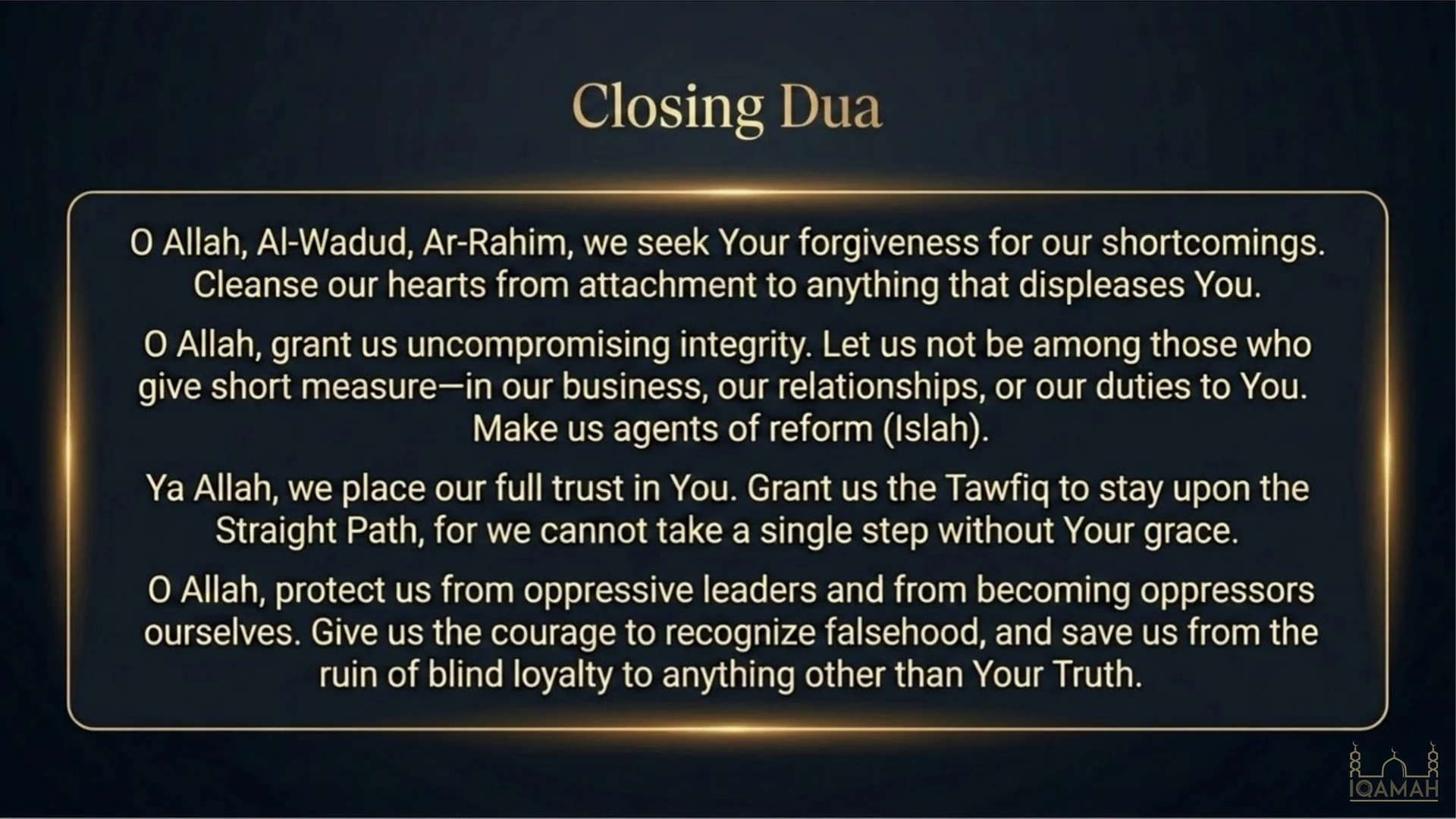
As is our custom, we close with duʿāʾ — and notice how it gathers up everything we have studied tonight. We call upon Allah by the very Names Shuʿayb عليه السلام invoked over Madyan — al-Wadūd and al-Raḥīm (Hūd 11:90) — seeking forgiveness for our shortcomings and asking Him to cleanse our hearts of attachment to anything that displeases Him.

We ask Him for the uncompromising integrity of the scales: that we never be among those who give short measure — in our business, in our relationships, or in our duties to Him — and that He make us agents of iṣlāḥ, of genuine reform, as Shuʿayb intended for his people. We place our full trust in Him, as Shuʿayb did — “my success is only through Allah” — and beg for the tawfīq to remain upon the Straight Path, upon istiqāmah, for we cannot take a single step without His grace.

And we ask protection from the scepter’s ruin: that He guard us from oppressive leaders and from ever becoming oppressors ourselves; that He give us the courage to recognise falsehood; and that He save us from the destruction of blind loyalty to anything other than His truth. O Allah, accept this gathering, forgive its shortcomings, and let what we have learned become a proof for us and not against us. Āmīn.

About this series

This is the fifth session in a planned six-part series walking through the tafsir of Sūrah Hūd. Parts 1–4 established the framework (vv. 1–24), walked the Nūḥ narrative (vv. 25–49), read the matched ruin of ʿĀd and Thamūd (vv. 50–68), and took the angelic guests of Ibrāhīm and the people of Lūṭ (vv. 69–83). Part 5 (this session) reads the two final destruction-narratives as a pair — Shuʿayb to Madyan and Mūsā before Firʿawn (vv. 84–99) — and closes with an epilogue on the barzakh. The sixth and final session, The Anchored Heart, walks the remainder of the sūrah (vv. 100–123) and its closing command to stand firm, fa-staqim kamā umirta. To be notified about future sessions, drop a line to admin@iqamah.org — we'll keep a list and reach out as new parts publish.

  1. 1
    An Illuminated Framework vv. 1–24 — Doctrinal core, cosmic context, prophetic challenge
  2. 2
    The Ark and the Oven vv. 25–49 — Nūḥ's daʿwah, the Ark, and the boiling oven
  3. 3
    Blueprints of Faith and Ruin vv. 50–68 — Hūd and ʿĀd, Ṣāliḥ and Thamūd, and the polished heart
  4. 4
    The Heavenly Guests vv. 69–83 — Ibrāhīm's guests, the glad tidings of Isḥāq, and the overturning of Lūṭ's people
  5. 5
    The Scales and The Scepter vv. 84–99 — Shuʿayb and Madyan, Mūsā and Firʿawn, and the question of the grave
    You are here
  6. 6
    The Anchored Heart vv. 100–123 — the ruins as diagnosis, the Witnessed Day, istiqāmah, and the command to worship and trust