Iqamah

Resources · Quranic Studies

The Duʿāʾ of Ibrāhīm

An Architecture of Supplication — from the House of Stone to the House of the Soul

A two-movement study of the duʿās Ibrāhīm عليه السلام poured into the foundations of the Kaʿba (Sūrah al-Baqarah 2:125–129), read through a single sustained image — architecture. The first movement follows the blueprint stone by stone: the foundation and its security, the provision that sustains it, the raising of the pillars, the courtyard built for generations yet unborn, and the crowning duʿāʾ for a Final Messenger. The second movement turns the same lens inward, gathering six foundational duʿās from the Qurʾān and Sunnah as the pillars of a believer's own heart, home, and destiny. Draws on Maʿāriful Qurʾān, al-Saʿdī, al-Zamakhsharī, al-Rāzī, Ibn Kathīr, Sayyid Qutb, and Ibn ʿĀshūr.

Slides 29
Format Slides + notes
Topic Supplication
Cover slide: The Duʿāʾ of Ibrāhīm
Slide 1
Slide 1 of 29 #

Bismillāhir-Raḥmānir-Raḥīm. Al-ḥamdu lillāhi Rabbil-ʿālamīn, wa-ṣ-ṣalātu wa-s-salāmu ʿalā Rasūlillāh ﷺ. We begin in the name of Allah ﷻ, with praise to Him and ṣalawāt upon His beloved Messenger ﷺ. Before we open the āyāt, let us place ourselves in the sūrah. We are in the heart of Sūrah al-Baqarah, in a passage that follows immediately upon Allah ﷻ taking Ibrāhīm عليه السلام through a series of trials and then announcing, “Indeed, I will make you a leader (imām) for the people” (2:124). From that appointment the Qurʾān turns to the House that this leader would raise, and to the duʿās he poured into its foundations. The setting is also a quiet argument: much of al-Baqarah is addressed to the Ahl al-Kitāb (the People of the Book), and here Allah ﷻ establishes who the true heirs of Ibrāhīm عليه السلام really are — not those who merely claim his name, but those who carry his submission and his duʿāʾ (Maʿāriful Qurʾān; Sayyid Quṭb).

Our deck takes a single sustained image — architecture — and reads these āyāt as a blueprint. Notice how the passage interlaces two things we usually keep apart: the physical labour of building, and the lifted hands of duʿāʾ. Ibrāhīm عليه السلام lays stone upon stone, and with the same breath begs, “Our Lord, accept this from us.” That is the thread to carry across the whole dars (our gathering of study): the believer builds with his hands and begs Allah ﷻ to complete what his hands can only begin. Over these slides we will move from the foundation and its security, to the provision that sustains it, to the raising of the pillars, to the courtyard built for generations yet unborn, and finally to the crown of the whole structure — the duʿāʾ for a Messenger. Bismillāh, let us begin.
Slide 2
Slide 2 of 29 #

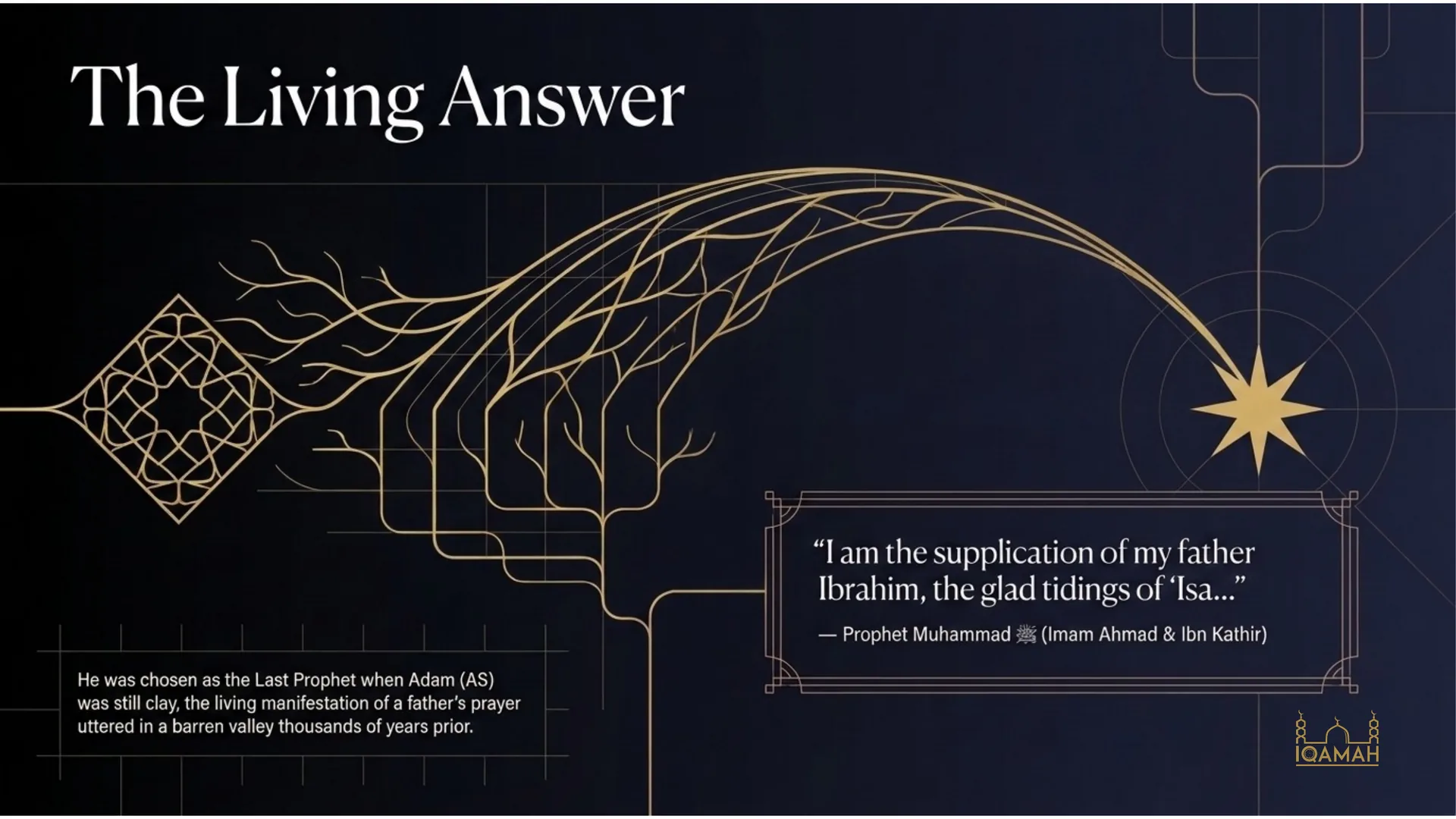
Let us open with the end in mind. In this dars we reflect upon a duʿāʾ; this slide shows us its harvest. Centuries upon centuries after Ibrāhīm عليه السلام stood in a barren valley and asked his Lord to “send among them a messenger from themselves,” that very Messenger walked the earth. The Prophet Muḥammad ﷺ described himself, in words preserved in the Musnad of Imām Aḥmad and cited by Ibn Kathīr, as “the duʿāʾ of my father Ibrāhīm and the glad tidings of ʿĪsā” — for ʿĪsā عليه السلام had foretold a messenger to come after him named Aḥmad (Sūrah al-Ṣaff 61:6).

Notice the timescale. The Prophet ﷺ taught that he was already decreed as the Khātam an-Nabiyyīn, the Final Prophet, “when Ādam عليه السلام was still clay.” The light we glimpse on this slide — a duʿāʾ travelling like an arc across the sky to a distant star — is the living manifestation of a father’s duʿāʾ uttered in an empty desert thousands of years before. We are being shown, at the outset, that duʿāʾ operates on the timeline of eternity, not on the calendar of our impatience. Hold that thought. When we reach the foundations of the House in the āyāt ahead, remember that the duʿāʾ whispered into those stones was answered in the person whose ummah we belong to. The architecture of this legacy reaches all the way to us.

Slide 3
Slide 3 of 29 #

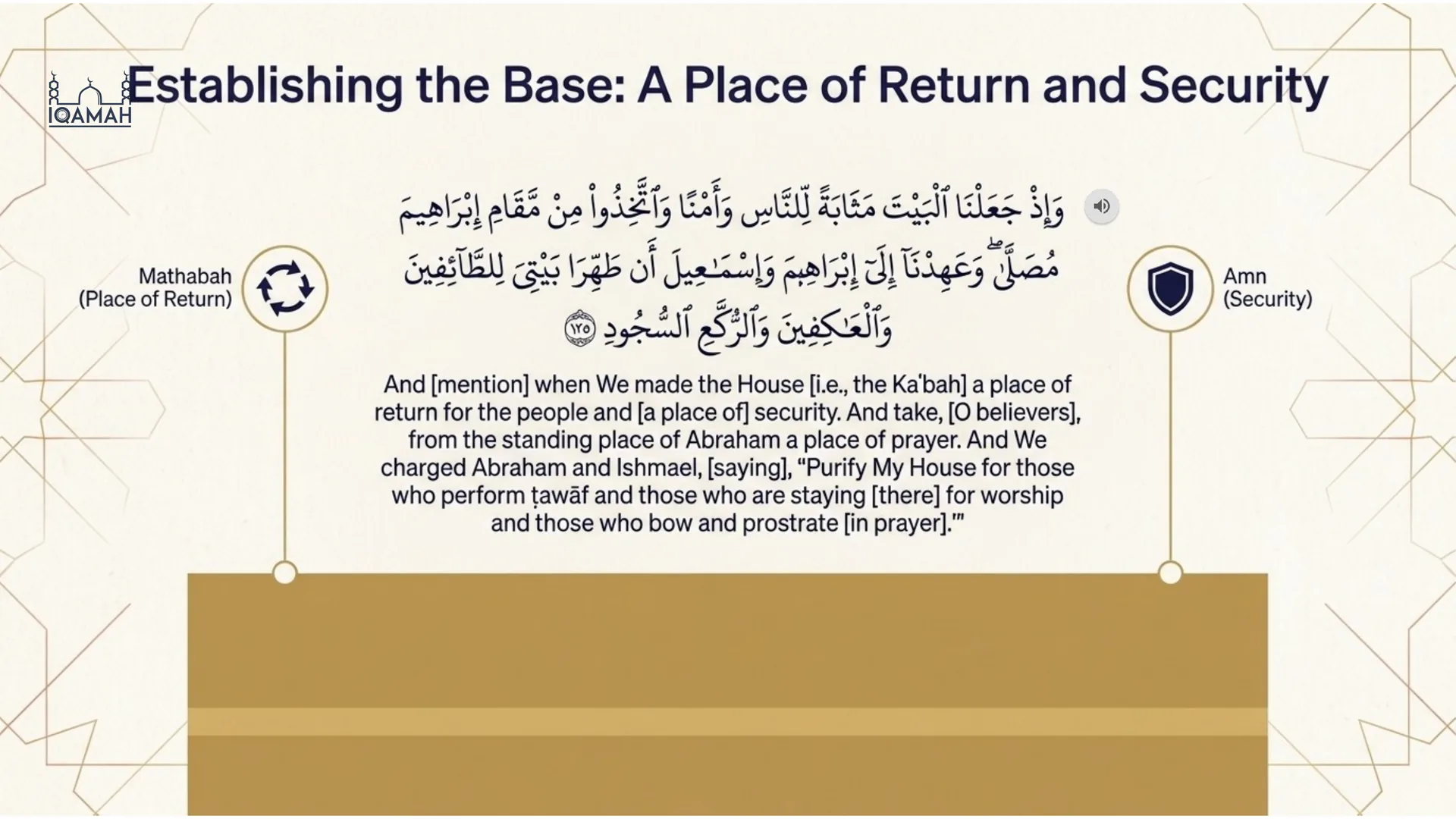
Let us lay the foundation stone. This first āyah establishes what the House is before any duʿāʾ is offered beside it: a destination and a refuge.

وَإِذْ جَعَلْنَا ٱلْبَيْتَ مَثَابَةً لِّلنَّاسِ وَأَمْنًا وَٱتَّخِذُوا۟ مِن مَّقَامِ إِبْرَٰهِۦمَ مُصَلًّى ۖ وَعَهِدْنَآ إِلَىٰٓ إِبْرَٰهِۦمَ وَإِسْمَٰعِيلَ أَن طَهِّرَا بَيْتِىَ لِلطَّآئِفِينَ وَٱلْعَٰكِفِينَ وَٱلرُّكَّعِ ٱلسُّجُودِ

“And [mention] when We made the House a place of return for the people and [a place of] security. And take, [O believers], from the standing place of Abraham a place of prayer. And We charged Abraham and Ishmael, [saying], ‘Purify My House for those who perform ṭawāf and those who are staying [there] for worship and those who bow and prostrate [in prayer].’”

Sūrah al-Baqarah 2:125 — Saheeh International

Two words carry the weight. The House is made a mathābah — a “place of return,” from the root thāba, “to come back.” It is a place the heart cannot visit once and be done with; one leaves it already longing to return. Mujāhid observed that no one takes their fill of it, and some of the salaf said a sign of an accepted Ḥajj is that one returns home with the longing only deepened (Maʿāriful Qurʾān, p.339; al-Saʿdī, vol.1 p.140). Al-Zamakhsharī notes the variant reading mathābāt, in the plural, precisely because it is a place of return for every one of mankind, reserved to none (al-Kashshāf — language).

The second word is amn, security. The Ḥaram is a sanctuary where even a wrongdoer who flees to it is not seized until he leaves, and where, in the days of jāhiliyyah, a man would not raise his hand against his own father’s killer (al-Saʿdī, vol.1 p.140; Ibn al-Jawzī cites Ibn ʿAbbās to the same effect, vol.1 p.496). Then comes the charge to Ibrāhīm and Ismāʿīl عليهما السلام to purify the House — which the mufassirūn read on two levels: cleansing it of idols and filth without, and of shirk, doubt, and the diseases of the heart within (Ibn Kathīr; al-Saʿdī, vol.1 p.141). We will return to these three categories of worshippers — those who circle, who stay, and who bow — two slides from now.

Slide 4
Slide 4 of 29 #

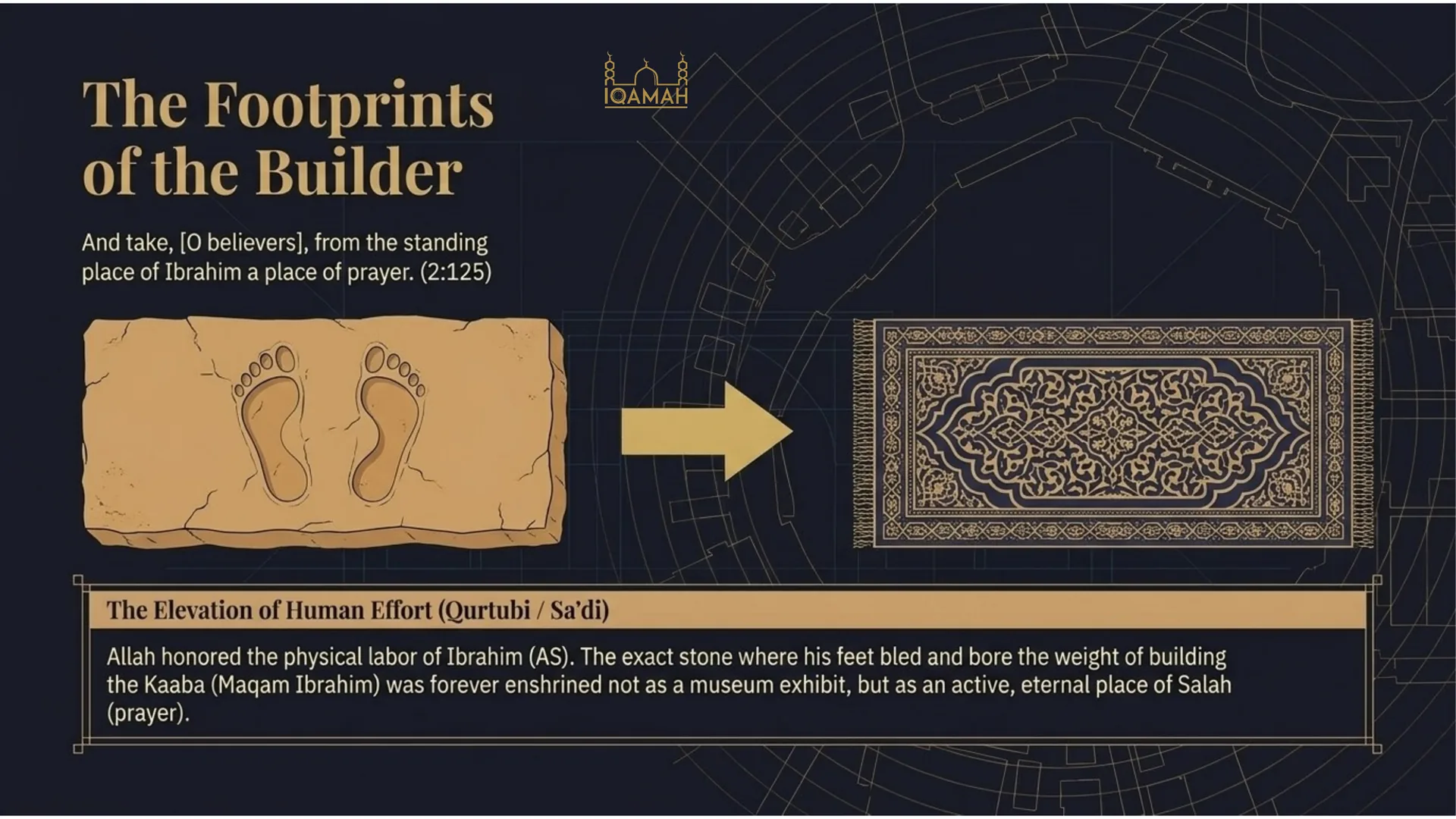
Let us pause on a remarkable detail. The āyah we have just read tells the believers to take “from the standing place of Abraham a place of prayer” — min maqāmi Ibrāhīma muṣallā. The Maqām Ibrāhīm is the stone on which Ibrāhīm عليه السلام stood as he raised the walls of the Kaʿba; the Ṣaḥābī Anas رضي الله عنه reported that he himself saw upon it the impression of the Prophet’s footprint (Maʿāriful Qurʾān, p.341, citing al-Bukhārī). Consider what this means: the very stone that bore the weight of a man’s exhausting, anonymous labour was not retired to a museum. It was enshrined forever as an active place of Ṣalāh (al-Qurṭubī; al-Saʿdī). Allah ﷻ honours human effort by making it sacred.

There is a further treasure here, one of the celebrated muwāfaqāt (concordances) of ʿUmar. ʿUmar ibn al-Khaṭṭāb رضي الله عنه relates: “I agreed with my Lord in three things. I said, ‘O Messenger of Allah, if only we took the Maqām of Ibrāhīm as a place of Ṣalāh’ — and the āyah was revealed” (Ibn Kathīr, pp.329–330, citing al-Bukhārī). The wish of a servant rose up, and waḥy (revelation) descended to confirm it. As his khilāfah came, it was ʿUmar himself who moved the Maqām back to the position it holds today, and not one Ṣaḥābī objected — for the Qurʾān had already agreed with him about this very stone (Ibn Kathīr, p.330). Let the lesson land: sincere love for the House can shape a heart so finely that its longing aligns with what Allah ﷻ was about to reveal.

Slide 5
Slide 5 of 29 #

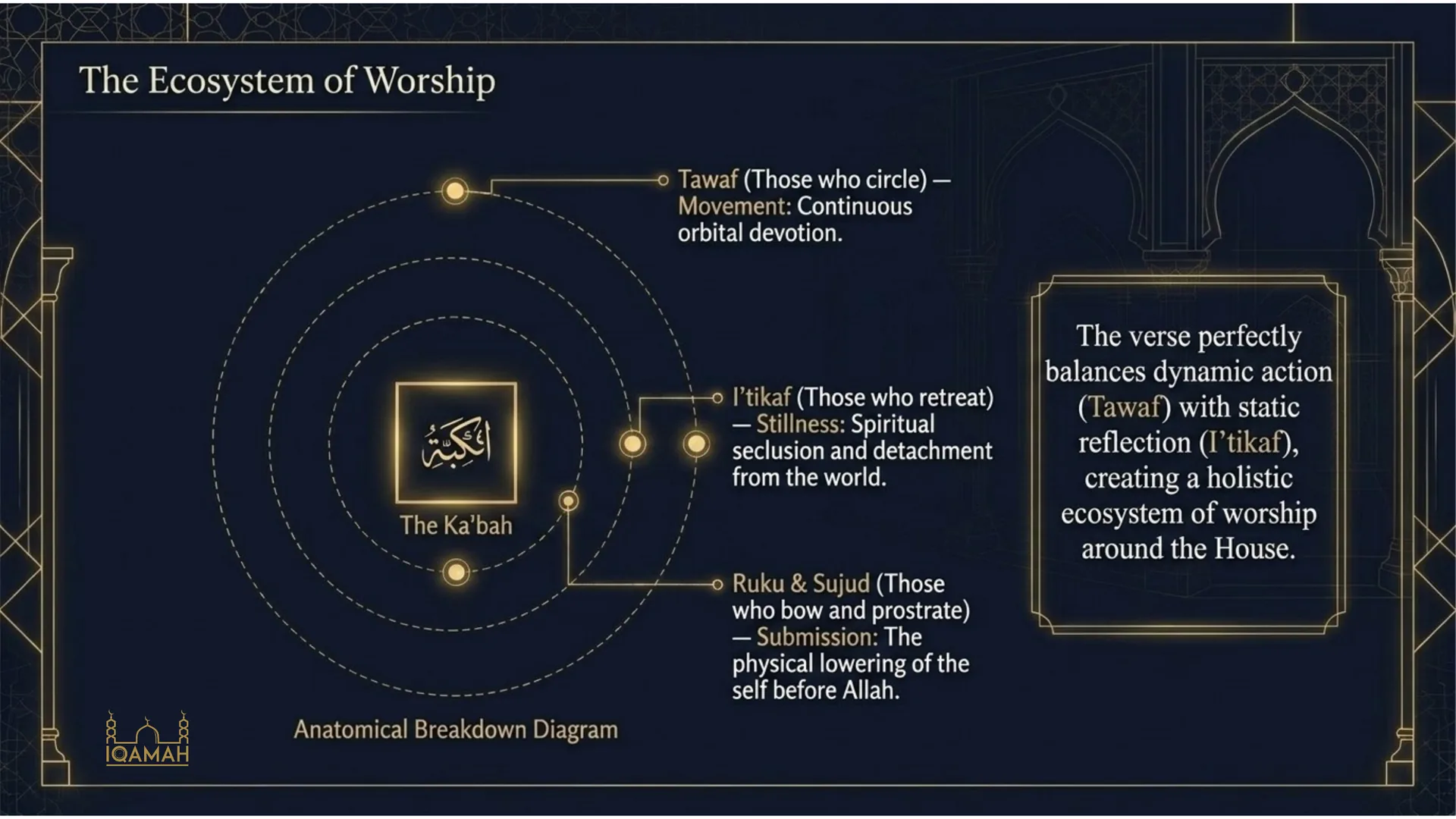
Let us dwell on the closing image of āyah 125 — the three kinds of worshippers the House is purified for: “those who perform ṭawāf, those who are staying for worship, and those who bow and prostrate.” This slide reads them as a single ecosystem of ʿibādah, and the order is not accidental.

Al-Saʿdī draws out the sequence with care. Ṭawāf is mentioned first because it is the act unique to the Masjid al-Ḥarām — performed nowhere else on earth. Iʿtikāf, “staying for worship,” comes next, for its condition is that it be in a masjid. And Ṣalāh — the bowing and prostrating — though it is the most excellent of the three, is mentioned last, precisely because it is not bound to this place; it may be offered anywhere Allah’s earth allows (al-Saʿdī, vol.1 p.141). Al-Zamakhsharī notes that the “bowing, prostrating” simply names the postures of the muṣallī, comparing the parallel wording in Sūrah al-Ḥajj 22:26 (al-Kashshāf — language).

Notice the balance the āyah strikes. Ṭawāf is pure movement — continuous, orbital devotion around the centre. Iʿtikāf is pure stillness — khalwah and seclusion with Allah ﷻ. And Ṣalāh gathers the body into submission. Motion and rest, the outward journey and the inward retreat, are held together in one sentence. The House is not built for a single mode of ʿibādah but for a whole life of it. As we move into Ibrāhīm’s duʿās in the coming āyāt, carry this sense of completeness: the sanctuary he raised was designed to hold every posture of a believing heart.

Slide 6
Slide 6 of 29 #

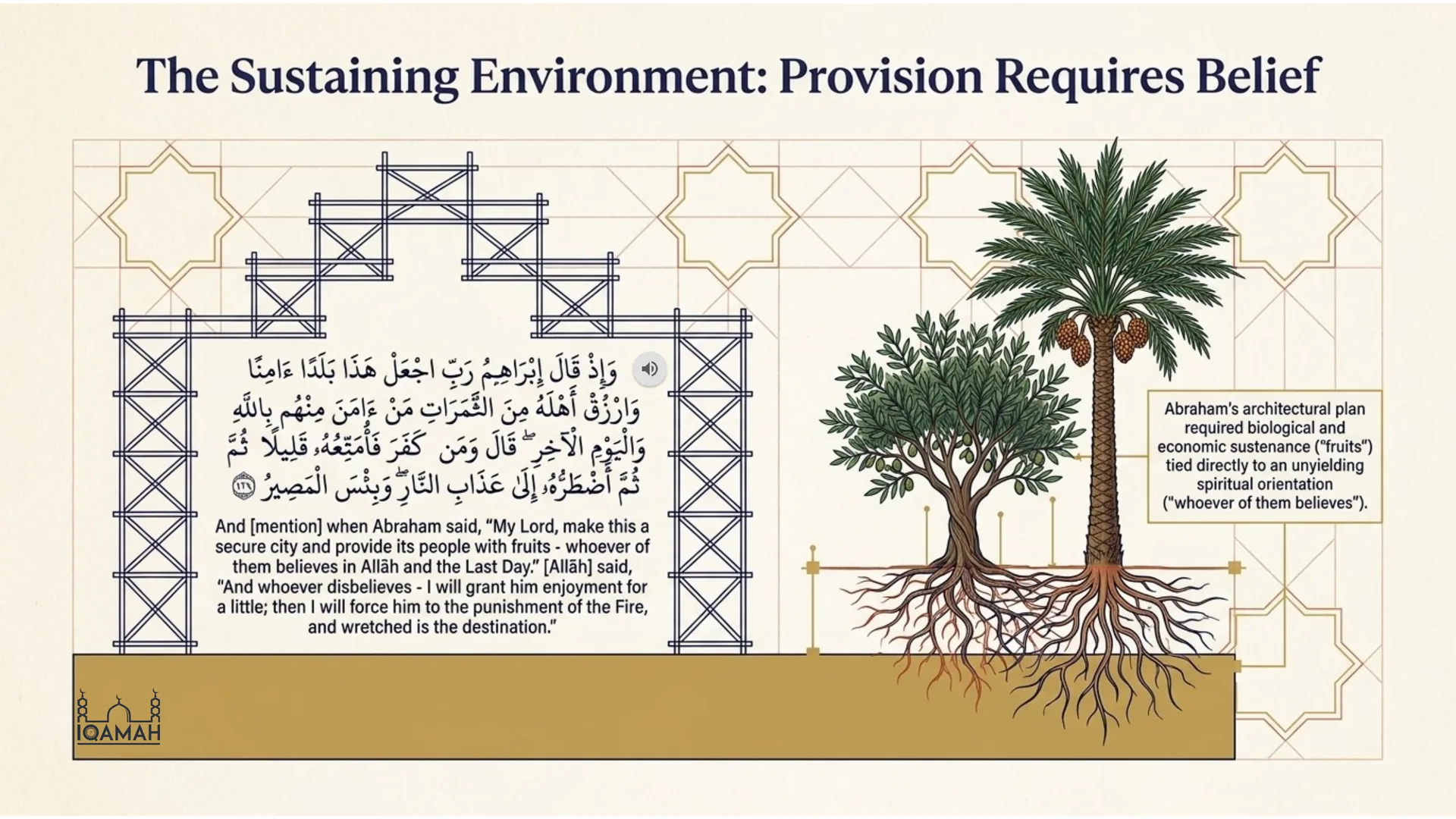
With the foundation laid, the second duʿāʾ asks for what every settlement needs to survive: safety and rizq (sustenance).

وَإِذْ قَالَ إِبْرَٰهِۦمُ رَبِّ ٱجْعَلْ هَٰذَا بَلَدًا ءَامِنًا وَٱرْزُقْ أَهْلَهُۥ مِنَ ٱلثَّمَرَٰتِ مَنْ ءَامَنَ مِنْهُم بِٱللَّهِ وَٱلْيَوْمِ ٱلْءَاخِرِ ۖ قَالَ وَمَن كَفَرَ فَأُمَتِّعُهُۥ قَلِيلًا ثُمَّ أَضْطَرُّهُۥٓ إِلَىٰ عَذَابِ ٱلنَّارِ ۖ وَبِئْسَ ٱلْمَصِيرُ

“And [mention] when Abraham said, ‘My Lord, make this a secure city and provide its people with fruits – whoever of them believes in Allah and the Last Day.’ [Allah] said, ‘And whoever disbelieves – I will grant him enjoyment for a little; then I will force him to the punishment of the Fire, and wretched is the destination.’”

Sūrah al-Baqarah 2:126 — Saheeh International

Notice the order once more — Ibrāhīm عليه السلام asks for security before rizq, for no provision can be enjoyed where there is fear (al-Saʿdī, vol.1 p.142). And notice the ḥikmah the mufassirūn find in what he did not ask. He did not ask that Makkah’s own barren soil be made fertile, but that fruits be carried to it from elsewhere — so that his descendants would not be consumed by agriculture but kept free for the ʿibādah of the House. The answer is visible in Sūrah al-Qaṣaṣ 28:57, where “fruits of all things are brought” to the sanctuary (Maʿāriful Qurʾān, pp.344–346).

Then comes a tender correction. Ibrāhīm عليه السلام limited his request for rizq to “whoever of them believes,” recalling that Allah ﷻ had just told him His covenant does not reach the wrongdoers (2:124). But the reply widens the mercy: even the one who disbelieves will be granted enjoyment “for a little,” before being driven to the Fire (Ibn Kathīr; al-Saʿdī, vol.1 p.142). Rizq in this world, the mufassirūn conclude, is no proof of Allah’s pleasure; He provides the brief comforts of this fleeting dunyā even to those He will hold to account (Maʿāriful Qurʾān; Mawdūdī). The believer eats the same fruit as the heedless — but reads in it a different message.

Slide 7
Slide 7 of 29 #

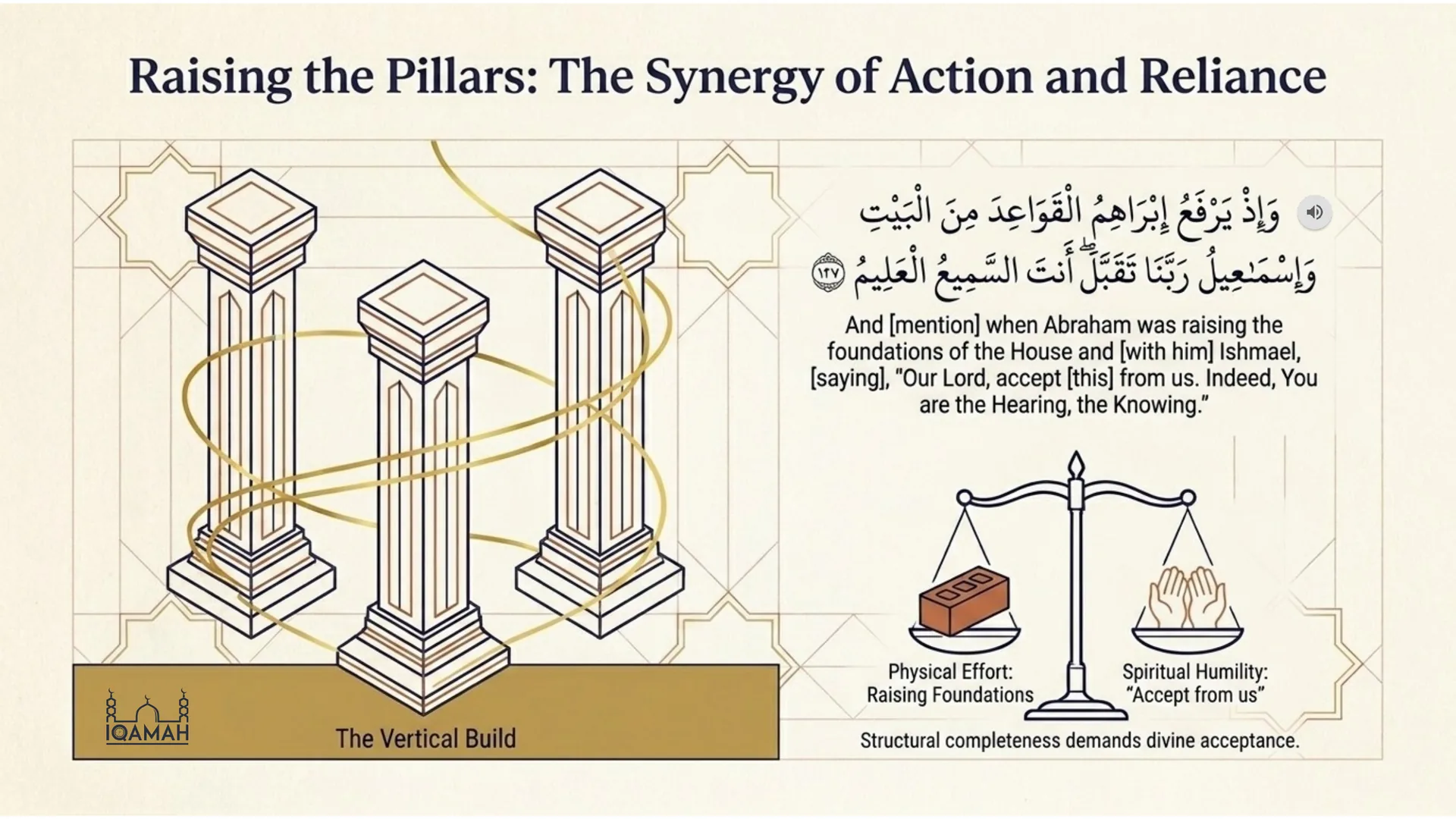
Now the pillars rise. This āyah captures the exact moment of construction, and freezes it on a single, astonishing word.

وَإِذْ يَرْفَعُ إِبْرَٰهِۦمُ ٱلْقَوَاعِدَ مِنَ ٱلْبَيْتِ وَإِسْمَٰعِيلُ رَبَّنَا تَقَبَّلْ مِنَّآ ۖ إِنَّكَ أَنتَ ٱلسَّمِيعُ ٱلْعَلِيمُ

“And [mention] when Abraham was raising the foundations of the House and [with him] Ishmael, [saying], ‘Our Lord, accept [this] from us. Indeed You are the Hearing, the Knowing.’”

Sūrah al-Baqarah 2:127 — Saheeh International

Notice the tense. The verb yarfaʿu — “is raising” — is in the present, though the event is long past. Al-Zamakhsharī explains this as ḥikāyat al-ḥāl: the past is narrated as if unfolding before our eyes, so that we stand in the dust beside the two builders and watch the walls climb (al-Kashshāf — language). The word al-qawāʿid, “the foundations,” is the base of the structure; what is “raised” is really what is built upon them (al-Shawkānī; al-Zamakhsharī — language).

But the heart of the āyah is the duʿāʾ braided into the labour. At the very summit of one of the greatest deeds a human being has ever performed — building the House of Allah ﷻ — Ibrāhīm and Ismāʿīl عليهما السلام do not pause to admire their work. They beg, “Our Lord, accept this from us.” Al-Rāzī notes the precision of taqabbal over a simple “accept”: it is the language of one who fears his ʿamal falls short, the confession of a servant’s smallness even in his finest hour (Mafātīḥ al-Ghayb). Maʿāriful Qurʾān draws the lesson plainly: in performing the hardest and highest tasks, one must never be proud of the attainment (p.346). The grammar even carries an unspoken “saying” — they raised the foundations while saying these words (al-Ṭabarī). Here is the synergy this slide names: full effort of the hands, full humility of the heart. Structural completeness still waits on qabūl — divine acceptance.

Slide 8
Slide 8 of 29 #

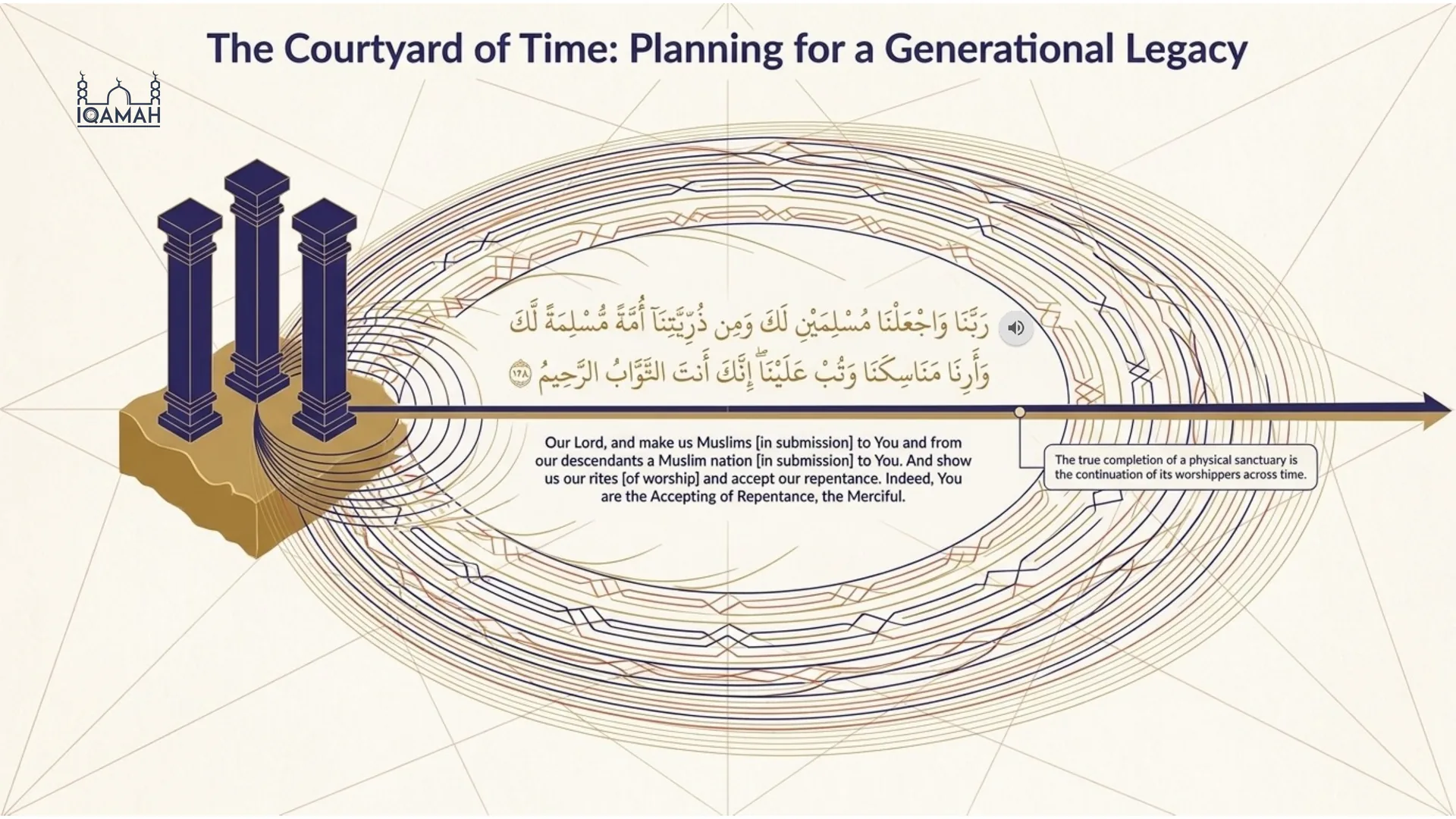
From the standing walls, the duʿāʾ now lengthens its horizon — it begins to plan for people not yet born.

رَبَّنَا وَٱجْعَلْنَا مُسْلِمَيْنِ لَكَ وَمِن ذُرِّيَّتِنَآ أُمَّةً مُّسْلِمَةً لَّكَ وَأَرِنَا مَنَاسِكَنَا وَتُبْ عَلَيْنَآ ۖ إِنَّكَ أَنتَ ٱلتَّوَّابُ ٱلرَّحِيمُ

“Our Lord, and make us Muslims [in submission] to You and from our descendants a Muslim nation [in submission] to You. And show us our rites [of worship] and accept our repentance. Indeed, You are the Accepting of repentance, the Merciful.”

Sūrah al-Baqarah 2:128 — Saheeh International

Notice the partitive “from.” When Ibrāhīm عليه السلام asks for “a Muslim nation” he says min dhurriyyatinā — “from our descendants,” not “all of them.” The mufassirūn read this as both realism and adab: he knew, from 2:124, that wrongdoers would be among his line, so he asked for what is fittingly possible (al-Zamakhsharī — language; al-Rāzī; al-Saʿdī, vol.1 p.143). And notice that he asks to “be made” Muslims though he was already the foremost of the submitted — a plea for increase and constancy, because the more a heart knows of Allah’s majesty the more it feels how far short it falls (Maʿāriful Qurʾān, p.347).

Two further requests round out the courtyard. “Show us our rites” — arinā manāsikanā — asks to be taught the acts and places of ʿibādah; al-Saʿdī observes that he asks to be shown them, for seeing is the most effective way of learning, and the mufassirūn relate that Jibrīl عليه السلام then walked Ibrāhīm عليه السلام through the manāsik of Ḥajj (al-Saʿdī, vol.1 p.143; Maʿāriful Qurʾān). The word manāsik itself reaches back to a root meaning pure worship and devotion (al-Ṭabarī; al-Qurṭubī). And “accept our tawbah” — from two maʿṣūm (sinless) prophets — teaches their ʿubūdiyyah: that the nearer one draws, the more one returns to Allah ﷻ (al-Ṭabarī). This is a courtyard built across time: a sanctuary completed only in the ʿibādah of the generations who would fill it.

Slide 9
Slide 9 of 29 #

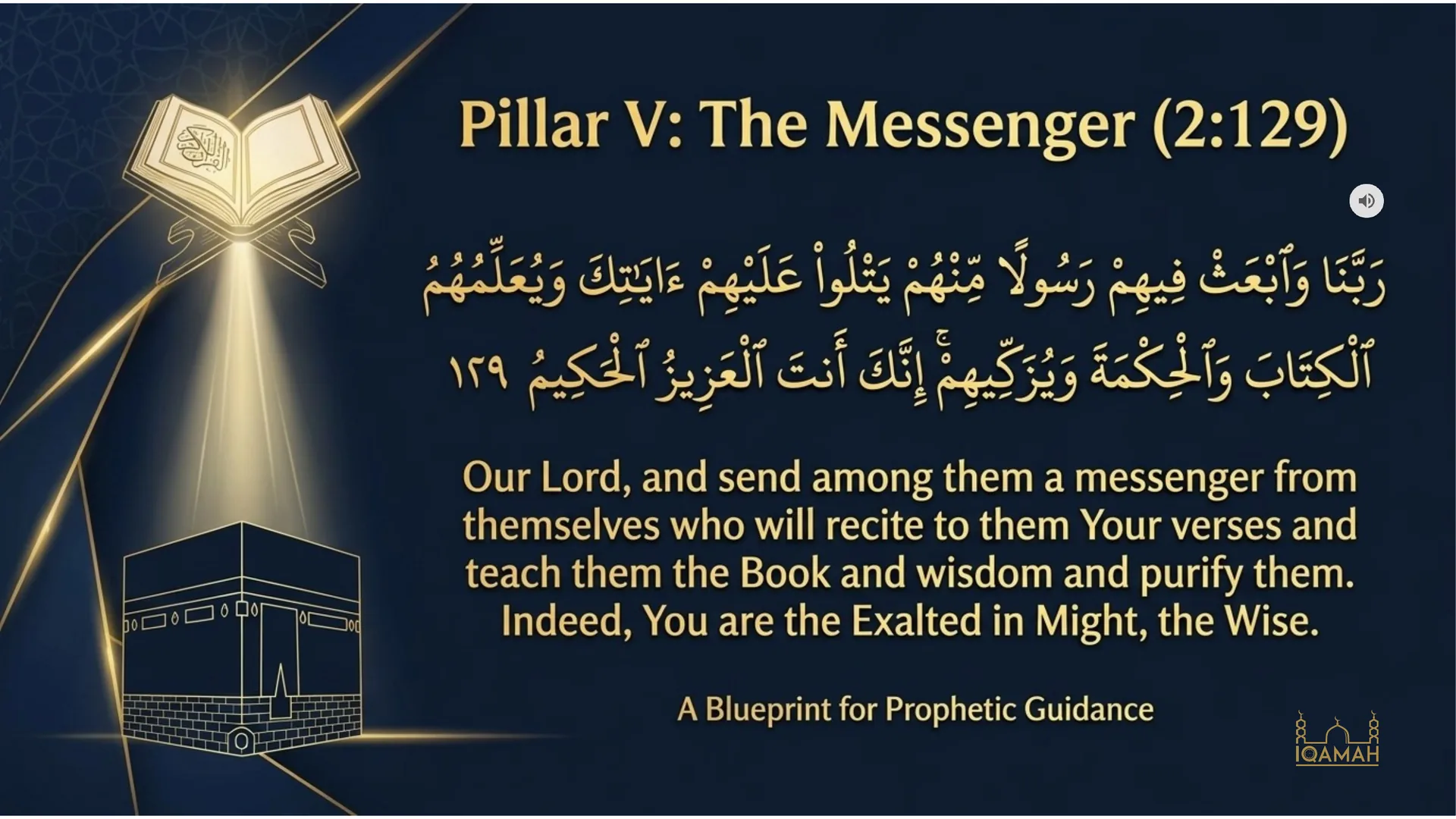
We arrive at the crown of the whole structure. Every foundation, every wall, every duʿāʾ for offspring has been building toward this final request.

رَبَّنَا وَٱبْعَثْ فِيهِمْ رَسُولًا مِّنْهُمْ يَتْلُوا۟ عَلَيْهِمْ ءَايَٰتِكَ وَيُعَلِّمُهُمُ ٱلْكِتَٰبَ وَٱلْحِكْمَةَ وَيُزَكِّيهِمْ ۚ إِنَّكَ أَنتَ ٱلْعَزِيزُ ٱلْحَكِيمُ

“Our Lord, and send among them a messenger from themselves who will recite to them Your verses and teach them the Book and wisdom and purify them. Indeed, You are the Exalted in Might, the Wise.”

Sūrah al-Baqarah 2:129 — Saheeh International

This is the duʿāʾ this entire dars has been ascending toward — and the very duʿāʾ whose answer we glimpsed on our second slide. Ibrāhīm and Ismāʿīl عليهما السلام ask not for wealth or dominion for their descendants, but for a Messenger to be raised among them. The mufassirūn note four works named for him, in their natural order: that he recite to them Allah’s āyāt; that he teach them the Book; that he teach them the wisdom — al-ḥikmah, understood by al-Imām al-Shāfiʿī and others as the Sunnah (al-Rāzī; Ibn Kathīr); and that he purify them — tazkiyah (al-Ṭabarī; Maʿāriful Qurʾān, pp.349–350).

Notice the scale of the ambition. Standing in an empty valley with a single son beside him, Ibrāhīm عليه السلام makes duʿāʾ for the highest possible good — not for himself, not even only for his children, but for all who would ever turn to this House in worship. This is the summit of the architecture: a structure raised by one family, crowned by a raḥmah sent to the worlds. The next slides will linger on this single āyah — on why the Messenger had to be “from themselves,” on his fourfold mission, and on the two majestic Names that seal the duʿāʾ.

Slide 10
Slide 10 of 29 #

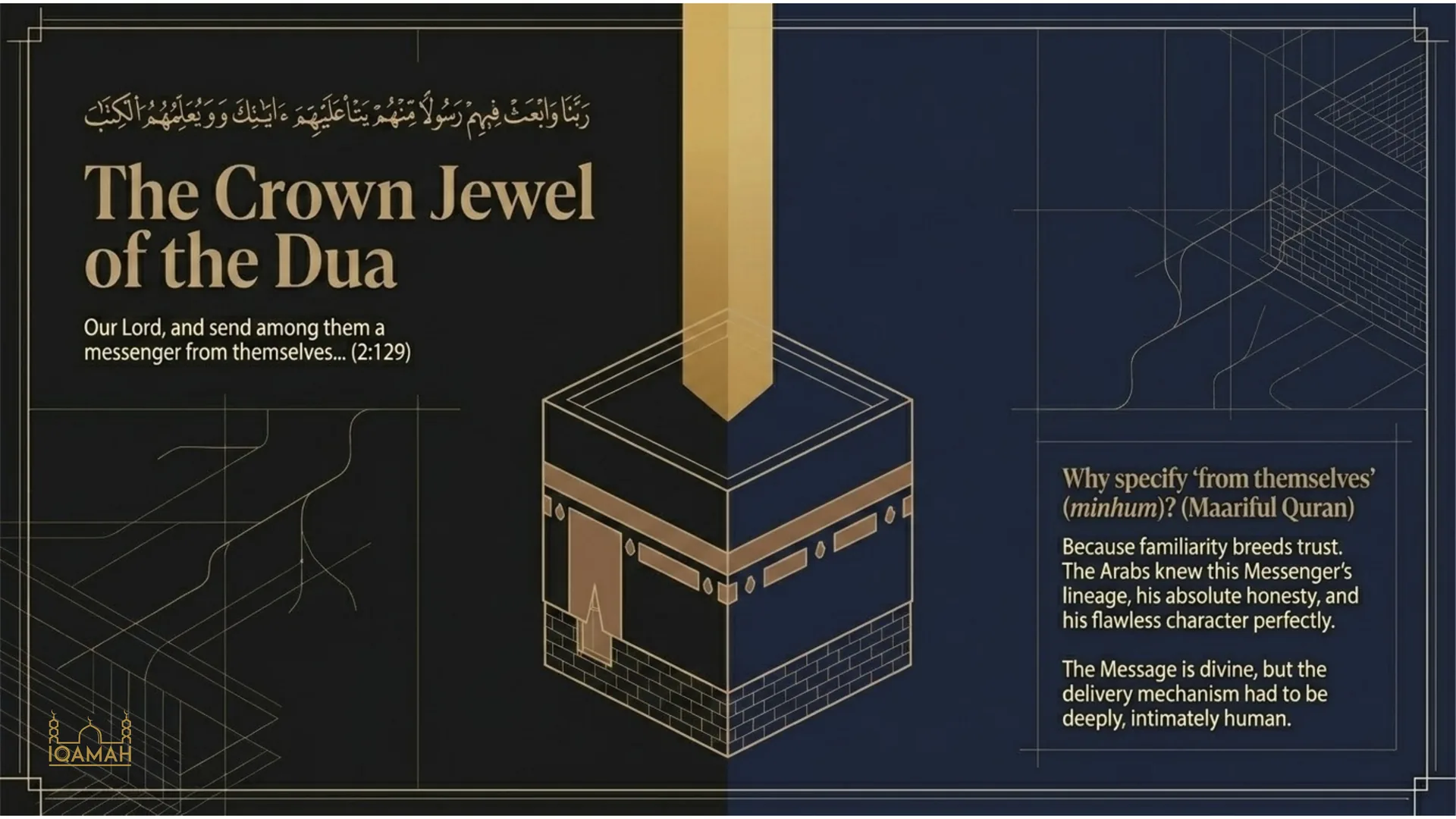
Let us linger on one precise word: “from themselves.” Having read the full āyah, notice that Ibrāhīm عليه السلام did not simply ask for a messenger, but for a messenger minhum — from among the very people he makes duʿāʾ for. Maʿāriful Qurʾān draws out why this matters: familiarity breeds trust. A people who had watched this man grow among them would know his lineage, his unblemished honesty, and his flawless character; they could not pretend not to know who he was (Maʿāriful Qurʾān).

Al-Rāzī gives three reasons folded into that single word. There is greater honour when the one sent and the ones he is sent to share a single origin. There is easier recognition of his ṣidq (truthfulness), because they have known his upbringing from childhood. And there is deeper compassion, for one of their own feels for them what a stranger never could (Mafātīḥ al-Ghayb). The message, in other words, is divine — but its delivery had to be intimately, recognisably human.

There is a tenderness in this for us as well. The Final Messenger ﷺ was not an abstraction descending from the sky, but a man who wept, who hungered, who carried the burdens of his ummah on his shoulders. When Ibrāhīm عليه السلام chose his careful word minhum, he was asking that hidāyah reach the human heart through a human face. That is the crown jewel of the duʿāʾ: not merely that the truth be sent, but that it be sent in a form a people could love.

Slide 11
Slide 11 of 29 #

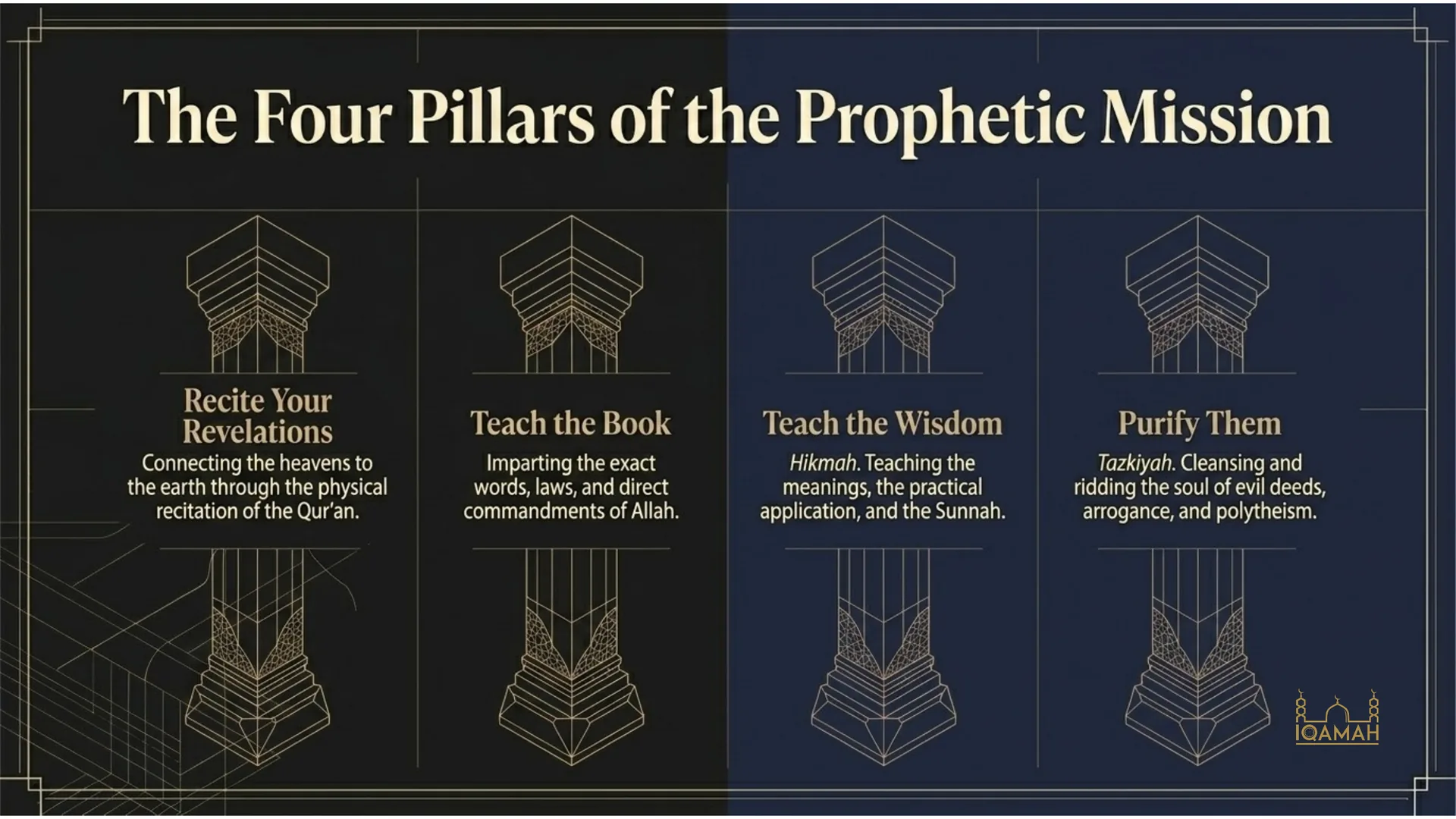
This slide unfolds the four works named in the Messenger’s mission, the four pillars of his prophetic task. Let us take them in the order the āyah gives them, for the order itself is instruction.

First, “he recites to them Your āyāt” — connecting heaven to earth through the very words of waḥy, conveyed exactly as they were received. Second, “he teaches them the Book” — imparting its words, its aḥkām, its direct commandments. Third, “and the ḥikmah” — which the mufassirūn explain as the meanings beneath the words, the practical application, and above all the Sunnah of the Prophet ﷺ; al-Rāzī traces ḥikmah to the root aḥkama, “to make firm,” so that ḥikmah is what makes knowledge solid and repels error (Mafātīḥ al-Ghayb; Maʿāriful Qurʾān, pp.349–350). Fourth, “and purifies them” — tazkiyah, the cleansing of the nafs of its diseases (Ibn Kathīr; al-Ṭabarī).

Notice the Urdu cognate, for it may help: ḥikmah is the very word that gives Urdu its hikmat — wisdom, and even the art of the ḥakīm, the healer. The Messenger ﷺ is sent as a physician of souls. Recitation, the Book, ḥikmah, and tazkiyah are not four separate errands but one continuous act of healing: words that descend, meanings that take root, and a heart that is cleansed so it can hold them. The next slide asks why tazkiyah had to come at all — and why, in the lived order of the soul, it often comes first.

Slide 12
Slide 12 of 29 #

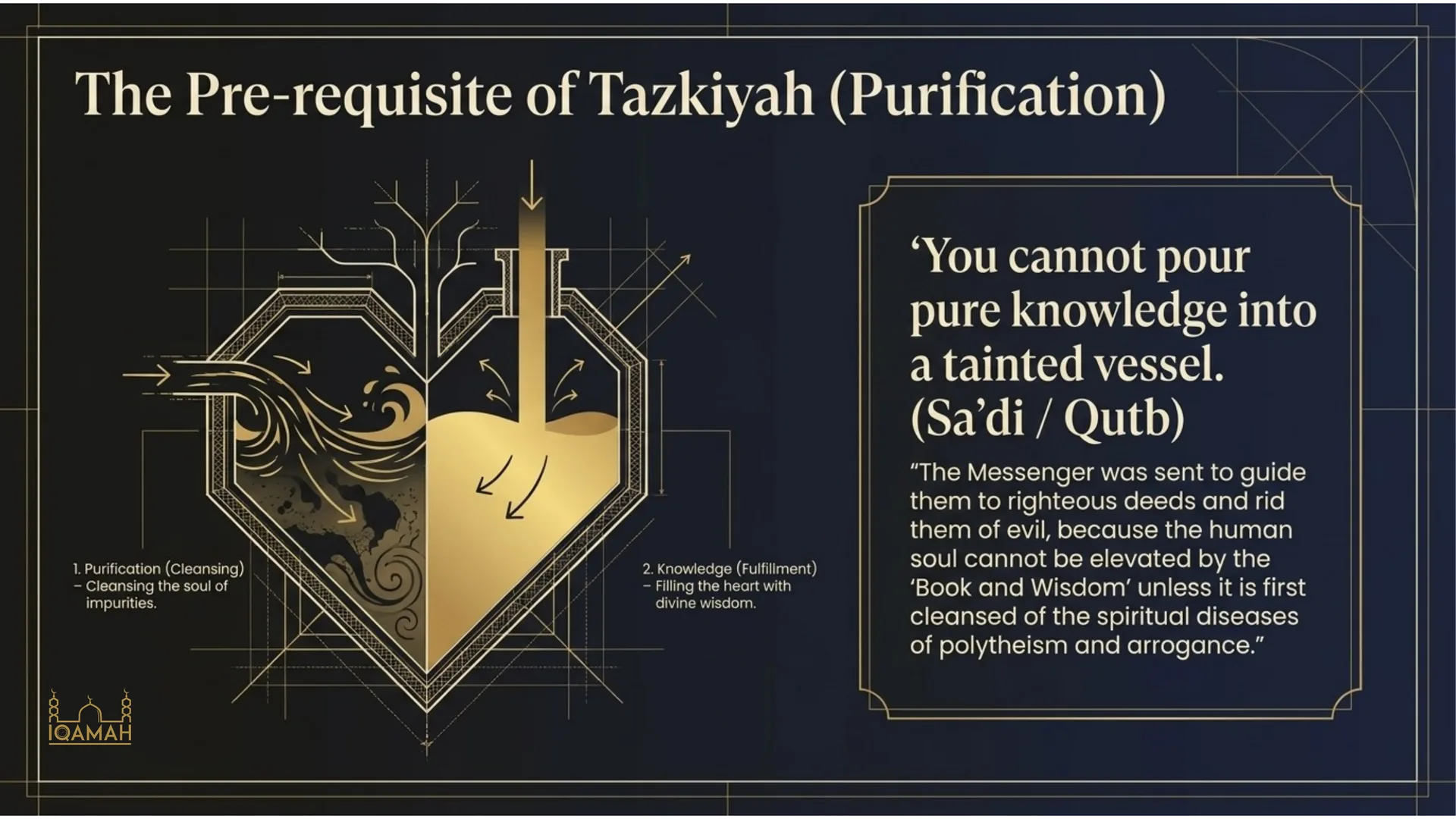
Let us pause on a paradox of order. In the āyah, “purifies them” is named last; but in the life of the soul, tazkiyah is the precondition for everything else. This slide captures it in a single line drawn from the spirit of al-Saʿdī and Sayyid Quṭb: you cannot pour pure knowledge into a tainted vessel.

Sayyid Quṭb reflects that the Messenger ﷺ was sent to guide people to righteous deeds and to rid them of evil, because the human nafs cannot be raised by “the Book and the Ḥikmah” until it is first cleansed of the spiritual diseases of shirk and kibr (arrogance) (Fī Ẓilāl al-Qurʾān). Knowledge poured into a heart still cluttered with pride, ḥasad, and the love of other-than-Allah simply spoils, the way clean water turns foul in a dirty cup. Tazkiyah — emptying and scouring the vessel — is what allows the water of waḥy to remain pure within it.

Hear in this the echo of where our dars began. On the third slide, Allah ﷻ charged Ibrāhīm and Ismāʿīl عليهما السلام to “purify My House.” Here, the Messenger ﷺ is sent to purify the worshippers themselves. The outer Kaʿba and the inner heart obey the same law: both must first be cleared of idols before they are fit for the presence of Allah ﷻ. The believer who would carry sacred ʿilm must therefore begin, always, with the cleansing of his own chamber.

Slide 13
Slide 13 of 29 #

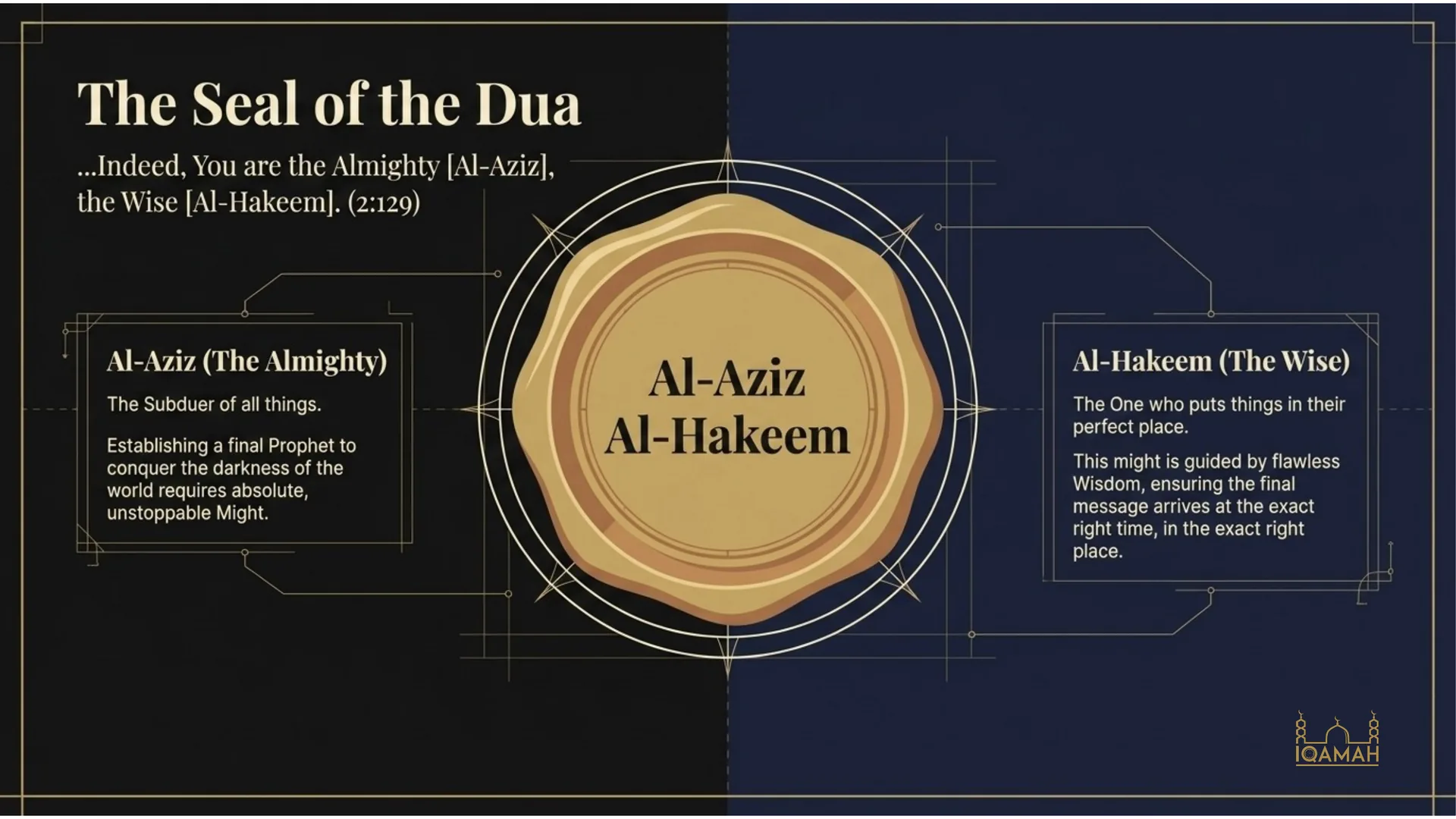
Let us read the seal. Every one of Ibrāhīm’s requests in this passage has closed with two of the Asmāʾ al-Ḥusnā, and the final duʿāʾ ends with al-ʿAzīz, al-Ḥakīm — the Almighty, the Wise. The mufassirūn teach that the Names a duʿāʾ closes with are not ornament; they are the grounds on which the request rests, a kind of tawassul — drawing near to Allah ﷻ through His attributes (al-Saʿdī, vol.1 p.144).

Consider how exactly the two Names fit this particular request. To raise up a Final Prophet who would conquer the darkness of the whole world requires absolute, unstoppable might — and so Allah is al-ʿAzīz, the Almighty, the Subduer of all things, before whom no power can stand. But raw might alone could send the message at the wrong moment or to the wrong place. So it is guided by al-Ḥakīm, the Wise, the One who puts every thing in its perfect place — ensuring the Final Message arrived at the exact right time, in the exact right valley, through the exact right man (Ibn ʿĀshūr; al-Saʿdī). Ibn ʿĀshūr notes how the closing Names function as a taʿlīl — a reasoned justification for everything the duʿāʾ has asked.

There is a quiet discipline here for our own duʿās. We are being taught to end our asking not with anxiety but with recognition — naming the very ṣifāt of Allah ﷻ by which our request can be granted. To seal a duʿāʾ with His Names is to remember Who it is we are asking.

Slide 14
Slide 14 of 29 #

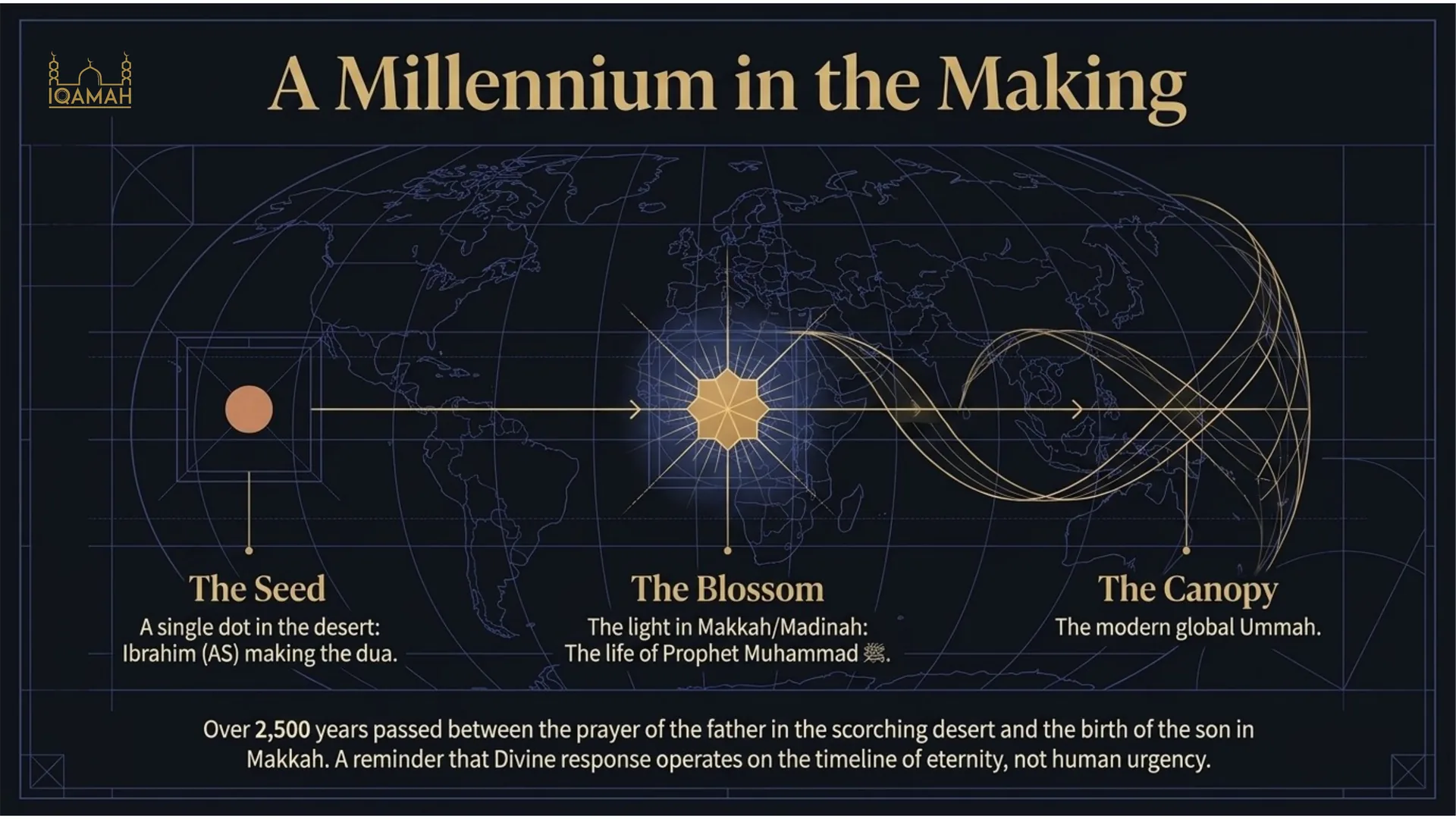
Step back now and take in the span of the whole. This slide measures the distance between the duʿāʾ and its answer, and the measurement is staggering.

The Seed: a single point in a scorching, empty desert — Ibrāhīm عليه السلام lifting his hands in duʿāʾ. The Blossom: a light kindled in Makkah and Madīnah, the life of the Prophet Muḥammad ﷺ. The Canopy: the modern global ummah, spread today across every continent on earth. Between the seed and the blossom, the mufassirūn and historians reckon well over two thousand years passed.

Let this reframe how we understand an answered duʿāʾ. We tend to measure the response in days and weeks, and to despair when a duʿāʾ seems to go unanswered within our own short horizon. But the divine response operates on the timeline of eternity, not the timeline of human urgency. Ibrāhīm عليه السلام never met the Messenger he made duʿāʾ for; he never saw the canopy his seed would become. He simply planted, in tawakkul, and returned the outcome to Allah ﷻ. We are, quite literally, the leaves of his answered duʿāʾ. When we lift our own hands and see no immediate change, this slide counsels ṣabr of a particular kind: the ṣabr of a planter who knows that some harvests are gathered by generations he will never meet — and that not one sincere word falls to the ground unheard.

Slide 15
Slide 15 of 29 #

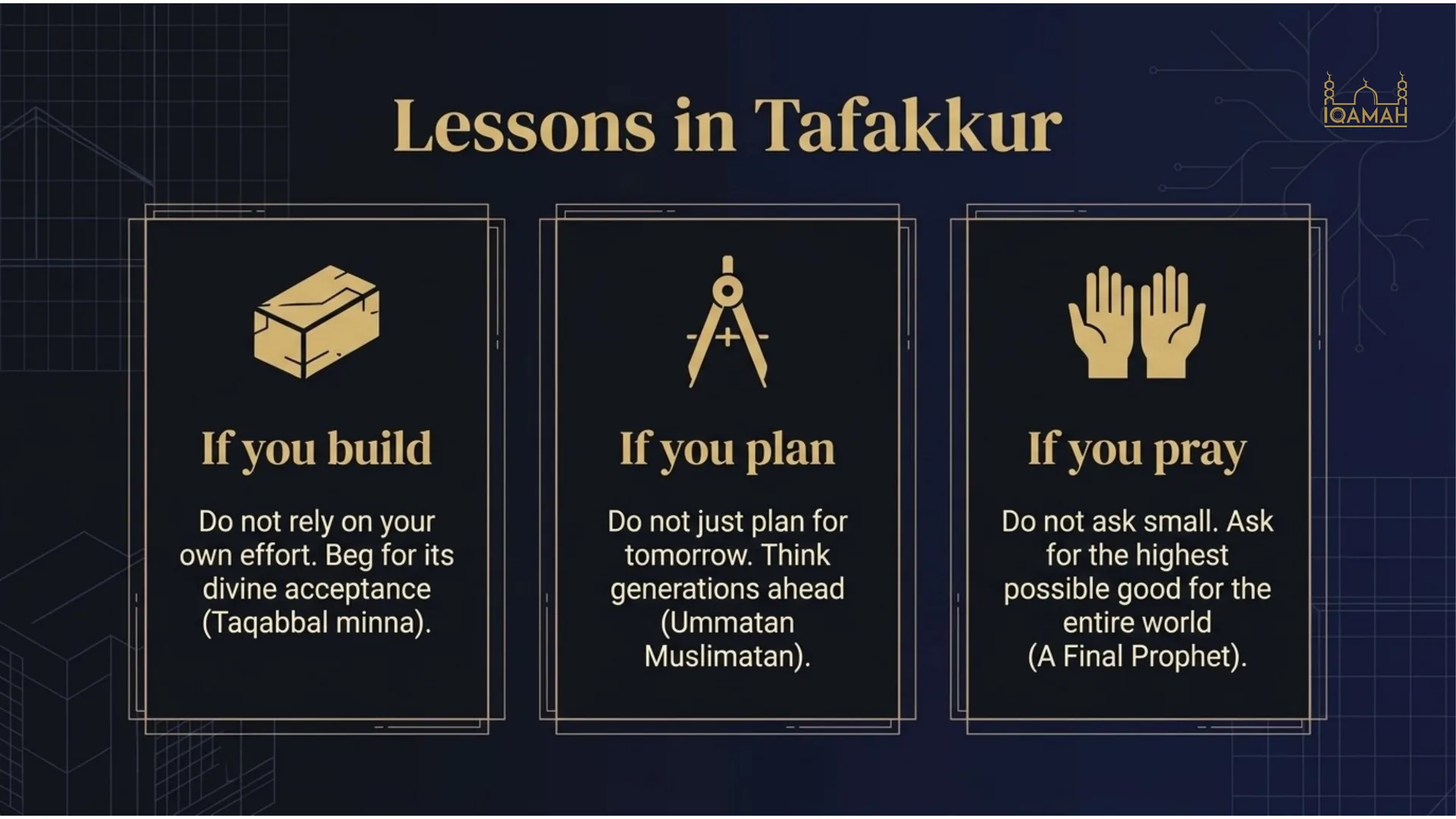
Before we close this first movement, let us gather what it asks of us. The deck distils three lessons of tafakkur — of reflective contemplation — and each draws directly on a phrase we have studied.

If you build, do not lean on your own effort; beg for its qabūl, its divine acceptance. This is taqabbal minnā — the duʿāʾ braided into the rising walls (2:127). The hands work; the heart still pleads. If you plan, do not plan only for tomorrow; think generations ahead. This is ummatan muslimatan — a Muslim nation drawn from descendants not yet born (2:128). The believer’s vision is measured not in years but in lineages. And if you make duʿāʾ, do not ask small; ask for the highest possible good for the entire world. This is the duʿāʾ for a Final Prophet — a single family in an empty valley asking for a raḥmah to the worlds (2:129).

Notice how these three move outward. From the work of one’s own hands, to the welfare of one’s dhurriyyah, to the good of all mankind — the believer’s concern keeps widening. The one who built the Kaʿba teaches us that humility, foresight, and ambition are not rivals but partners: be humble about what you achieve, far-sighted about whom you achieve it for, and audacious about what you dare to ask of Allah ﷻ. Carry these three out of this dars and into your own duʿās this very week.

Slide 16
Slide 16 of 29 #

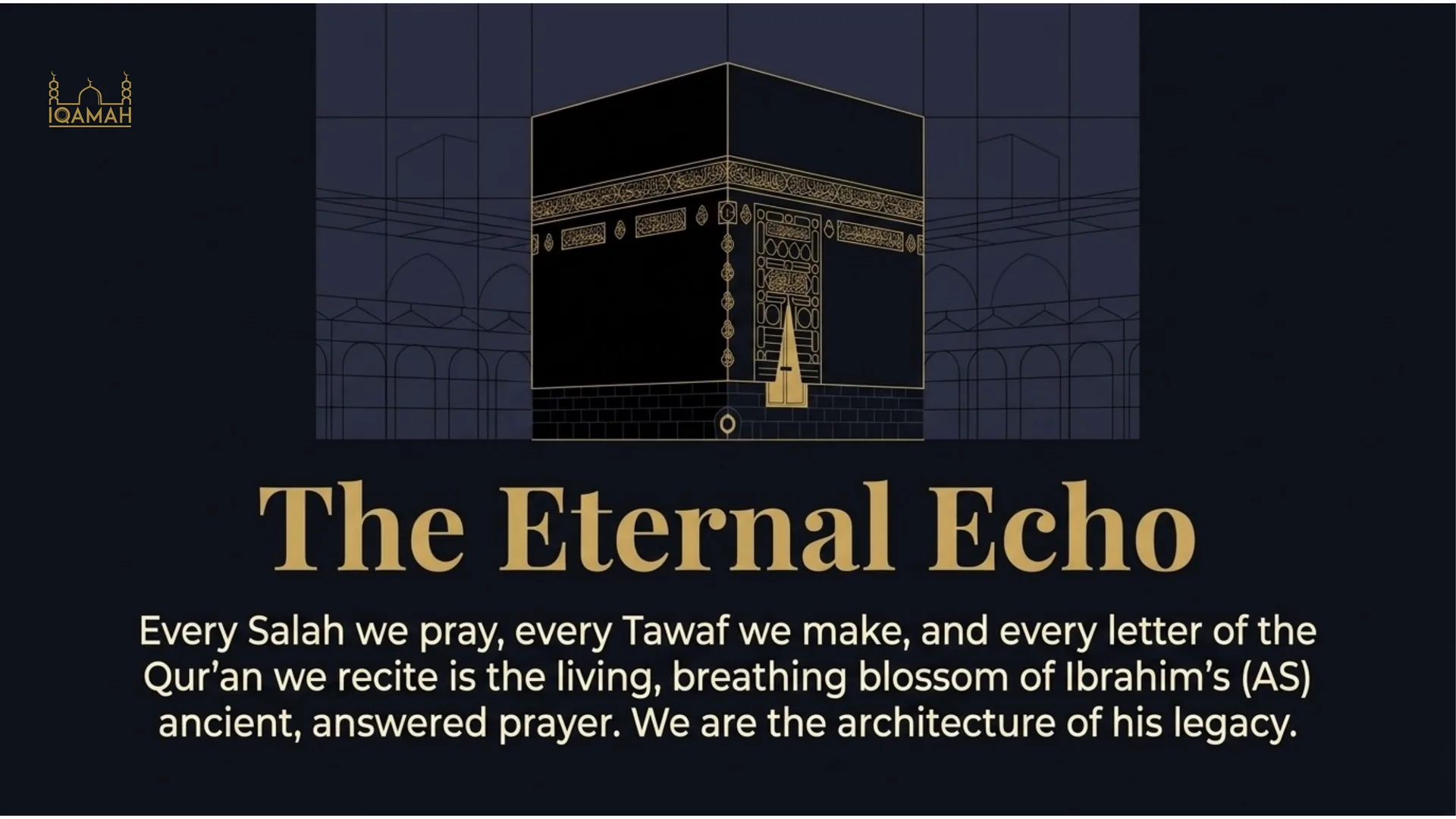
Let us close the first movement where we are standing right now — inside the answer. This final image returns us to the House itself, and gathers the whole arc into a single sentence: every Ṣalāh we pray, every Ṭawāf we make, and every letter of the Qurʾān we recite is the living, breathing blossom of Ibrāhīm’s ancient, answered duʿāʾ.

Sit with what that means. When you stand for Ṣalāh, you stand inside a duʿāʾ made in an empty valley before recorded history. When you circle the House, you trace the orbit its builder asked Allah ﷻ to make beloved to the hearts of the believers. When your tongue moves over the Qurʾān, you are the recitation he made duʿāʾ that his Messenger would bring. We did not merely inherit a dīn; we are the architecture of his legacy — the standing, worshipping proof that his duʿāʾ was heard.

And this turns us toward the second half of our dars. If the duʿāʾ of Ibrāhīm عليه السلام could raise an entire ummah across two thousand years, then we should learn to build our own lives the same way — with duʿāʾ as the blueprint. So we move now from the duʿās that built the House to a set of duʿās that build the believer: the essential supplications by which a Muslim raises the architecture of his own heart, home, and ultimate destiny.

Slide 17
Slide 17 of 29 #

We begin the second movement. Having watched how a single family’s duʿāʾ built a sanctuary and an ummah, we now turn the same architectural lens upon ourselves. This part of the deck gathers six foundational duʿās — drawn from the Qurʾān and the Sunnah — as the pillars of a believer’s own spiritual structure. Each is presented in four registers at once: the Arabic of waḥy, an Urdu rendering for the heart, an English translation for clarity, and a transliteration for the tongue still learning.

Let us preview the six pillars, so the movement reads as one building and not eight scattered cards. The first is the duʿāʾ for family — the duʿāʾ of ʿIbād al-Raḥmān, the servants of the Most Merciful, in Sūrah al-Furqān (25:74). The second is the duʿāʾ for a sound, unresentful heart toward the believers, from Sūrah al-Ḥashr (59:10). The third is the Shield — a single, longer prophetic duʿāʾ preserved by al-Tirmidhī, which we will read across three cards because of its length. The fourth asks that the Qurʾān itself become the rabīʿ (spring) of the heart (Musnad Aḥmad). The fifth asks for the maḥabbah of Allah ﷻ and of all that draws us to it (al-Tirmidhī). And the sixth is the duʿāʾ for clear sight of ḥaqq and bāṭil, a duʿāʾ beloved of the pious and associated with Shaykh al-Islām Ibn Taymiyyah.

As we move through them, keep the building in view: family is the ground floor, the purified heart is its sanctuary, the Shield is its defences, the Qurʾān its light, maḥabbah its engine, and clear sight its compass. Six duʿās; one well-built soul.

Slide 18
Slide 18 of 29 #

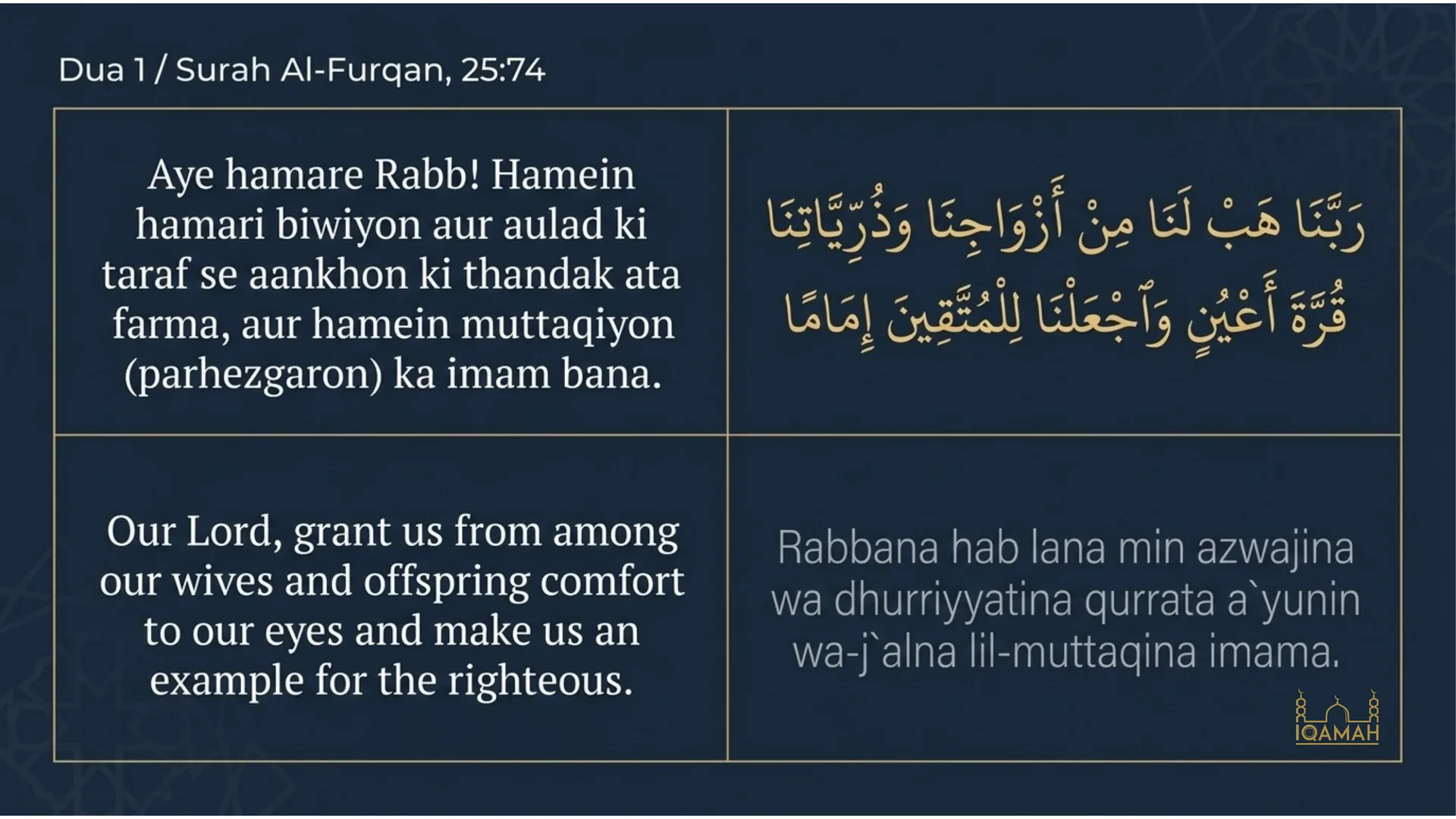
Our first pillar is the ground floor of any believing life: the family. This is the closing duʿāʾ of ʿIbād al-Raḥmān, the servants of the Most Merciful, whose long description ends in Sūrah al-Furqān with this request.

وَٱلَّذِينَ يَقُولُونَ رَبَّنَا هَبْ لَنَا مِنْ أَزْوَٰجِنَا وَذُرِّيَّٰتِنَا قُرَّةَ أَعْيُنٍ وَٱجْعَلْنَا لِلْمُتَّقِينَ إِمَامًا

“And those who say, ‘Our Lord, grant us from among our wives and offspring comfort to our eyes and make us an example for the righteous.’”

Sūrah al-Furqān 25:74 — Saheeh International

The phrase qurrata aʿyun — “coolness,” or comfort, of the eyes — is the Arabic idiom for the deepest delight. But notice for what they seek that delight. Al-Ḥasan al-Baṣrī was asked whether this coolness is in this dunyā or the next, and answered: in this dunyā — for nothing cools a believer’s eye more than to see his wife and child obedient to Allah ﷻ (Ibn al-Jawzī, vol.10 p.200; al-Zamakhsharī — language, citing the same from Muḥammad ibn Kaʿb). Ibn ʿAbbās رضي الله عنهما even described it as the joy of seeing one’s child learning the dīn (al-Zamakhsharī — language). So the duʿāʾ is not for children as worldly ornaments, but for righteous dhurriyyah — a request, al-Saʿdī notes, that returns its benefit to the parents themselves, since they will not rest until they see their household worshipping their Lord (al-Saʿdī, vol.7 p.56).

And the closing word is breathtaking in its ambition: “make us an example — imāman — for the muttaqīn.” These servants are not content to be saved; they ask to lead others in salvation. We will unfold that word on the next slide, where the architecture of this first pillar comes fully into view.

Slide 19
Slide 19 of 29 #

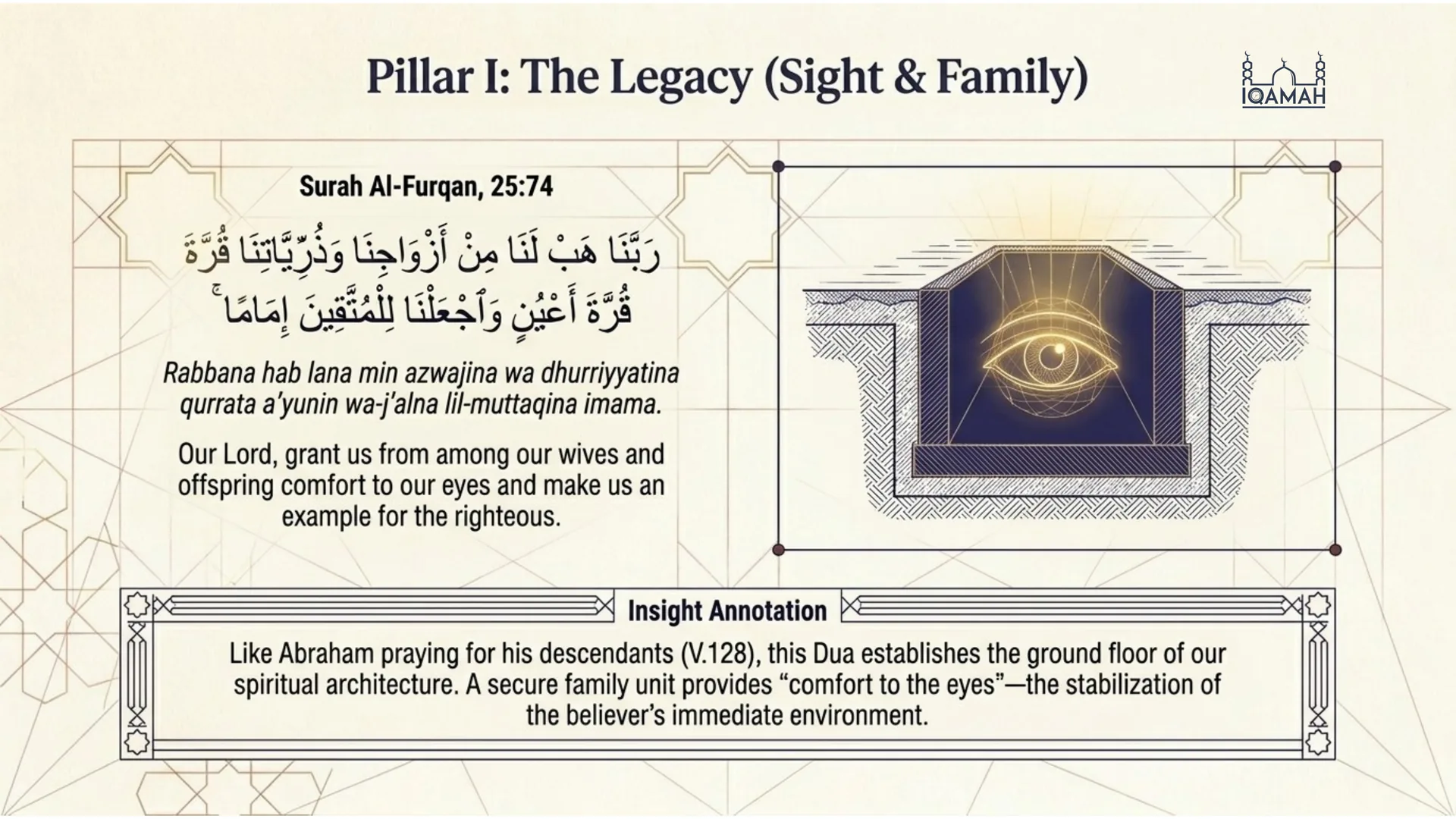
Let us build out the first pillar. On the previous slide we read the duʿāʾ of ʿIbād al-Raḥmān; here the deck frames it as the ground floor of our spiritual architecture. A secure, believing family provides the “comfort to the eyes” that stabilises the believer’s entire immediate environment — and, the slide notes, it mirrors Ibrāhīm’s own duʿāʾ for his dhurriyyah back in āyah 128. The pattern repeats: the godly always make duʿāʾ for those who will come after them.

The word that rewards reflection is imāman — “an example,” or leader, “for the muttaqīn” — and notice that it is singular, though the supplicants are many. Al-Zamakhsharī offers several explanations: that they intend the kind or genus of leadership; that each one asks to be made an imām; or that, in their unity of purpose, they ask to be made as if a single guide (al-Kashshāf — language). Ibn ʿAbbās رضي الله عنهما glossed it directly: “make us leaders who are followed in good” (Ibn al-Jawzī, vol.10 p.201).

But does asking for leadership not clash with the Qurʾān’s warning against craving high station (Sūrah al-Qaṣaṣ 28:83)? The mufassirūn answer with care. Ibrāhīm al-Nakhaʿī said the duʿāʾ seeks a character that others emulate in righteous deeds, so the reward multiplies; Makḥūl said it asks for such taqwā that even the pious draw from it; and al-Qurṭubī concludes that desiring a high station in the dīn, for the sake of the Ākhirah, is praiseworthy, while craving worldly exaltation is what stands condemned (Maʿāriful Qurʾān, p.501). To ask to be an imām of the muttaqīn, then, is to ask to be of benefit to Allah’s servants — the very opposite of vanity.

Slide 20
Slide 20 of 29 #

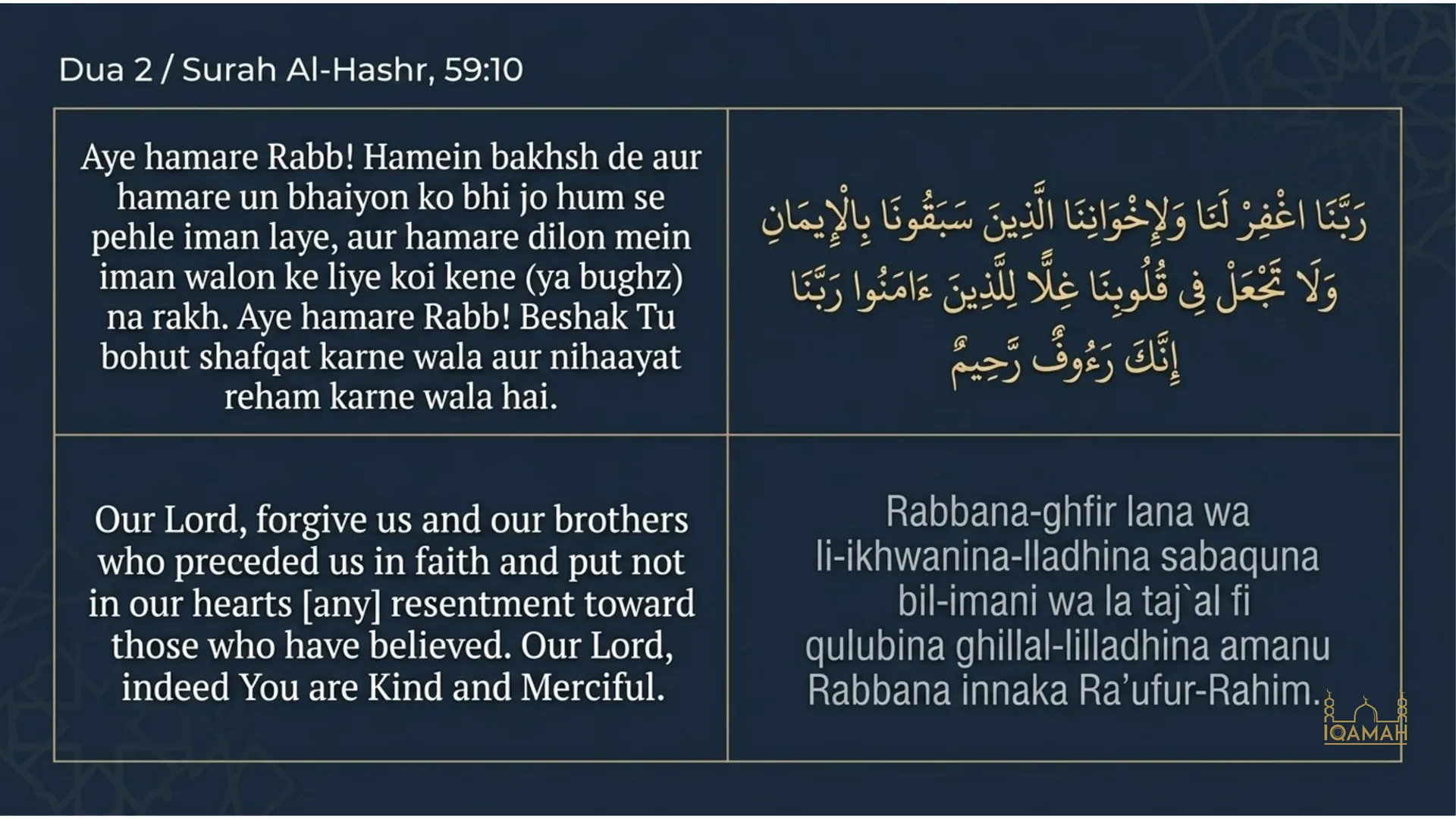
The second pillar moves from the home to the heart, and from our descendants to those who came before us. This is the duʿāʾ of the generations who inherited Islam from the Ṣaḥābah — which means it is our duʿāʾ.

وَٱلَّذِينَ جَآءُو مِنۢ بَعْدِهِمْ يَقُولُونَ رَبَّنَا ٱغْفِرْ لَنَا وَلِإِخْوَٰنِنَا ٱلَّذِينَ سَبَقُونَا بِٱلْإِيمَٰنِ وَلَا تَجْعَلْ فِى قُلُوبِنَا غِلًّا لِّلَّذِينَ ءَامَنُوا۟ رَبَّنَآ إِنَّكَ رَءُوفٌ رَّحِيمٌ

“And [there is a share for] those who came after them, saying, ‘Our Lord, forgive us and our brothers who preceded us in faith and put not in our hearts [any] resentment toward those who have believed. Our Lord, indeed You are Kind and Merciful.’”

Sūrah al-Ḥashr 59:10 — Saheeh International

Who are “those who came after them”? The mufassirūn answer: every believer down to the Day of Resurrection — the third great body of the ummah after the Muhājirūn and Anṣār (Ibn al-Jawzī, vol.13 p.118; al-Saʿdī, vol.10 p.60). Al-Saʿdī observes that this description — believers who seek maghfirah for those who preceded them in īmān and carry no rancour toward them — fits no group so well as Ahl al-Sunnah wa-l-Jamāʿah (vol.10 p.61). To inherit the faith is to love those who passed it down.

Notice the word ghill. It means rancour, a buried grudge or hatred (al-Zamakhsharī — language, glossing it as al-ḥiqd; Ibn Kathīr renders it rage or ḥasad). The duʿāʾ asks Allah ﷻ to keep the heart clear of it toward fellow believers. Maʿāriful Qurʾān, following al-Qurṭubī, notes that the āyah became a proof for the obligation of loving the Ṣaḥābah رضي الله عنهم: Imām Mālik held that one who harbours a grudge against them has no share in this āyah, and ʿĀʾishah رضي الله عنها lamented those who, “commanded to seek forgiveness for them, cursed them instead” (Maʿāriful Qurʾān, pp.397–398; Ibn Kathīr). The next slide builds this pillar out — the heart as a sanctuary that must be kept pristine.

Slide 21
Slide 21 of 29 #

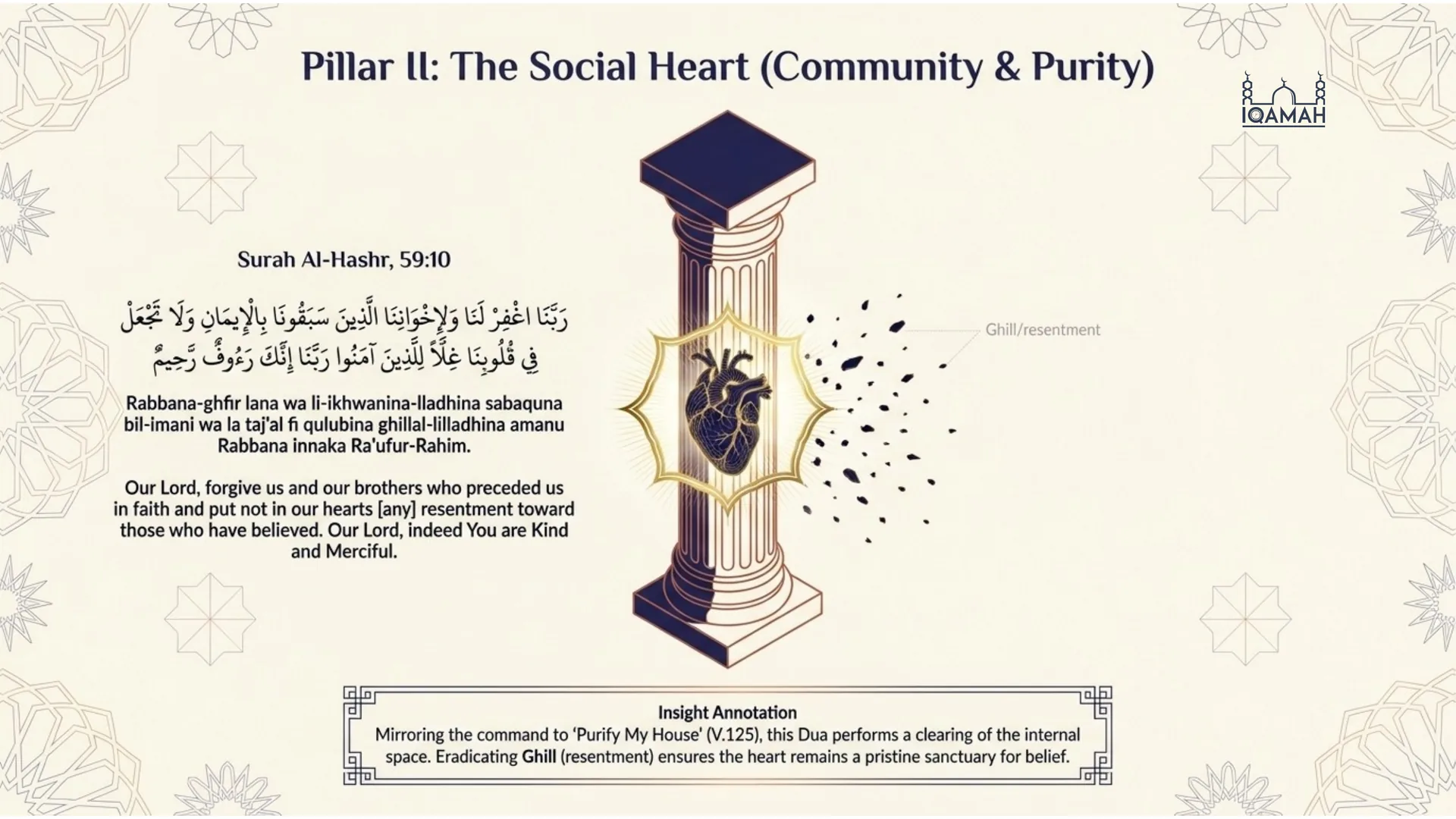
Let us complete the second pillar. This duʿāʾ, the slide observes, performs upon the heart exactly what Allah ﷻ commanded for the Kaʿba back in āyah 125: a purification. There the charge was “purify My House”; here the believer asks that his own inner house be cleared of ghill — resentment toward his brothers and sisters in īmān. The heart, like the sanctuary, must be swept clean before it is fit for ʿibādah.

Al-Saʿdī draws out a subtle point of logic: when the Qurʾān rules out a thing — here, rancour — it is affirming its opposite. To ask “put no resentment in our hearts” is to ask for its replacement: maḥabbah, loyalty, and sincere goodwill among the believers, which he calls the rights they hold over one another (al-Saʿdī, vol.10 p.61). The duʿāʾ is not merely defensive; it is the cultivation of a heart that actively warms toward every believer.

Sayyid Quṭb feels the breadth of it across time: this is “the strong bond that unites all generations of believers,” so that a Muslim remembers one who lived centuries earlier as warmly as a neighbour next door, with love and honour (Fī Ẓilāl al-Qurʾān, on this āyah). Here is the pillar, then: a social heart kept pure. A believer cannot raise a sound structure upon a foundation of grudges. To clear the chest of ghill — especially toward the best of this ummah, its first generations — is to keep the inner sanctuary pristine for the ʿibādah of Allah ﷻ.

Slide 22
Slide 22 of 29 #

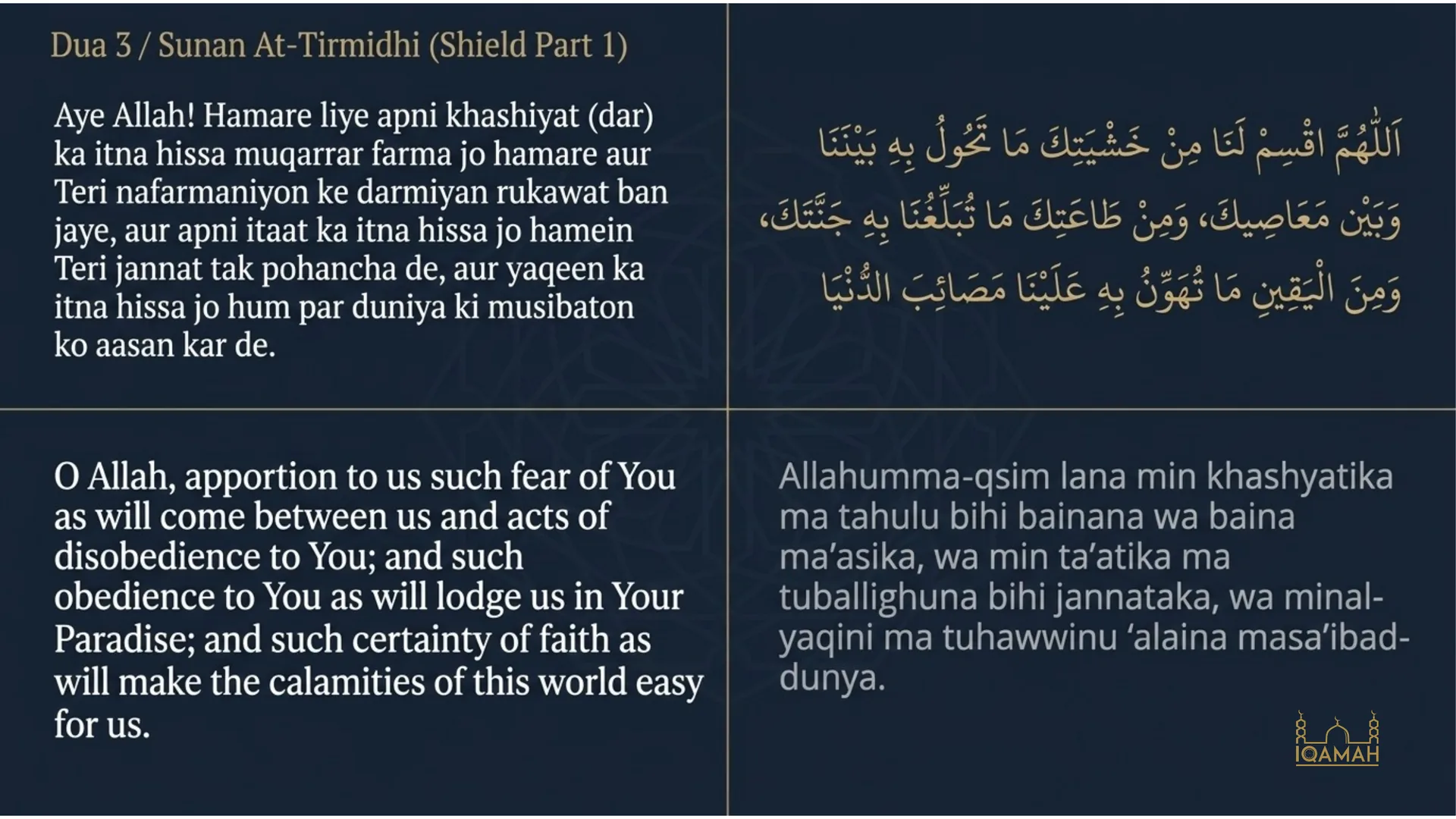
The third pillar is the Shield — a single, comprehensive duʿāʾ of the Prophet ﷺ that we will read across three cards because of its length. It is reported by al-Tirmidhī from Ibn ʿUmar رضي الله عنهما; al-Tirmidhī graded it ḥasan, though some later muḥaddithūn considered its chain weak. Its themes, in any case, are unimpeachably rooted in the Qurʾān and Sunnah, and it has been treasured by the ummah for centuries.

Notice where the Shield begins — with khashyah of Allah ﷻ. The opening petition asks: “O Allah, apportion to us such khashyah (fear) of You as will come between us and acts of disobedience to You.” This is the first line of defence. Khashyah here is not raw terror; it is the awe of a heart that loves and reveres Allah ﷻ, and that awe becomes a living barrier — standing, as the words say, between the servant and sin.

The duʿāʾ then rises from restraint to attainment: “and such ṭāʿah (obedience) to You as will lodge us in Your Jannah; and such yaqīn (certainty of faith) as will make the calamities of this dunyā easy for us.” See the architecture of the request: khashyah that fences out sin, ṭāʿah that carries us home, and yaqīn that absorbs every worldly blow. A heart anchored in yaqīn does not break under hardship, because it sees past the calamity to the One who decreed it and the reward held in store. This is the first wall of the Shield: a soul fortified from within.

Slide 23
Slide 23 of 29 #

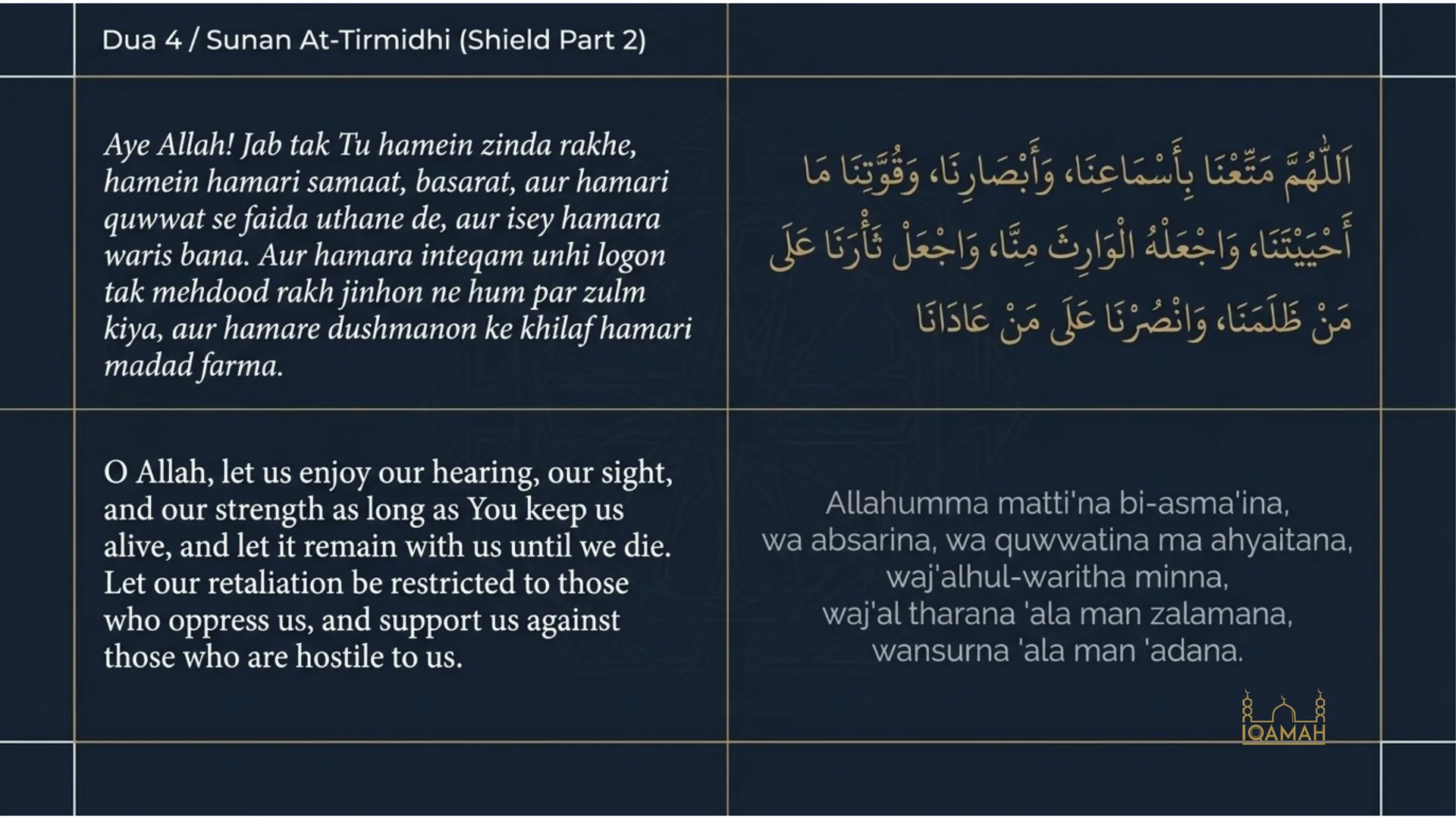
The Shield continues — the same prophetic duʿāʾ preserved by al-Tirmidhī — and now it turns to the gifts of this worldly life and how a believer should hold them.

Notice the shukr woven into the asking. “O Allah, let us enjoy our hearing, our sight, and our strength as long as You keep us alive, and let it remain with us until we die.” The believer does not take his faculties for granted; he asks that they be sound to the very end, and — beautifully — that they be “the inheritor from us,” meaning that these blessings outlast the trials of age and remain as a legacy of well-being. It is a duʿāʾ to be allowed to worship with a whole body for a whole lifetime.

Then the duʿāʾ turns outward, to the believer’s dealings with those who wrong him: “Let our retaliation be restricted to those who oppress us, and support us against those who are hostile to us.” Notice the precise ʿadl (justice) of it. He does not ask to triumph over everyone, nor to be free of all opponents; he asks that any response be measured and aimed only at genuine ẓulm, and that Allah ﷻ Himself be his support against real hostility. This is the Shield protecting the believer’s outward life — his health and his dealings — without ever spilling into vengeance. Īmān fortifies the soul within and disciplines the conduct without.

Slide 24
Slide 24 of 29 #

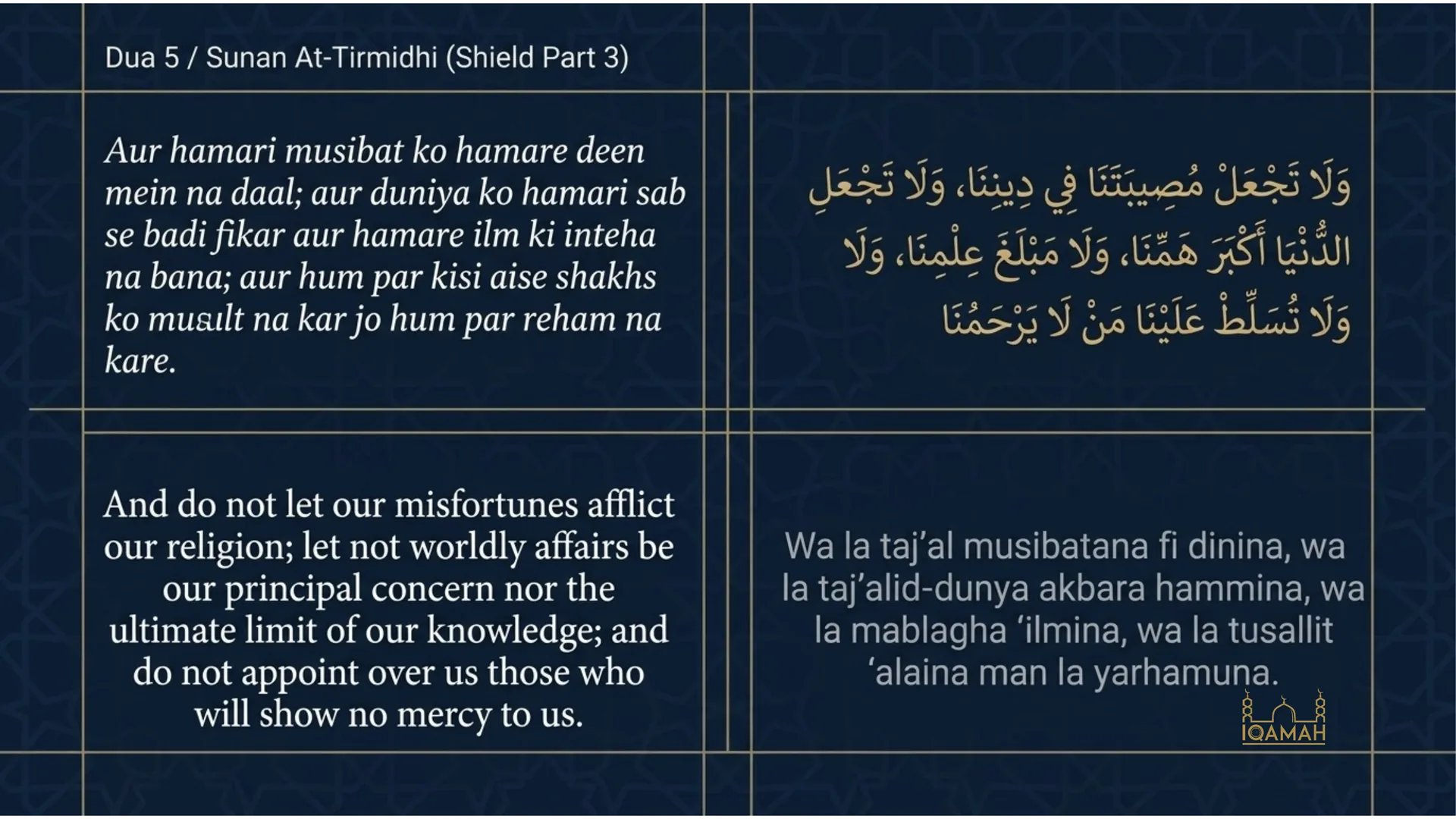
We reach the climax of the Shield — the final portion of al-Tirmidhī’s duʿāʾ — and here it guards the one thing more precious than life, health, or fortune: the dīn itself.

Listen to the order of priorities. “And do not let our misfortunes afflict our dīn.” A believer may lose wealth, health, or standing and still be whole, so long as the calamity does not reach his dīn. So the duʿāʾ asks that whatever trials strike, they be kept out of the one chamber that must never be breached — īmān. This is the innermost wall of the Shield.

Then two further petitions guard the heart’s priorities: “let not worldly affairs be our greatest concern, nor the ultimate limit of our knowledge.” The believer asks not to be a person whose largest worry is the dunyā, nor one whose horizon of learning ends at the worldly. And finally: “do not appoint over us those who will show no mercy to us” — a plea for protection from merciless authority, from rulers and powers that crush rather than shelter. Taken together, the three cards of this Shield move from the inner fortress of khashyah and yaqīn, through the disciplined conduct of daily life, to the final defence of the dīn against every storm. The next slide gathers the Shield into a single architectural image.

Slide 25
Slide 25 of 29 #

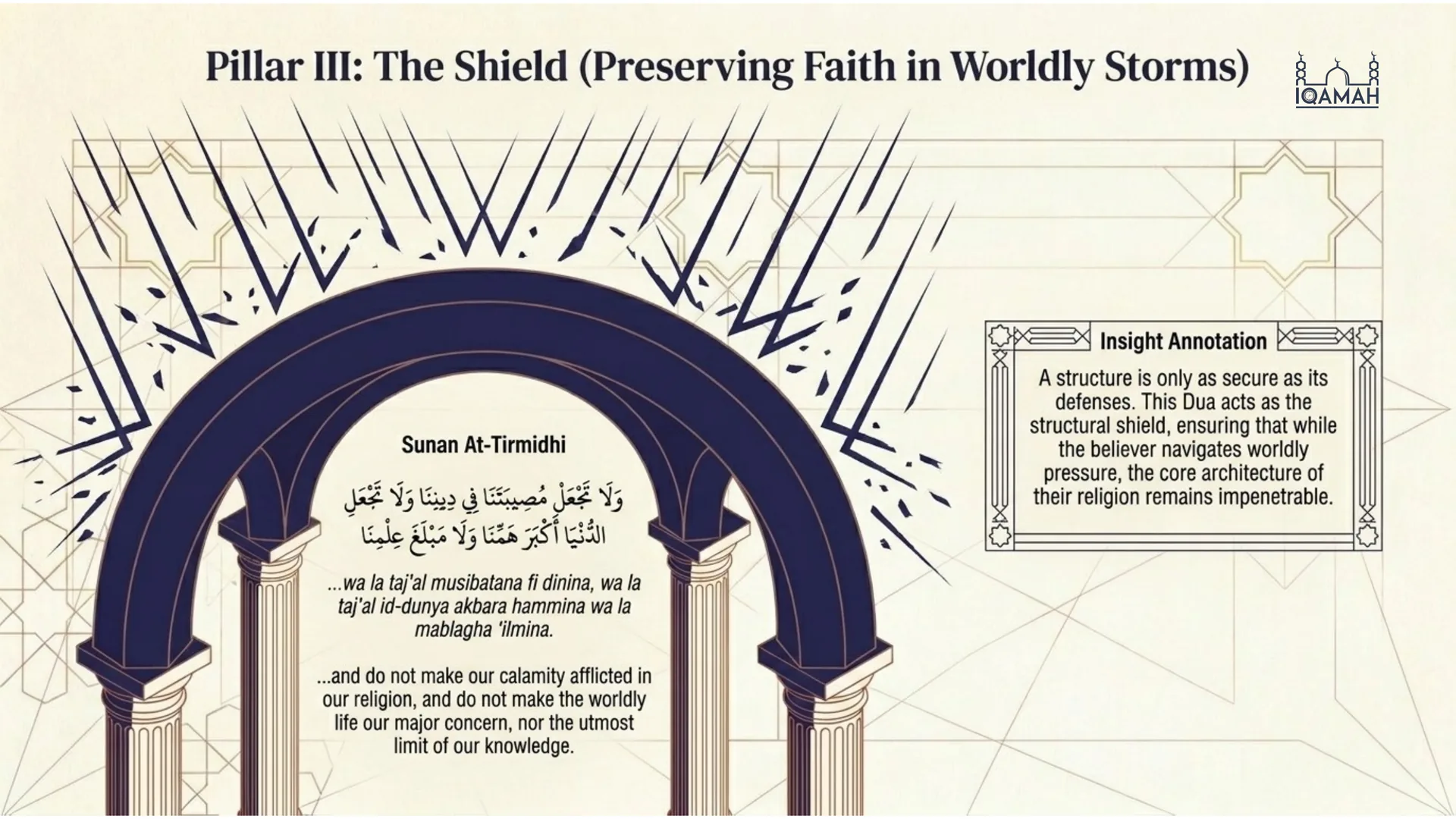
Let us step back and see the Shield whole. Across the last three cards we read one long prophetic duʿāʾ; this slide renders it as the structural defences of the believer’s building. A structure, after all, is only as secure as its defences — and this duʿāʾ ensures that while the believer navigates the pressures and storms of the dunyā, the core architecture of his dīn remains impenetrable.

Trace the design once more. The Shield began at the foundation of the inner life — a khashyah of Allah ﷻ that bars the door to disobedience, a ṭāʿah that carries the servant toward Jannah, and a yaqīn that makes worldly calamity bearable. It then extended outward to protect the believer’s health, faculties, and dealings, disciplining even his response to those who wrong him so that ʿadl never curdles into revenge. And it culminated in the deepest defence of all: that no misfortune be allowed to reach his dīn, that the dunyā never become his greatest concern, and that no merciless power be set over him.

Notice what kind of duʿāʾ this is. It is not a request to be spared all hardship — for hardship is woven into this dunyā — but a request that hardship never breach the walls that matter. This is the mature petition of a believer who expects storms and asks, above all, that his īmān outlast them. Build your defences in calm weather, this pillar teaches, by making such duʿāʾ a habit of the tongue long before the storm arrives.

Slide 26
Slide 26 of 29 #

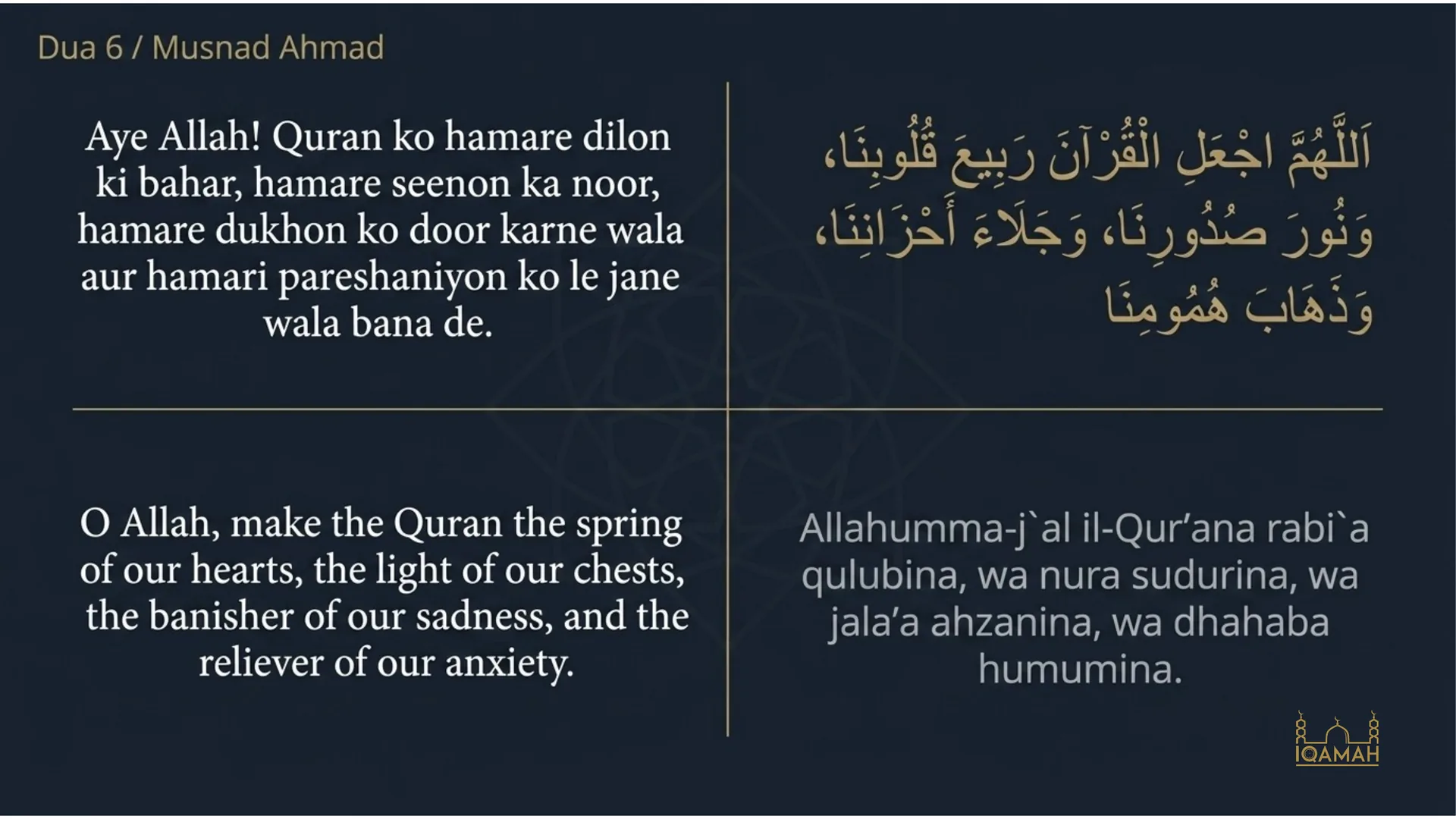
The fourth pillar brings light into the building: the duʿāʾ that the Qurʾān itself become the life of the heart. It is reported in the Musnad of Imām Aḥmad from Ibn Masʿūd رضي الله عنه, and a number of scholars have graded it authentic. It is among the most beloved adʿiyah for grief and anxiety.

Notice the central image — rabīʿ, “the spring.” “O Allah, make the Qurʾān the rabīʿ (spring) of our hearts.” In Arabic, rabīʿ is the season of spring rain that revives the dead earth and brings it into bloom. The believer asks that the Qurʾān do to his heart what the spring rains do to barren land: soften it, green it, bring it back to life. This is the same imagery that ran through our first movement — the barren valley made to blossom — now turned inward upon the soul.

The duʿāʾ continues: “the light of our chests, the banisher of our sorrow, and the reliever of our anxiety.” See how it gathers the Qurʾān’s effects: it is nūr for the chest, dispelling the darkness of confusion; it is the remover of ḥuzn, the grief that weighs on the past; and the reliever of hamm, the anxiety that frets over the future. A heart watered by waḥy is neither crushed by what has passed nor terrified by what is coming. This pillar recalls the charge to “purify My House”: the inner sanctuary, once cleared, is now to be filled — not with our own restless thoughts, but with the living words of Allah ﷻ.

Slide 27
Slide 27 of 29 #

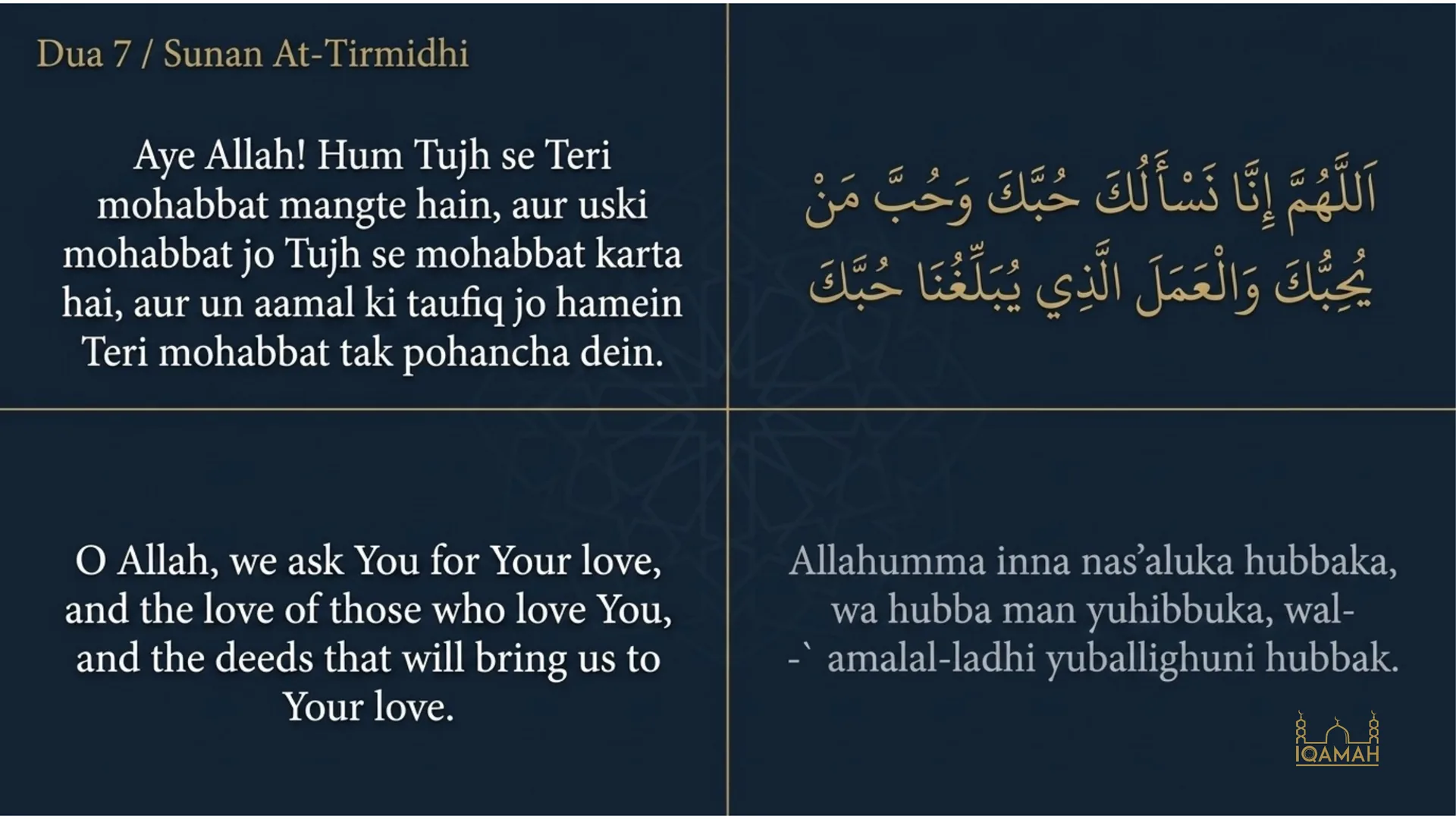
The fifth pillar is the engine that drives the whole structure: maḥabbah, love. This duʿāʾ is part of the famous ḥadīth of the “dispute of the highest assembly” (al-mala al-aʿlā), reported by al-Tirmidhī, who graded it ḥasan ṣaḥīḥ — a vision in which the Prophet ﷺ was taught the most beloved means of nearness to Allah ﷻ.

Notice the three loves the duʿāʾ asks for, in sequence. “O Allah, we ask You for Your love, and the love of those who love You, and the deeds that will bring us to Your love.” First, the maḥabbah of Allah Himself — the root of every good. Second, the love of those who love Him — for the ṣuḥbah we keep shapes the heart, and to love the lovers of Allah is to be drawn into their orbit. And third, the love of the very deeds that carry us toward His love — so that ʿibādah becomes not a burden grimly borne but a delight sincerely desired.

See the ḥikmah of the order. The believer does not merely ask to love Allah ﷻ; he asks for the means of that love — righteous companions and beloved deeds — so that the love is fed and sustained rather than left to flicker. Where the Shield protected the believer and the Qurʾān illuminated him, this pillar sets him in motion. A structure may be secure and well-lit, but without maḥabbah it is cold and still. Ask Allah ﷻ, this duʿāʾ teaches, not only to be obeyed but to be loved — and to make the path to His love itself a thing you love to walk.

Slide 28
Slide 28 of 29 #

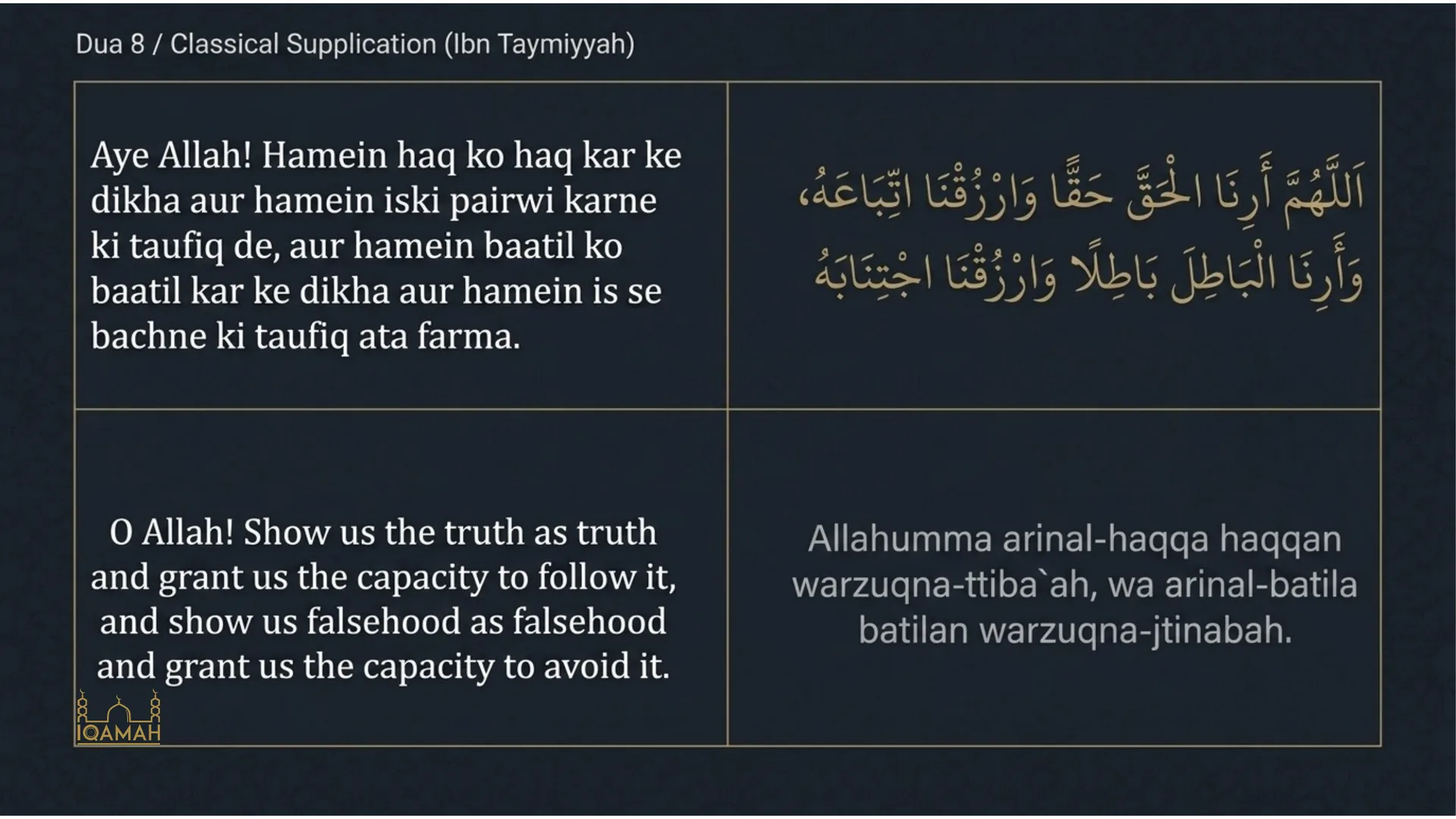
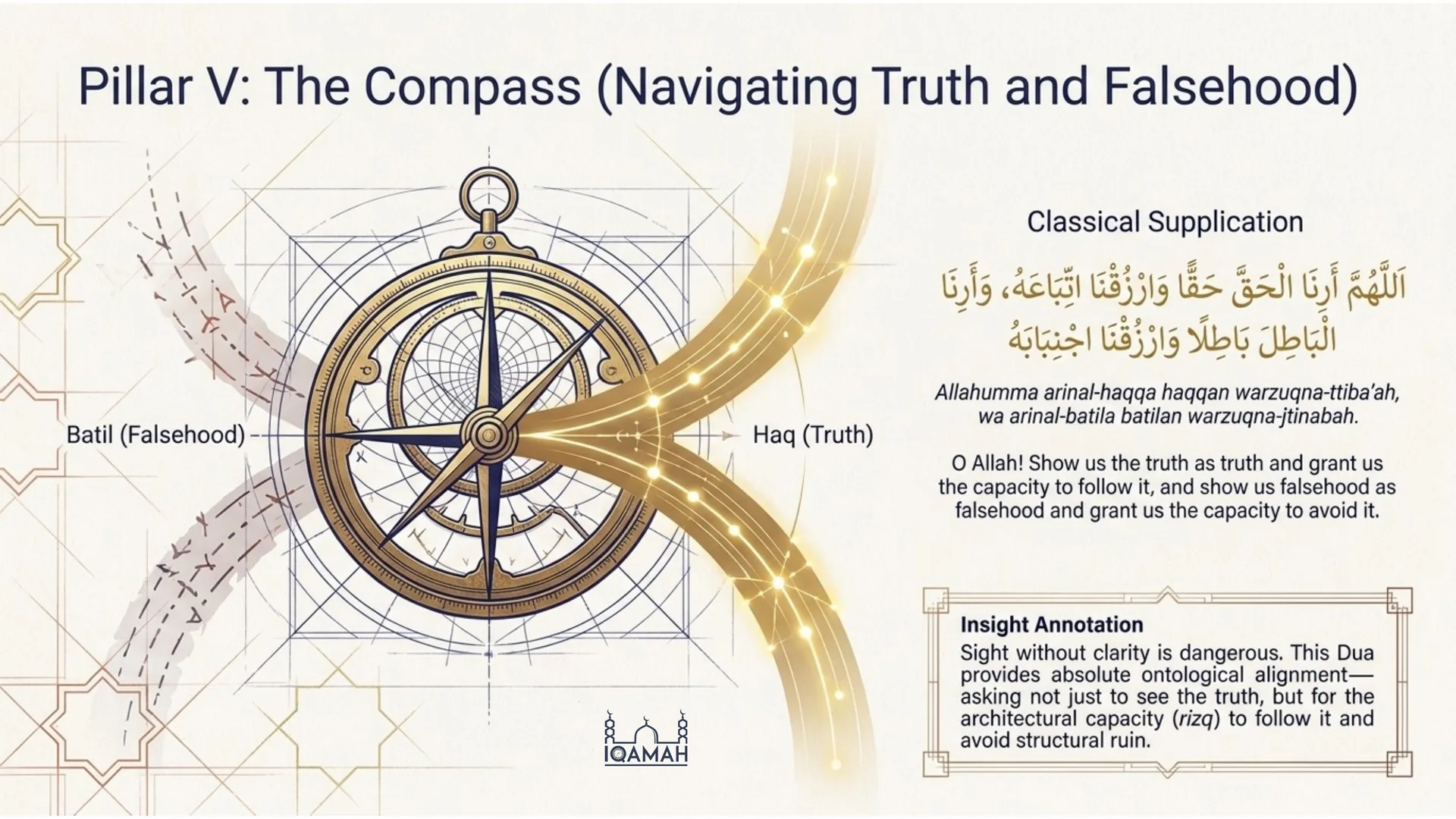
The sixth and final pillar is the compass: clear sight of ḥaqq and bāṭil. A word of honesty about its source, in keeping with our discipline of citation — this beloved duʿāʾ is not authentically traced to the Prophet ﷺ as a ḥadīth; it is a cherished duʿāʾ of the pious, widely associated with Shaykh al-Islām Ibn Taymiyyah, and the slide rightly labels it a “classical supplication.” Its meaning is sound and its need is universal.

Notice that it asks for two things about each of two things. “O Allah, show us the ḥaqq (truth) as truth, and grant us the capacity to follow it; and show us bāṭil (falsehood) as falsehood, and grant us the capacity to avoid it.” For the ḥaqq, the believer asks first to see it clearly — for much error is simply truth misperceived — and then for the rizq, the provision, to actually follow it. And for bāṭil, he asks both to recognise it for what it is and to be given the strength to keep away. Four petitions, perfectly balanced: sight and capacity, for both ḥaqq and bāṭil.

Notice the realism in asking separately for sight and for capacity. It is possible to see the ḥaqq and yet lack the strength to follow it; it is possible to know a thing is bāṭil and still be dragged toward it. So the duʿāʾ does not stop at clarity; it asks Allah ﷻ for the inner rizq to act on what one sees. This is the compass that keeps the whole building oriented. The final slide will gather this pillar — and the entire dars — into a closing duʿāʾ.

Slide 29
Slide 29 of 29 #

Let us bring our dars to a close. This last pillar is the compass, and its lesson is sharp: sight without clarity is dangerous. It is not enough to have eyes; one can look directly at the ḥaqq and mistake it for bāṭil, or gaze at bāṭil and find it beautiful. So this duʿāʾ asks for absolute alignment — not merely to see the ḥaqq, but to be granted the inner rizq to follow it, and to avoid the ruin that following bāṭil brings.

And here our two movements meet. We began with Ibrāhīm عليه السلام building a House of stone and braiding every course of it with duʿāʾ — “Our Lord, accept from us.” We end with the believer building a house of the soul, and learning to braid it with the same thread. The architecture is the same. The ground floor is a righteous family; the sanctuary is a heart swept clean of ghill; the walls are the Shield of khashyah, ṭāʿah, and yaqīn; the light within is the Qurʾān made the rabīʿ of the heart; the engine is the maḥabbah of Allah ﷻ and of all that draws us to Him; and the compass is clear sight of ḥaqq and bāṭil. Six duʿās, one well-built soul.

So let us close as Ibrāhīm عليه السلام closed — with our hands lifted and our work returned to its Owner. O Allah, accept from us the building of our days; secure our families and make them a coolness to our eyes; purify our hearts of every ghill; shield our dīn from every storm; make Your Book the rabīʿ of our hearts and the nūr of our chests; grant us Your maḥabbah and the love of those who love You; and show us the ḥaqq as truth and grant us to follow it, and the bāṭil as falsehood and grant us to shun it. Innaka anta as-Samīʿ al-ʿAlīm — al-ʿAzīz, al-Ḥakīm. Āmīn. Wa ṣallallāhu ʿalā Sayyidinā Muḥammadin wa ʿalā ālihi wa ṣaḥbihi ajmaʿīn.