Iqamah

Resources · Quranic Studies

Akhir Al-Zaman & The Sacred Continuum

An Orthodox Analysis of the Apocalyptic Timeline and the True Promise of Al-Aqsa

A reading of the end-times material in the Qurʾān and Sunnah through the gate of Bayt al-Maqdis and Masjid al-Aqṣā — the sanctuary the Prophet ﷺ called the spiritual barometer of the world. The session walks the apocalyptic timeline from the major signs and the Mahdī, through the Dajjāl and the return of ʿĪsā (ʿalayhi al-salām), to the Day of Judgment and the true inheritance — Paradise.

Slides 27
Format Slides + notes
Topic End Times
Cover slide: Akhir Al-Zaman & The Sacred Continuum
Slide 1
Slide 1 of 27 #

Bismillāh, wa-l-ḥamdu lillāh, wa-l-ṣalātu wa-l-salāmu ʿalā Rasūlillāh. Tonight we set out on the horizon of ākhir al-zamān — the end of time — and we read it through the gate of one sacred place: Bayt al-Maqdis and Masjid al-Aqṣā. The title before you names a 'sacred continuum,' and that is the single thread I want us to hold from the first slide to the last. From the first raising of the sanctuary by the Prophets of old, through its two destructions and its liberations, down to the final unfolding of the Hour, there runs one unbroken divine plan — and Bayt al-Maqdis is the barometer by which we read it.

Let me say a word about how we will study this, because the method matters as much as the material. Knowledge of the Hour belongs to Allah alone. He says in Sūrat al-Aʿrāf, 'They ask you about the Hour: when is its arrival? Say: its knowledge is only with my Lord' (7:187), and in Luqmān, 'Indeed, Allah — with Him is knowledge of the Hour' (31:34). So we do not gather here to fix dates; setting a date for the Hour is something the Sharīʿah forbids, and every generation that has tried has been humbled. We gather instead to read the ashrāṭ al-sāʿah — the signs of the Hour — so that the heart wakes up and prepares.

What makes our position unique is this: the Prophet ﷺ was given, in the Qurʾān and in the authentic Sunnah, a sequence of the great end-time events more ordered and more detailed than any nation before us ever received. Our task across these slides is threefold — to recognise that order, to distinguish firmly what is established in the Book and the Ṣaḥīḥ corpus from what is the interpretation of later scholars, and to let the whole picture move us toward taqwā and readiness. Throughout, we lean above all on the great narration of al-Nawwās ibn Samʿān in Ṣaḥīḥ Muslim, which lays the Dajjāl, the descent of ʿĪsā, and Yaʾjūj wa Maʾjūj in sequence, and on Ibn Kathīr's al-Bidāya wa-l-Nihāya for the history and the malāḥim.
Slide 2
Slide 2 of 27 #

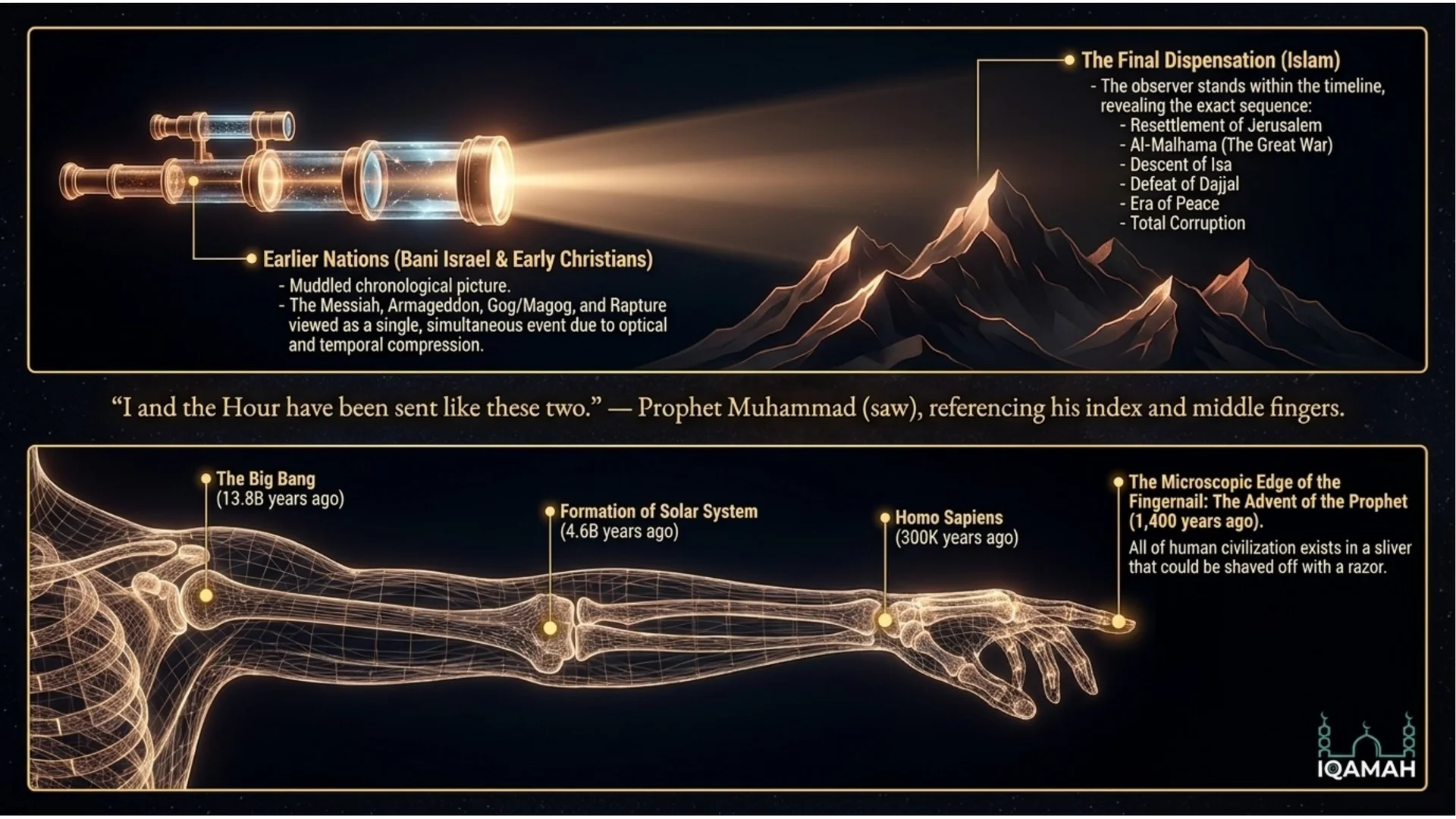
Begin with how near we truly are. The Prophet ﷺ raised his two fingers — the forefinger and the middle finger together — and said, as recorded in al-Bukhārī and Muslim, 'I was sent, and the Hour, like these two.' Reflect on the image: there is no finger between those two. And just as no finger stands between them, no Prophet stands between Muḥammad ﷺ and the Day of Judgement. He is the seal — al-khātam — and the entire remaining story of mankind is that narrow gap between the two fingertips.

The illustration on the slide — the 'arm of time' — is a way to feel that nearness in our bones. Imagine the whole age of the cosmos laid along a human arm: the Big Bang at the shoulder, the forming of our solar system near the elbow, the first of mankind only at the final knuckle, and the coming of the Prophet ﷺ at the very edge of the fingernail — a sliver so thin you could shave it off with a razor, and on it sits the whole of recorded human history: Babylon, the Pyramids, Rome, the Caliphates, the modern age, all of it. I caution you not to fix on the exact scientific figures; they are not the point, and we need not stake anything upon them. The point is the lesson of those two fingers — the nearness of the Hour, and the weight that lays upon us as the final Ummah, who have no Prophet to come after to set things right.

There is a second reason earlier nations could not read the end as clearly as we can, and the slide captures it with the telescope and the mountains. When you look at a great mountain range from far off, the peaks appear stacked flat against one another; the deep valleys between them vanish from sight. So it was with the peoples before us. Banī Isrāʾīl knew a Messiah would come and a kingdom of peace would be established, but the sequence and the spacing of events were invisible to them. The early followers of ʿĪsā glimpsed even more — a returning Messiah, a great deceiver, a final war, Gog and Magog, a Day of Judgement — but they collapsed it all into one jumbled, imminent moment, and at every turn of a century expected the end at once. Only in the final revelation did the valleys open and the order appear. And here is our privilege: we now stand inside the range itself, walking the valleys between the peaks, watching some prophecies already fulfilled and others unfolding before our eyes. This is why the Prophet ﷺ urged that his words be carried to those who come after, 'for perhaps one to whom it is conveyed will understand it better than the one who heard it.'

Slide 3
Slide 3 of 27 #

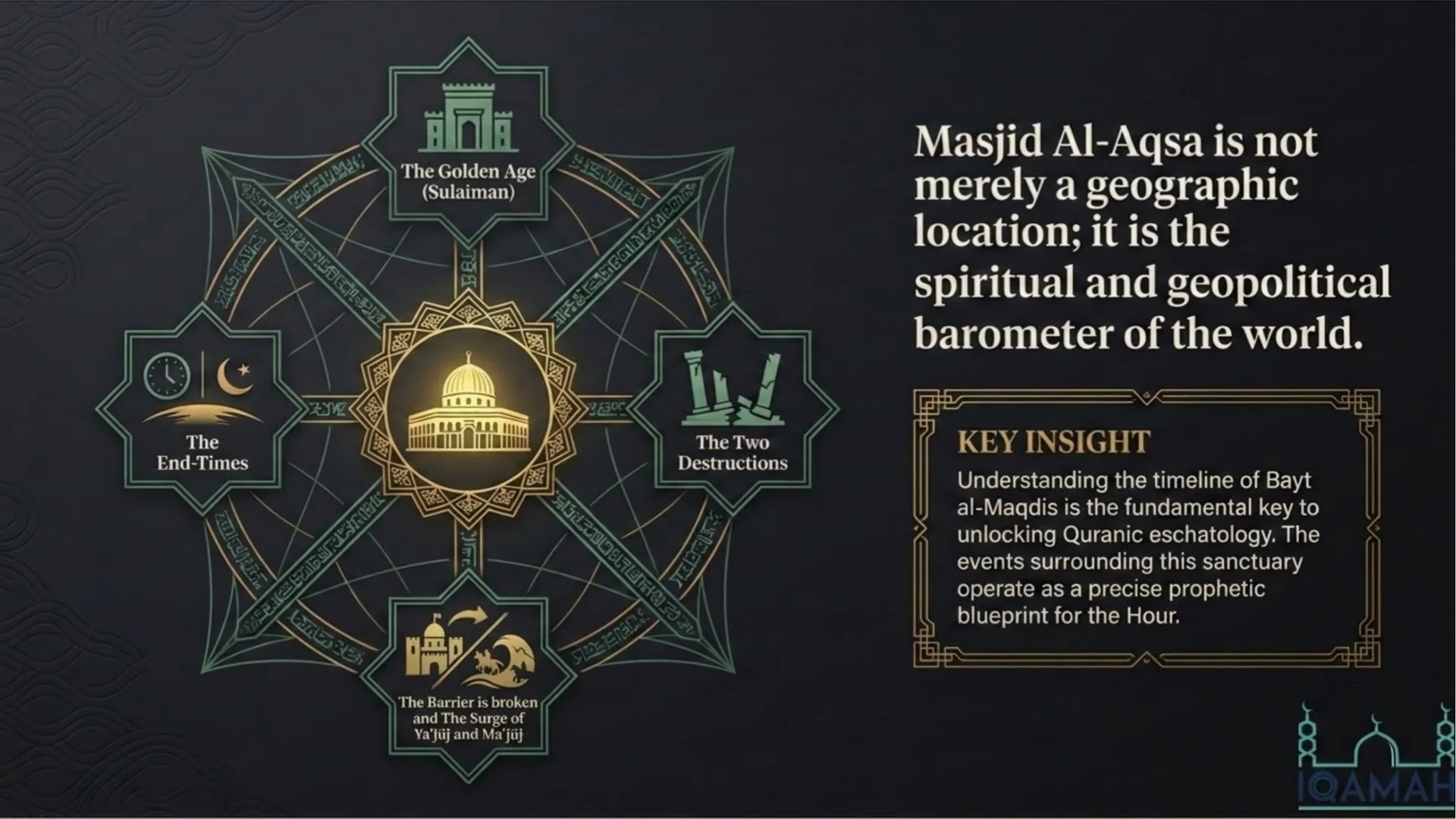
Of every place on the face of the earth, none sits closer to the heart of these prophecies than Bayt al-Maqdis and Masjid al-Aqṣā. I call it, and the scholars before me have called it, the spiritual barometer of the world — for the fortunes of this single sanctuary have risen and fallen, across the centuries, in step with the spiritual state of mankind itself. When the people of the covenant were faithful, the sanctuary flourished; when they fell into corruption, it was given over to ruin. To map the history of this one city — its raising, its two destructions, the ban placed upon it, and its liberations — is to hold in your hand the very key that unlocks the Qurʾānic timeline of the end.

That is why we read the entire sweep of ākhir al-zamān through the gate of this one city, as the diagram shows: the golden age of Sulaimān, the two destructions, the breaking of the barrier and the surge of Yaʾjūj wa Maʾjūj, and the end-times — all of them circling Bayt al-Maqdis at the centre. And remember what al-Aqṣā is to us: it was the first qiblah, toward which the Prophet ﷺ and the Companions turned in prayer before the qiblah was turned to the Kaʿbah. It is the third of the three sanctuaries toward which a Muslim may set out on a journey of worship, as in the ḥadīth, 'Saddles are not to be fastened except toward three mosques.' And it is the earthly anchor of al-Isrāʾ wa-l-Miʿrāj — the place from which the Prophet ﷺ was carried up through the seven heavens. Its story, then, is not some regional history off to the side; it is the very spine of the sacred continuum we are tracing tonight.

Slide 4
Slide 4 of 27 #

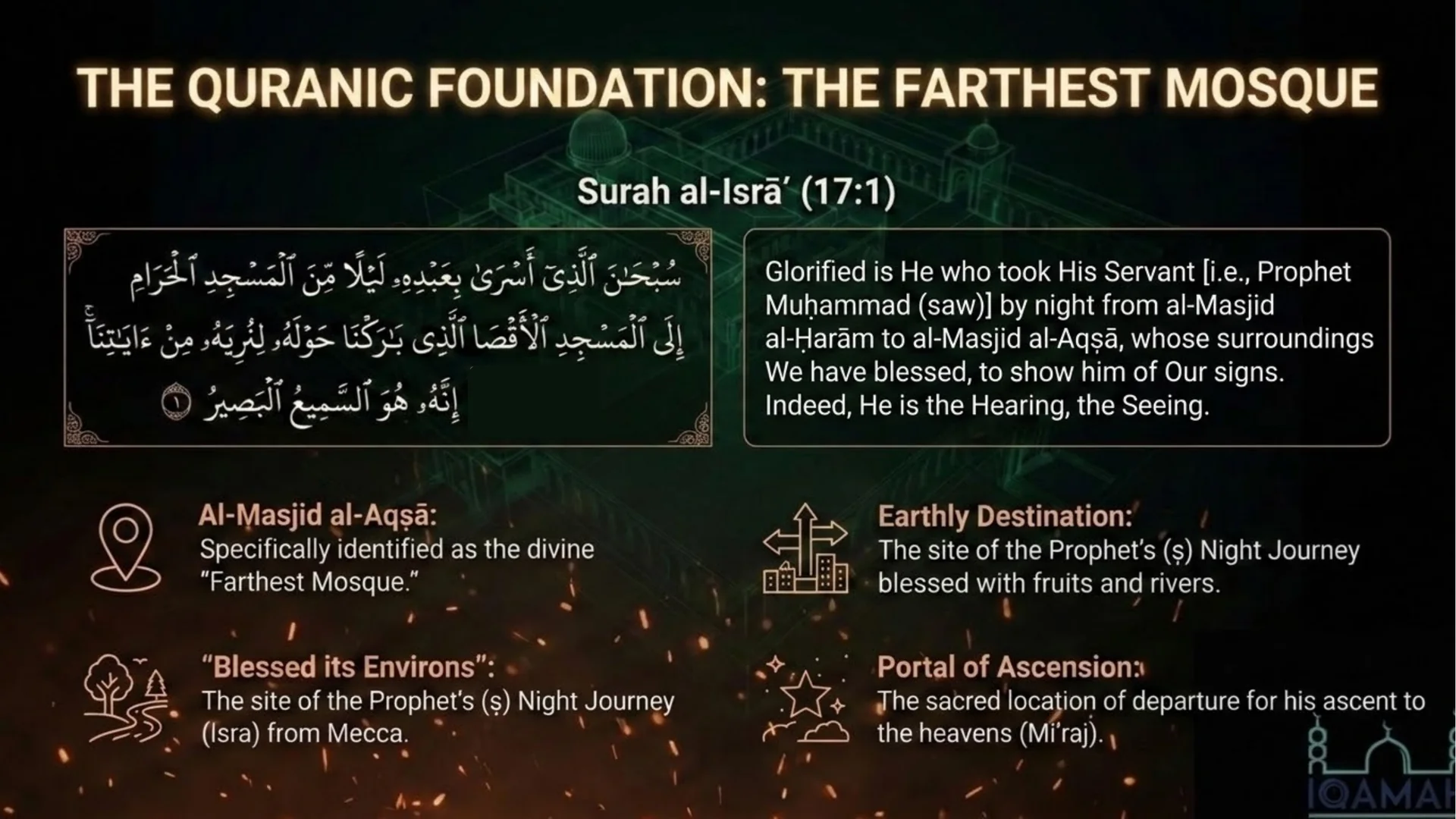
Here is the Qurʾānic foundation, and it is fitting that the sūrah which carries the whole prophecy of Jerusalem opens with the honour of Jerusalem. Allah says: 'Exalted is He who took His servant by night from al-Masjid al-Ḥarām to al-Masjid al-Aqṣā, whose surroundings We have blessed, to show him of Our signs. Indeed, He is the Hearing, the Seeing' (al-Isrāʾ 17:1). On the night of al-Isrāʾ, Allah carried His servant ﷺ from the Sacred Mosque in Makkah to the Farthest Mosque in Jerusalem, and from its courts He ascended through the heavens in the Miʿrāj.

Notice the three honours of al-Aqṣā gathered into this single āyah, as the icons on the slide set out. First, it is al-Masjid al-Aqṣā, 'the Farthest Mosque' — named and dignified by Allah Himself as the destination of the night journey. Second, its precincts are declared blessed: alladhī bāraknā ḥawlahu, 'whose surroundings We have blessed' — a blessing in the land, its water, its fruits, and the Prophets who walked it. Third, it is the launching-point of the ascension, the place from which the Prophet ﷺ rose to his Lord.

And the placement of this verse is itself a teaching. The same sūrah that begins by exalting Bayt al-Maqdis will, within only three more verses, turn to foretell the destiny of the ancient people of that land — as if Allah is telling us that the sanctity of the place and the trials of its people are woven into one single telling. Hold this firmly: the blessing upon the land is fixed by Allah and does not change. What changes across the centuries is the faithfulness of those entrusted with it.

Slide 5
Slide 5 of 27 #

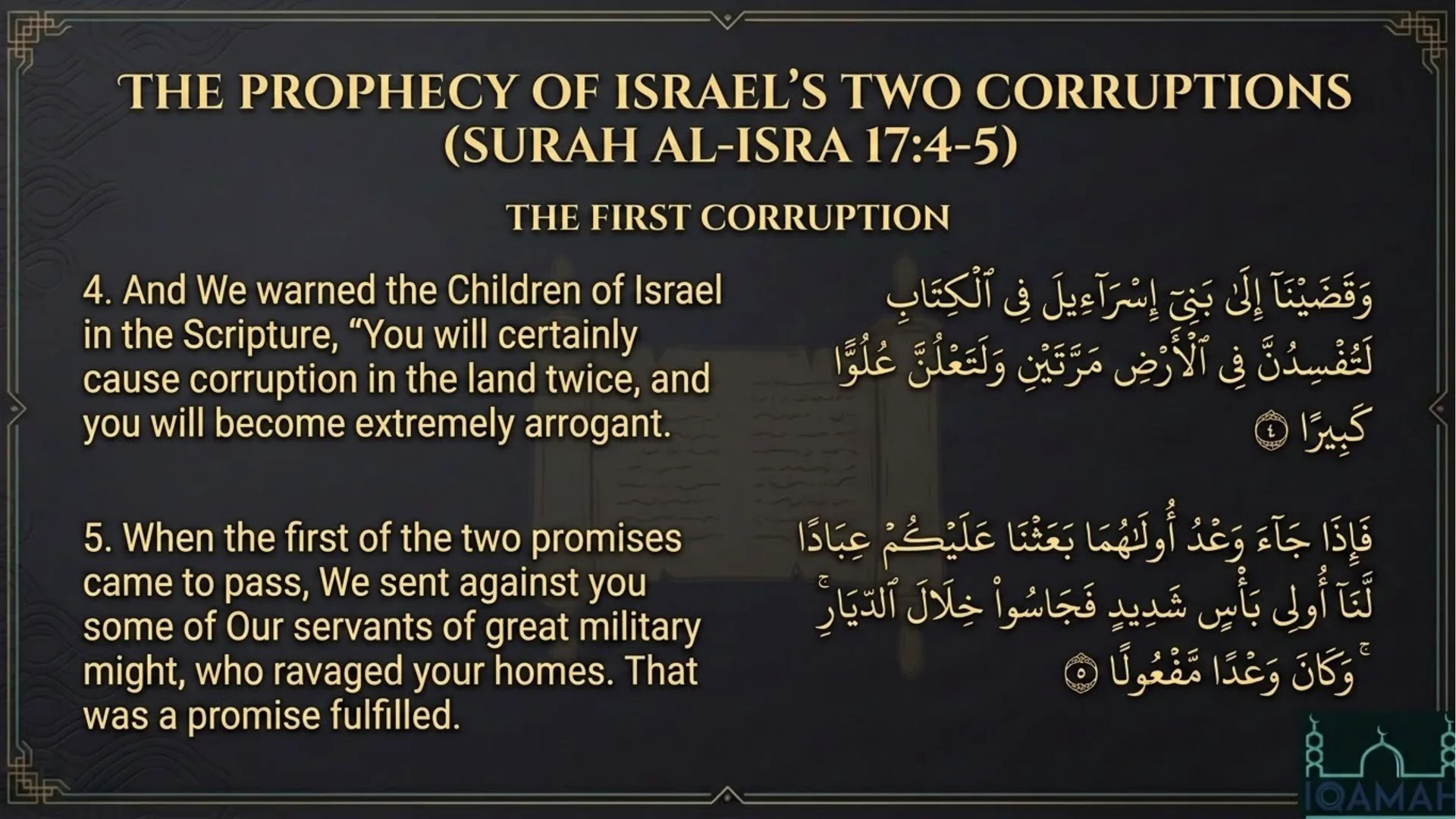
Now the sūrah turns from honour to prophecy. Allah says: 'And We decreed for the Children of Israel in the Scripture: you will surely cause corruption upon the earth twice, and you will surely reach a great height of arrogance' (al-Isrāʾ 17:4). He informed them, in their own revealed Book, that they would twice spread fasād in the land and twice rise to overweening pride — and that each time, a reckoning would answer.

Then the first reckoning: 'So when the promise of the first of the two came, We sent against you servants of Ours of great might, and they probed into the very homes; and it was a promise fulfilled' (17:5). Fa-jāsū khilāl al-diyār — they searched through the houses, sparing nothing. The mufassirūn, and Ibn Kathīr foremost among them, most often identify this first reckoning with the conquest of Bukhtnaṣṣar — Nebuchadnezzar — the king of Babylon, around 586 before the common era, when Jerusalem was stormed, the sanctuary was destroyed, and the people were carried off into the Babylonian exile.

But hear how the tradition reads this verse — not as an ethnic verdict against a people, but as a moral law of Allah that holds for every nation. A people raised high and entrusted with a covenant fell into corruption and arrogance, and the consequence came down by divine appointment. That law turns back upon every community that carries a trust — and that includes our own Ummah. So before this āyah is a history lesson about others, it is a mirror held up to ourselves. If we, who carry the final revelation, fall into the same fasād and the same arrogance, we should not imagine ourselves exempt from the same sunnah of Allah.

Slide 6
Slide 6 of 27 #

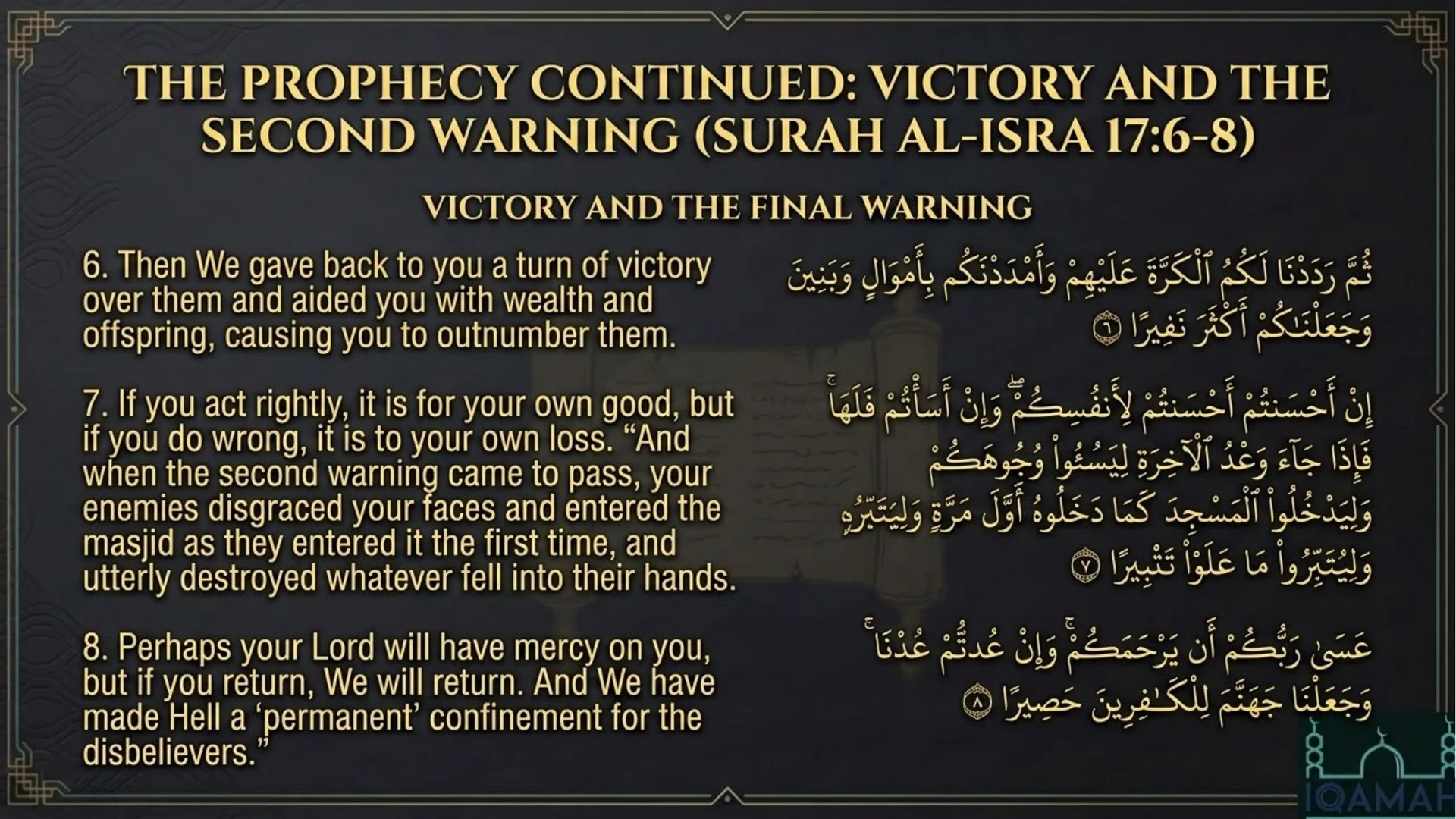
The sūrah continues, and the wheel turns again. 'Then We gave you back the turn against them, and We supplied you with wealth and sons, and made you more in numbers' (al-Isrāʾ 17:6). After the first punishment came a restoration — a second flourishing, with wealth and children and strength returned to them.

Then Allah sets down the principle that governs the whole cycle: 'If you do good, you do good for yourselves; and if you do evil, it is against yourselves. So when the promise of the latter came — to disgrace your faces, and to enter the masjid as they entered it the first time, and to destroy utterly all that they overcame' (17:7). The second corruption brought the second reckoning: an enemy sent to humiliate them and to enter the sanctuary a second time, just as it had been entered before. Many of the mufassirūn read this second devastation as the Roman destruction of Jerusalem in the year 70 of the common era, when, after the rejection of al-Masīḥ ʿĪsā ibn Maryam (ʿalayhi al-salām) and the revolts that followed, the Romans under Titus levelled the Second Temple and scattered the people into a diaspora that would last nearly two thousand years.

And then the hinge of the entire passage: 'It may be that your Lord will have mercy upon you; but if you return, We shall return; and We have made Hell a prison for the disbelievers' (17:8). Wa-in ʿudtum ʿudnā — if you return to corruption, We return to punishment. Both doors are left standing open: the door of mercy for those who repent, and the door of consequence for those who relapse. This is the engine of the whole continuum, and I want it fixed in your minds: the story of Jerusalem is not finally about blood or about geography. It is about the law of return — corruption invites reckoning, and repentance invites mercy.

Slide 7
Slide 7 of 27 #

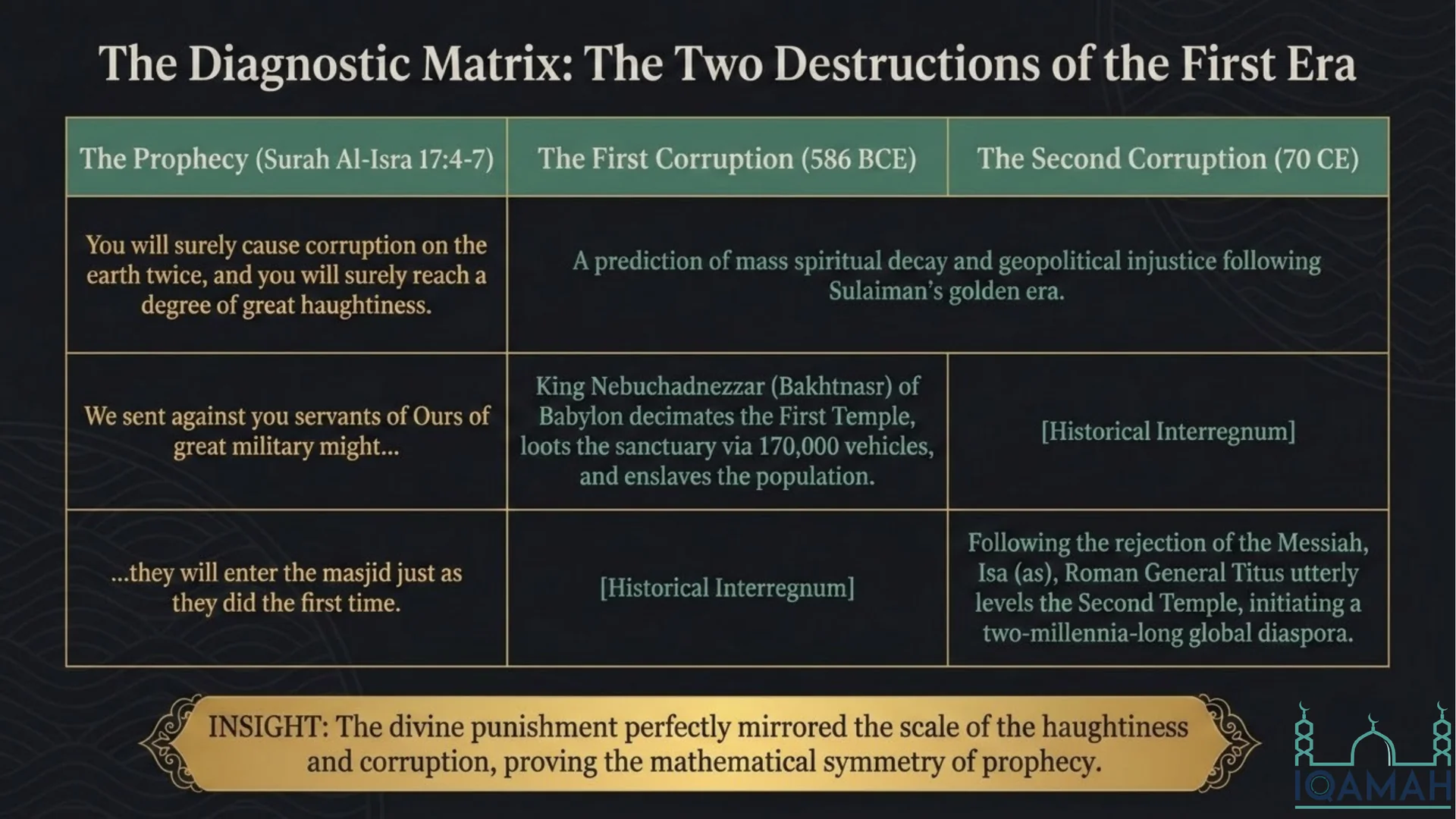
Set the two reckonings side by side and the symmetry is striking, exactly as the matrix lays it out. The prophecy was twofold — twice corruption, twice arrogance — and history answered it twice. The first corruption was met by the Babylonians under Bukhtnaṣṣar around 586 BCE, who broke the sanctuary, plundered its treasures, and enslaved the people. The second was met by the Romans in 70 CE, who razed the Temple and began the long scattering. Both times, precisely as the āyah foretold, the enemy 'entered the masjid as they entered it the first time.'

And in the interval between those two reckonings — the historical interregnum the chart marks — sits one of the most consequential periods of all: it was in this second era of Banī Isrāʾīl that Allah sent to them al-Masīḥ ʿĪsā ibn Maryam (ʿalayhi al-salām), with clear signs and the Injīl. He was, for the most part, rejected by his own people, and then Allah raised him to Himself — and it was after this rejection that the second devastation fell.

Let me place a word of care here, because a serious study circle owes the text this discipline. The precise identification of these two punishments — which empire, in which order — is the reading of many of the mufassirūn; it is not a fixed article of ʿaqīdah. Ibn Kathīr himself records more than one view on the agents and their sequence. What the Qurʾān fixes beyond dispute is the pattern: twice corruption, twice reckoning, and the warning bound to both. So we hold the pattern firmly, as creed, and we wear the historical mapping lightly, as interpretation.

Slide 8
Slide 8 of 27 #

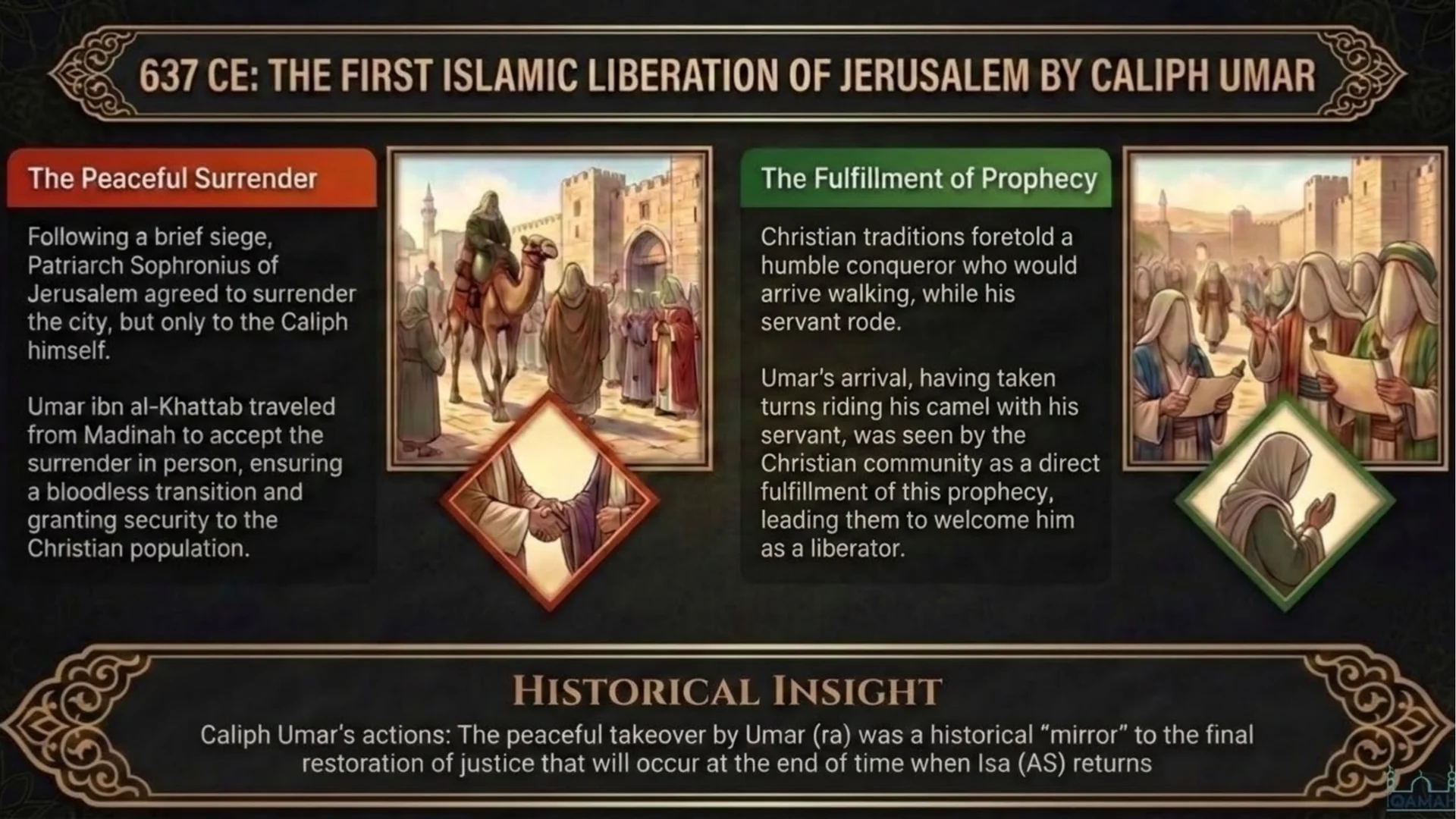
The next great turn in the city's story is an Islamic one, and it is a turn toward justice. In the year 637 to 638 of the common era, Jerusalem opened its gates — not to a conqueror's sword, but to a peaceful surrender. The Byzantine Patriarch Sophronius agreed to hand over the city, but only to the Caliph in person. So Amīr al-Muʾminīn ʿUmar ibn al-Khaṭṭāb (raḍiya Allāhu ʿanhu) travelled from Madīnah to receive it himself. The surrender was sealed by the covenant known as al-ʿUhda al-ʿUmariyya, which guaranteed to the inhabitants the safety of their lives, their churches, and their property.

And the manner of ʿUmar's entry has echoed down the centuries. He came humbly, sharing a single mount with his servant, taking turns to ride and to walk — so that, the narrations relate, it was the servant's turn to ride as they entered the holy city. When the time for prayer came and he was invited to pray inside the Church of the Holy Sepulchre, he declined, and prayed outside — lest later Muslims take his prayer there as a pretext to seize the church from the Christians. This is the justice and the trust that Islam brought to the city.

The slide records a poignant detail of that hour: at the surrender, the Christian authorities asked that the long-standing bar on Jewish settlement in the city be kept in place. Whatever the politics of that moment, hold on to the larger point for our timeline. With ʿUmar's entry, Bayt al-Maqdis passed for the first time into the guardianship of the final Ummah — the very community of the very Prophet ﷺ who, only a few years before, had been carried to these courts by night. And the Companions saw in ʿUmar's peaceful, just restoration a foreshadowing — a mirror — of the final restoration of justice that will come when ʿĪsā (ʿalayhi al-salām) returns at the end of time.

Slide 9
Slide 9 of 27 #

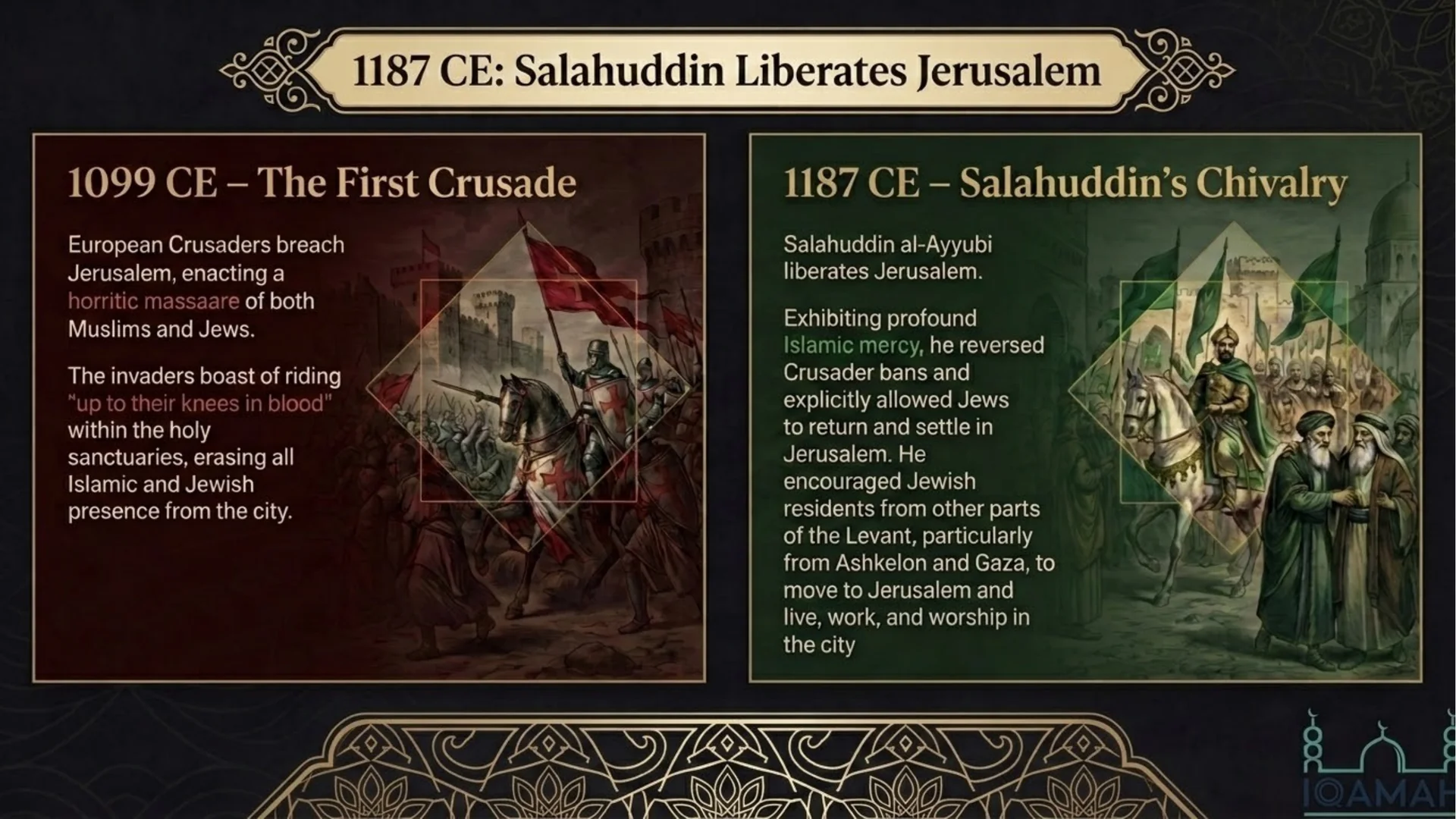
Across the next centuries the city changed hands again, and the contrast the slide draws is one we should sit with. In 1099 the armies of the First Crusade breached the walls of Jerusalem and put its people — Muslims and Jews alike — to a notorious slaughter. The Crusader chroniclers themselves boasted of riding through the sanctuaries in blood. The Islamic and Jewish presence in the city was, for a time, wiped away.

Then, in 1187, came Ṣalāḥ al-Dīn al-Ayyūbī — Saladin. After his decisive victory at the Battle of Ḥaṭṭīn, he recovered Jerusalem, and he answered cruelty not with cruelty but with the mercy his dīn demanded of him. There was no massacre. Captives were ransomed gently, and the poor among them were simply set free. And he reversed the old bans: he permitted the Jews, who had been kept out, to return and to settle in the city once more, encouraging communities from across the Levant — from Ashkelon and Gaza and beyond — to come and live and worship there.

It is here that I locate a turning point in our reading of the prophecies. Ṣalāḥ al-Dīn's act of mercy — the lifting of the bar against Jewish settlement — opens the door to the gradual return that the next several slides will trace. Keep in your mind, as we go forward, the verse of the 'ban' in Sūrat al-Anbiyāʾ (21:95–96), to which we will shortly come; and keep the discipline of distinguishing what the texts state plainly from the historical correlations that we, as later readers, draw alongside them.

Slide 10
Slide 10 of 27 #

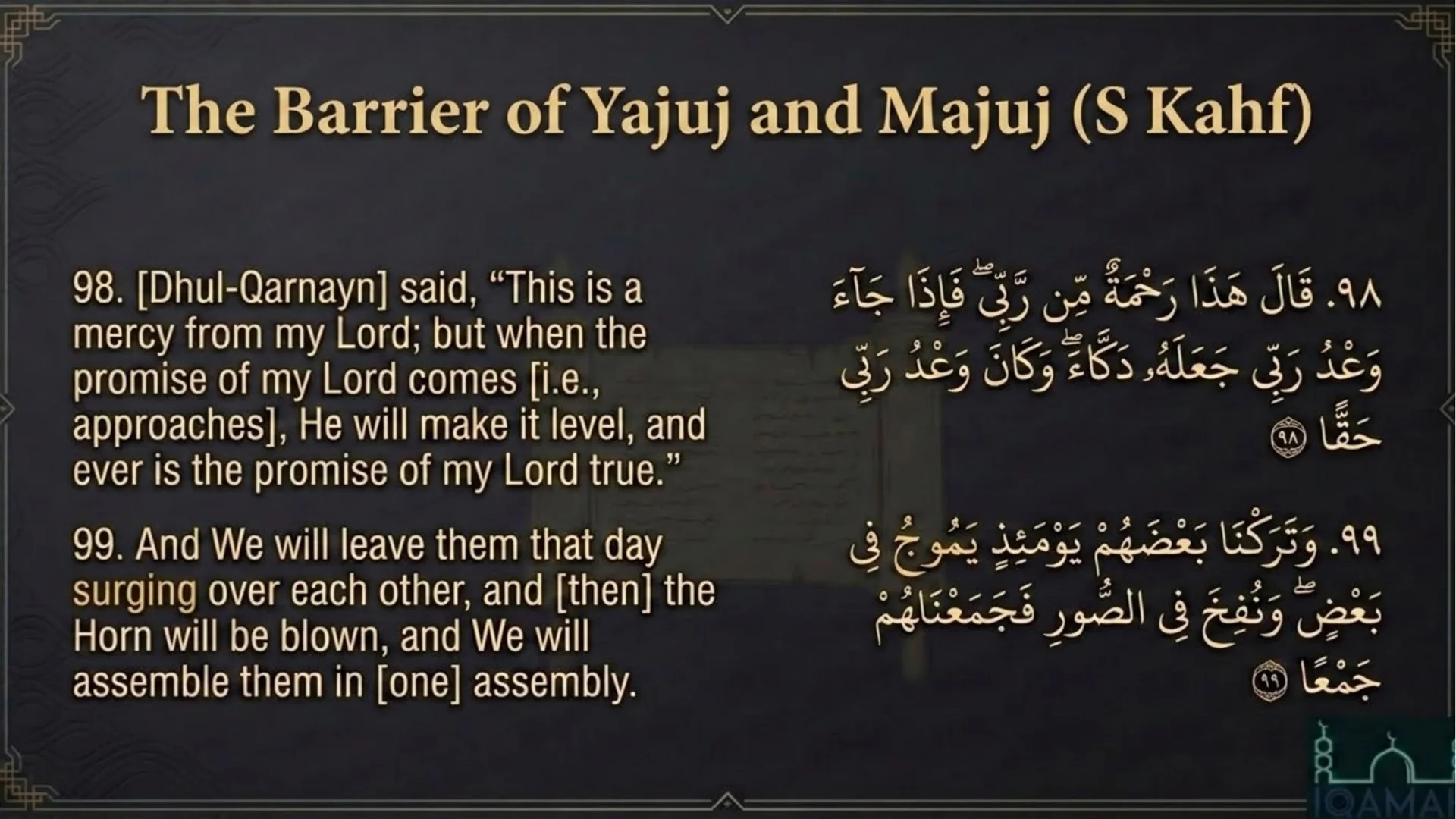
To follow that thread of Yaʾjūj wa Maʾjūj, we return to Sūrat al-Kahf and the barrier of Dhū al-Qarnayn. You remember the story: the righteous traveller Dhū al-Qarnayn reached a people who begged him to wall off Yaʾjūj wa Maʾjūj, who were spreading corruption in the land. He built for them a mighty rampart of iron, then poured molten copper over it, sealing them behind it. But when it was done, he did not boast. He said: 'This is a mercy from my Lord. But when the promise of my Lord comes, He will make it level — and the promise of my Lord is ever true' (al-Kahf 18:98). Even this great barrier, he taught, is only a temporary mercy; when Allah wills, it will be flattened to the ground.

And the very next āyah leaps straight to the end of time: 'And We will leave them, on that Day, surging over one another; and the Horn will be blown, and We will gather them all together' (18:99). Fix your attention on that verb — yamūj, baʿḍuhum fī baʿḍ: to surge and heave and swell like a restless sea. It does not picture a tidy marching army. It pictures a heaving, oceanic mass of humanity, held back now by a barrier that will one day be levelled by the decree of Allah.

So two questions open before us, and the next slides take them up in turn: who are Yaʾjūj wa Maʾjūj, and when do they come? The Ṣaḥīḥ corpus gives a firm and final answer for the end of time — and, as we will see, it also invites a careful conversation about the meantime, about whether history has already seen waves of this surging before the final flood.

Slide 11
Slide 11 of 27 #

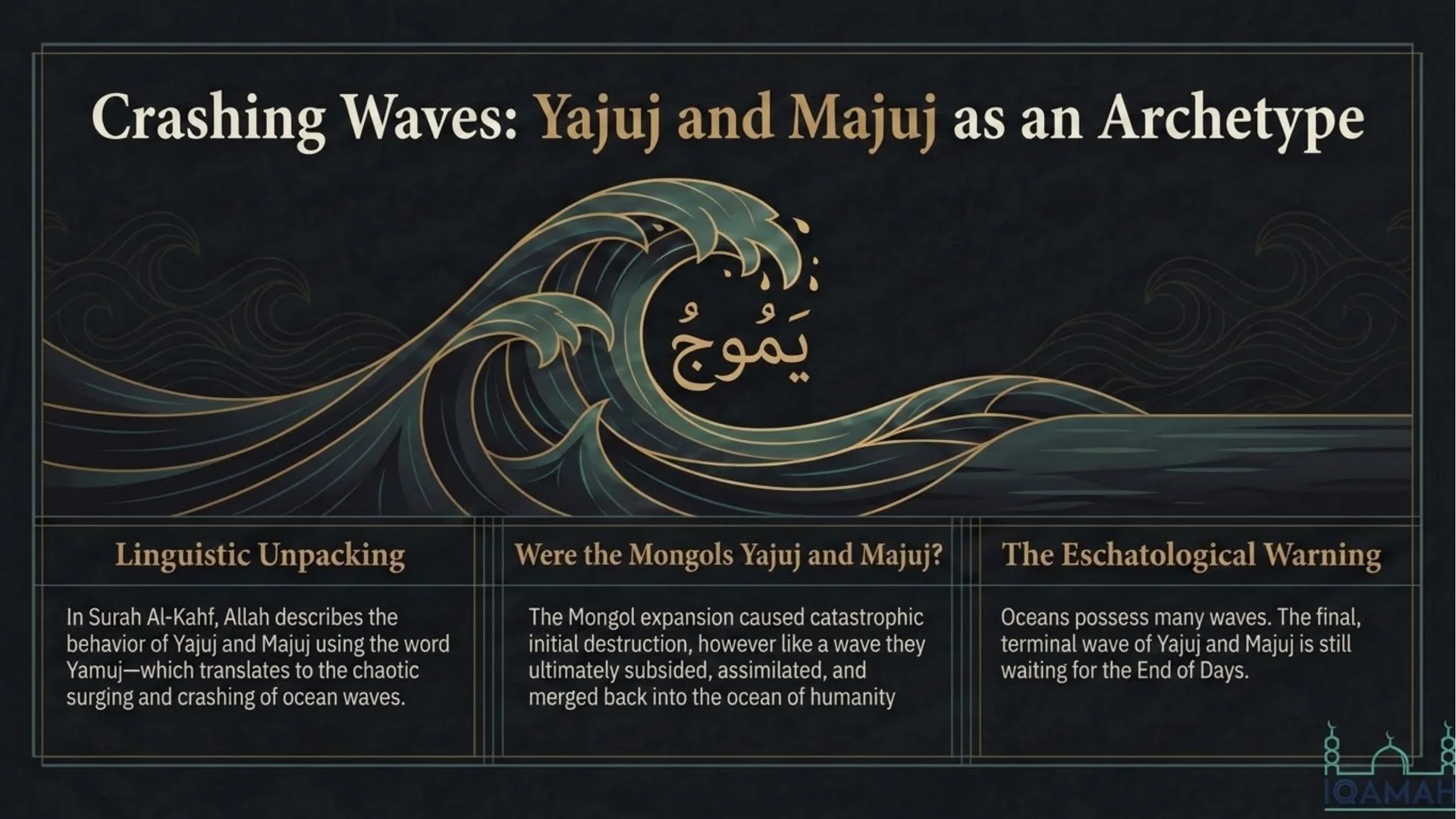
Here is the linguistic key that unlocks the whole image. When Allah describes Yaʾjūj wa Maʾjūj in Sūrat al-Kahf, He uses that root we just met — yamūj — the surging and crashing of waves upon an open sea. And once you hear the word that way, a whole pattern of history comes into focus. The ocean does not have one wave; it has many. A wave rises, it crashes with devastating force upon the shore, and then it recedes — drawing back into the body of the sea until it is indistinguishable from the rest of the water.

This is the lens through which I want us to read the Mongol cataclysm of the thirteenth century. Were the Mongols Yaʾjūj wa Maʾjūj? Consider what they were: a people who poured out of the high steppe of Eurasia 'from every elevation,' who annihilated the Muslim heartlands — Bukhārā, Samarqand, and at last Baghdād itself in 656 AH — building pyramids of skulls as they came. And then, like a wave, the destruction subsided: their empire fractured, and within a few generations many of their own descendants had entered Islam and dissolved back into the ocean of the Ummah.

This reading has real roots among the scholars. Ibn Kathīr, in al-Bidāya wa-l-Nihāya, traces the lineage of Yaʾjūj wa Maʾjūj to Yāfith (Japheth), the son of Nūḥ (ʿalayhi al-salām), and ties them to the Turkic and nomadic peoples of the steppe. And Ibn Taymiyyah, who lived through the Mongol devastation with his own eyes, drew direct parallels between what he witnessed and these very prophecies.

But now I must draw a careful line, and I ask you to hold it precisely. That the Mongols were a foreshadowing — a 'wave' — of Yaʾjūj wa Maʾjūj is an interpretive view. It was held by some scholars and is pressed by a number of teachers in our own time, and it is a compelling way of reading history. It is not, however, a settled article of creed, and we must not let it blur the firm position. What the Ṣaḥīḥ corpus fixes — above all the long ḥadīth of al-Nawwās ibn Samʿān in Ṣaḥīḥ Muslim — is that the great release of Yaʾjūj wa Maʾjūj is a future major sign, coming after the descent of ʿĪsā (ʿalayhi al-salām) and after the death of the Dajjāl, a people no human force can stand against, whom Allah Himself will destroy. So take the 'wave' reading as an illuminating way of seeing history — never as a substitute for the fixed sequence of the end, which we will lay out on slide 22.

Slide 12
Slide 12 of 27 #

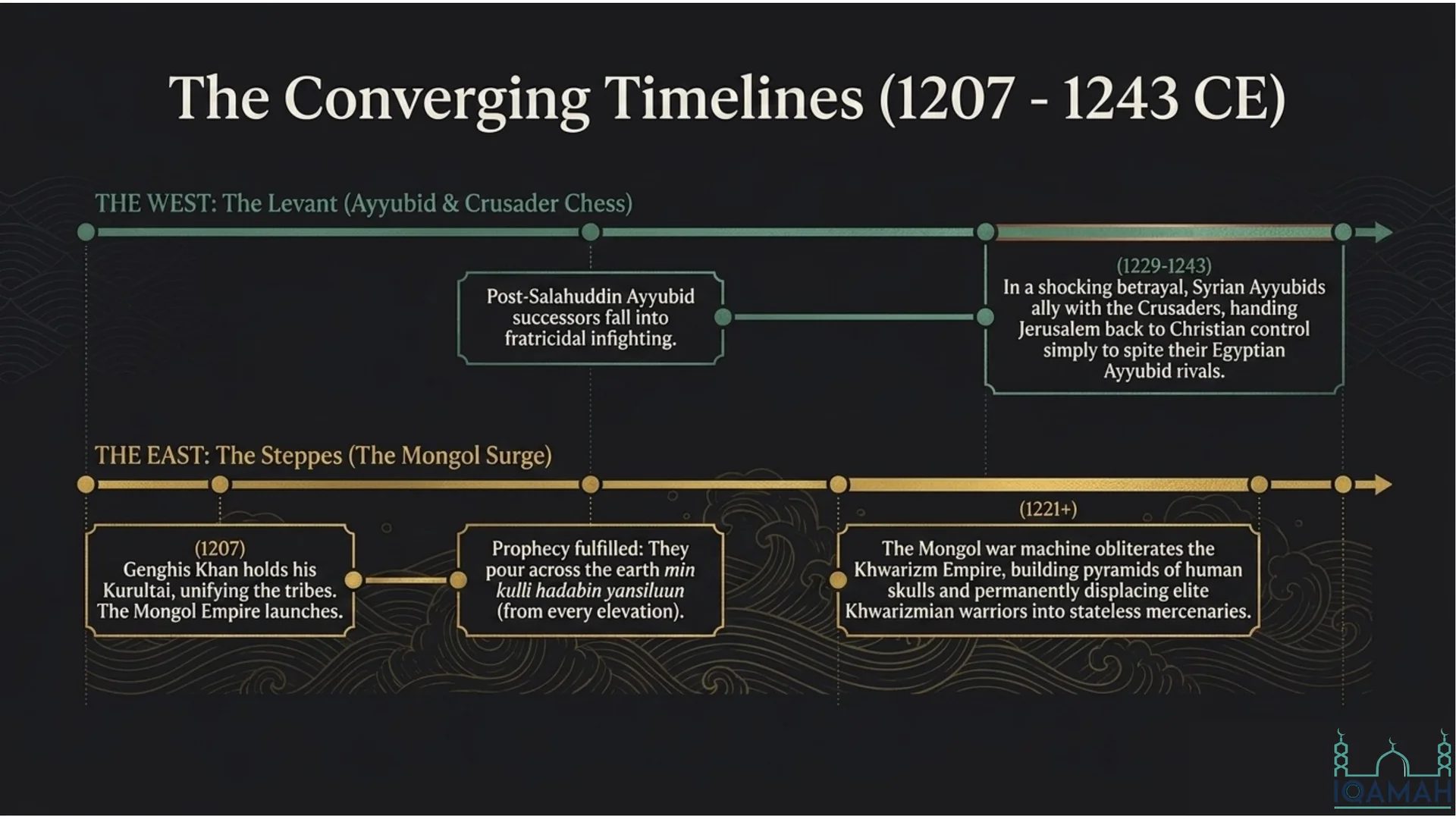
Now watch two histories unfold at the same moment, on opposite ends of the known world, as the two timelines on the slide show. In the West, in the Levant, Jerusalem is being passed back and forth in a game of chess between the heirs of Ṣalāḥ al-Dīn and the Crusaders — the Ayyūbid successors falling into fratricidal infighting, even, by 1229 to 1243, the Syrian Ayyūbids allying with the Crusaders and handing Jerusalem back to Christian control simply to spite their Egyptian rivals.

And in the East, in the very same span of years, in 1206 to 1207, Genghis Khan gathers the scattered tribes of the steppe at his great quriltai and unifies them under one command. The Mongol war-machine is launched. Within a few short years it pours out 'from every elevation,' shattering empires from China in the east to the gates of Europe in the west — and, by 1221, falling upon the Khwārazmian empire of Central Asia and grinding it to dust.

I want you to see these two streams as converging by design. The eastern surge is not a distant event with no bearing on Jerusalem; it sends shockwaves rolling westward that will, within a single generation, crash directly upon the holy city itself. The Mongol destruction of Khwārazm set loose the very forces that the next slide brings to the walls of Bayt al-Maqdis.

Slide 13
Slide 13 of 27 #

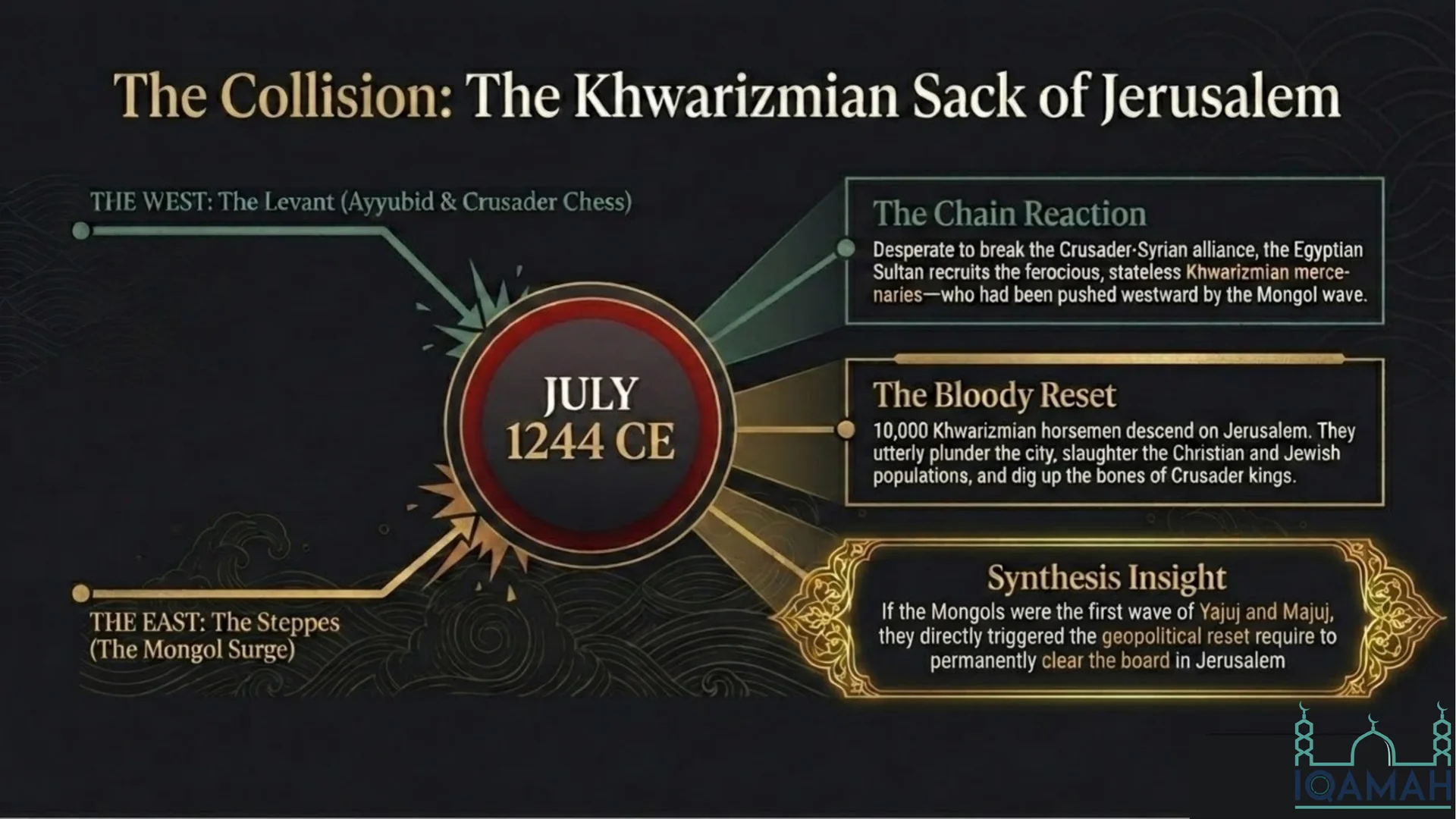
And here, in July of 1244, the two timelines collide upon Jerusalem. Follow the chain of cause. When the Mongols destroyed the Khwārazmian empire in the East, they did not kill every warrior; they shattered a state and left behind thousands of fierce, stateless, displaced horsemen — mercenaries with no home and nothing to lose, pushed westward by the Mongol wave. Then, in the West, the Egyptian Ayyūbid Sultan, As-Ṣāliḥ Ayyūb, desperate to break the alliance his Syrian relatives had made with the Crusaders, hired exactly these displaced Khwārazmian horsemen to fight for him.

In the summer of 1244 these warriors descended upon Jerusalem. They stormed the city and plundered it utterly. They desecrated the sanctuaries and dug up the very bones of the Crusader kings from their tombs. They devastated the Christian population and drove out the last of the Jews. The city was emptied of its old communities, its quarters left in ruin.

Terrible as the means were, see what the result was in the providence of Allah. This sack was the final, bloody chapter of the ancient ban — the ground was, as it were, swept clean. The old populations were cleared away, and the stage was set for a new and lasting resettlement: the 'mixed assembly' that another āyah of the Qurʾān had foretold, which the next two slides take up.

Slide 14
Slide 14 of 27 #

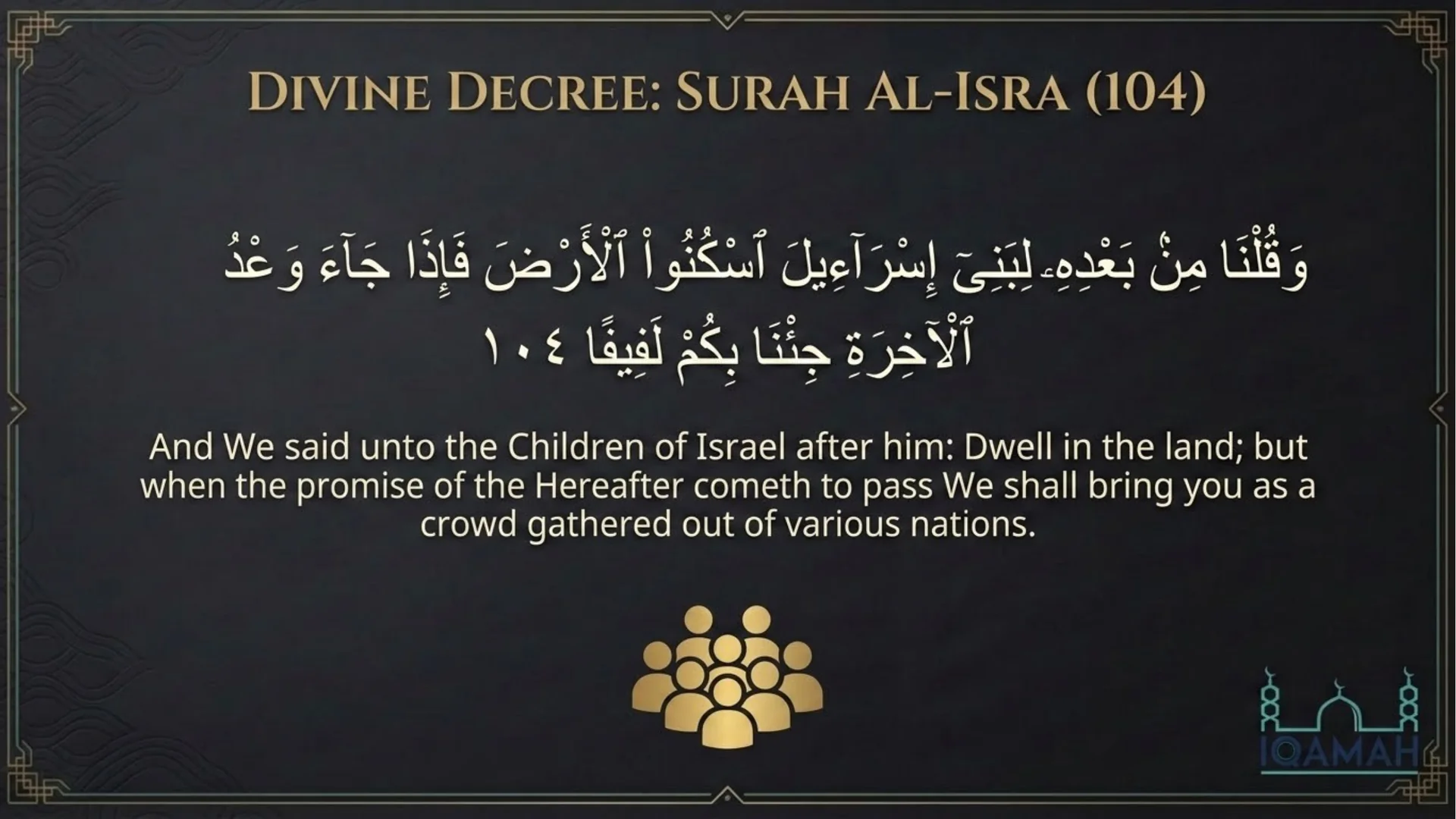
Return now to Sūrat al-Isrāʾ. After the two corruptions and their two reckonings, the same passage closes with a quieter prophecy that points far down the centuries: 'And We said after him to the Children of Israel: dwell in the land; but when the promise of the Hereafter comes, We will bring you forth as a lafīf' (al-Isrāʾ 17:104). Dwell in the land for now — but at the end, We will gather you as a lafīf.

That word, lafīf, is precise and deserves our attention. It does not mean a single, pure, ancient tribe returning in unbroken line. It denotes a crowd wound together from many different strands — a mixed, heterogeneous gathering drawn from every direction. And this is exactly the character of the return that began from the thirteenth century onward and continues to our own day: not one monolithic nation, but a mingled people gathered from Spain, from North Africa, from France, from across Europe and eventually the whole earth — Sephardi and Ashkenazi together, a lafīf in the exact Qurʾānic sense.

As with the 'wave' reading of the Mongols, I present this to you as an interpretive application of the verse, and I am honest with you about that. The mufassirūn offer a range of readings of 17:104. The value here is not a claim to have decoded a date; it is the pattern the āyah illumines — that the final gathering of this people in the land, in the run-up to the promise of the Hereafter, was itself written into the Book long before it came to pass.

Slide 15
Slide 15 of 27 #

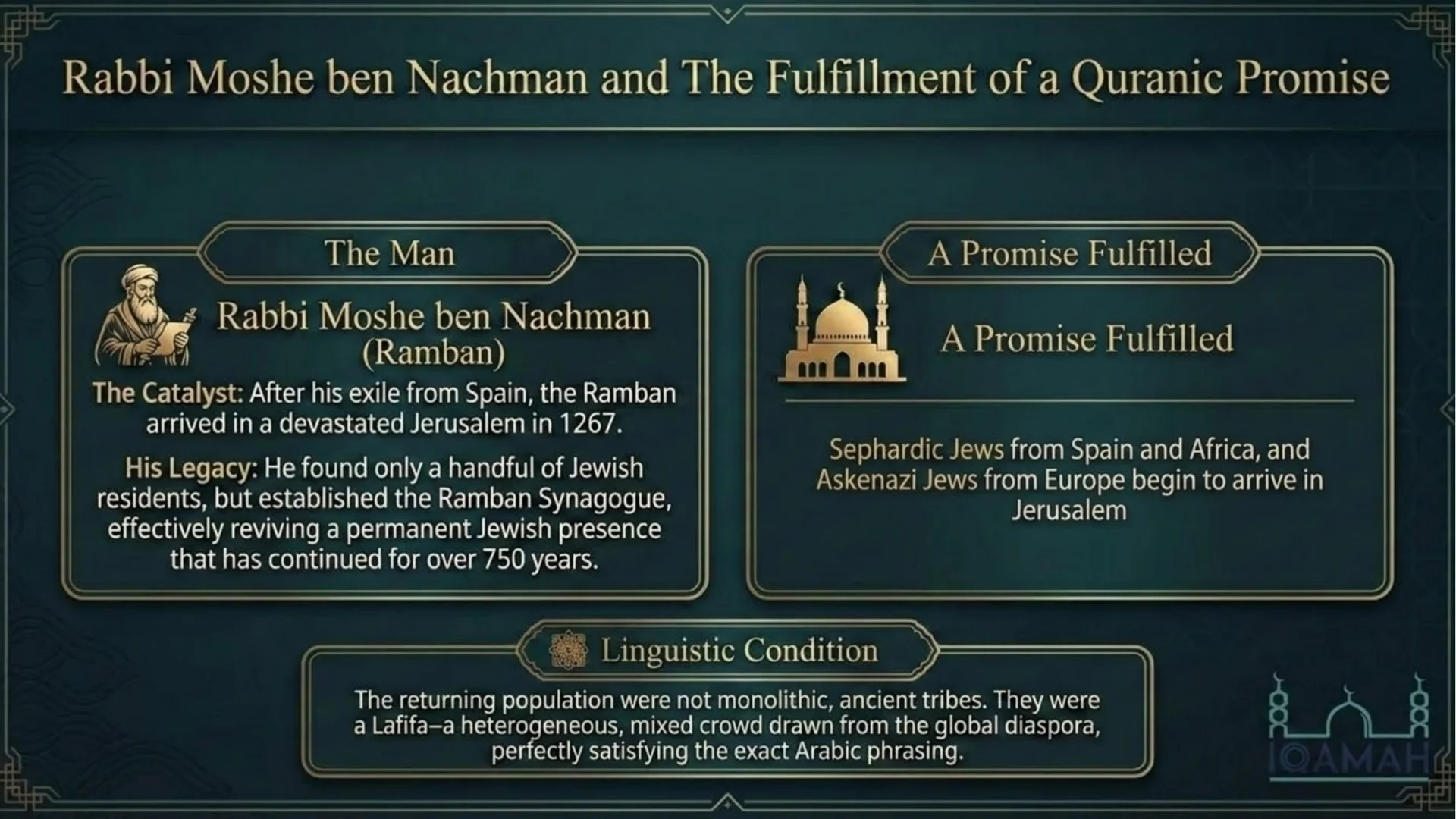
The resettlement that the verse describes, in this reading, finds its starting point in the year 1267, with one remarkable man. Rabbi Moshe ben Naḥman — known as Nachmanides, or by his acronym the Ramban — was a great Jewish scholar of Spain who, after being driven from his homeland, made his way to Jerusalem. He arrived to find a city emptied by the Khwārazmian sack of a generation before: only a handful of Jews remained among the ruins.

What he did there is, in this telling, the catalyst. He established a synagogue — the Ramban Synagogue — and from that small beginning grew the continuous, unbroken Jewish presence in the city that has endured, by the slide's reckoning, for over seven and a half centuries since. And the population that came was, again, a lafīf: Sephardi Jews from Spain and Africa, and Ashkenazi Jews from Europe, a mixed crowd drawn from the global diaspora — fulfilling, in this reading, the exact linguistic condition of the āyah.

Let me gather the threads of this whole section honestly. The easing of the ban under Ṣalāḥ al-Dīn, the clearing of the city in 1244, and the Ramban's resettlement in 1267 — all of it set against the great Mongol surge of that same thirteenth century — we read together as the lifting of the bar of Sūrat al-Anbiyāʾ: 'until Yaʾjūj wa Maʾjūj are let loose.' It is an elegant and a sobering reading. But I hold it before you as interpretation, not as dogma. The texts fix the pattern and the eventual return; the precise dating of these events onto these particular centuries is the work of the interpreter, offered for your reflection — not a matter upon which anyone's imān stands or falls.

Slide 16
Slide 16 of 27 #

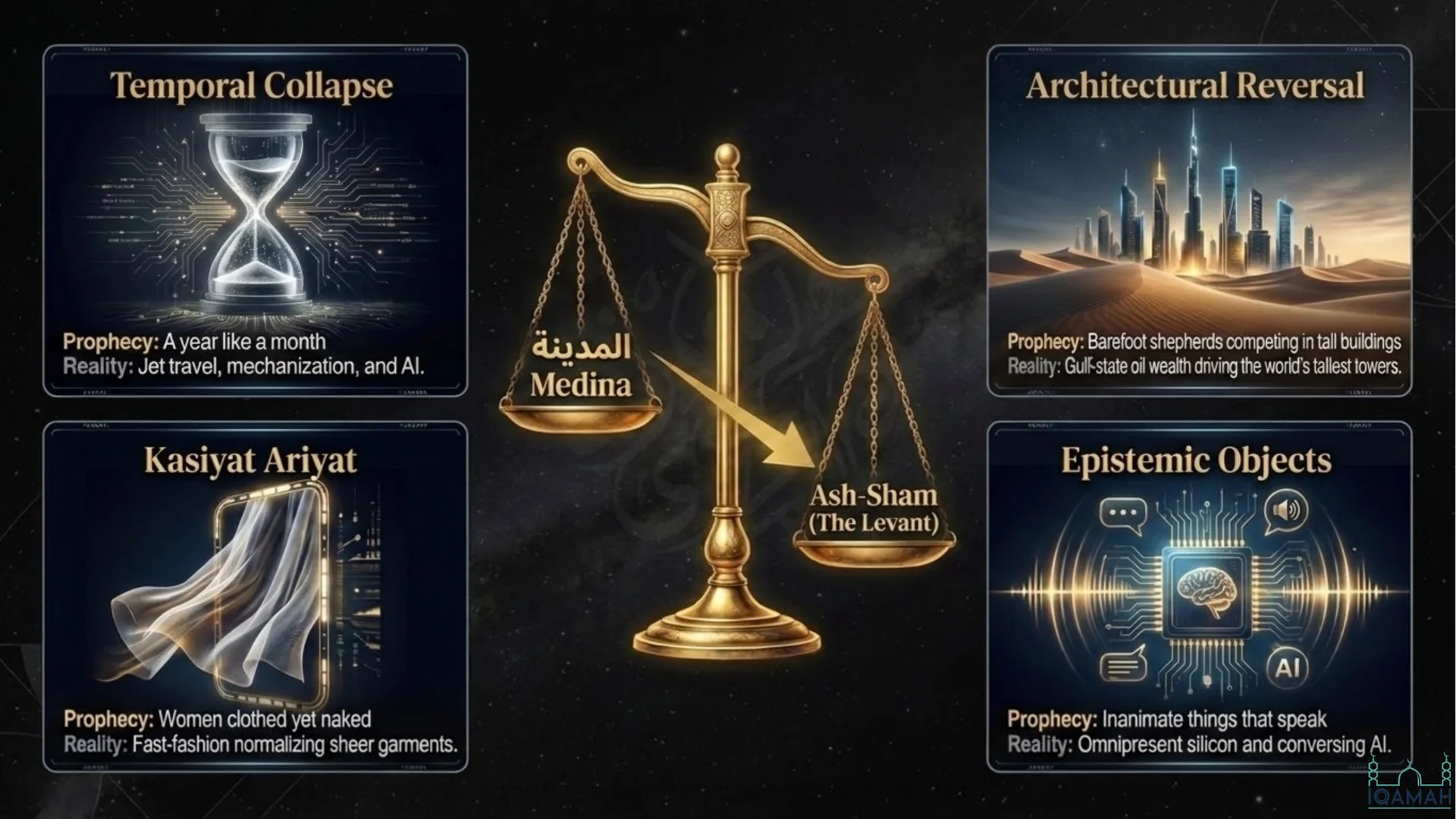
From the medieval turning-points we step now into our own age — into the minor signs of the Hour, the ashrāṭ al-sāʿah al-ṣughrā, which the Prophet ﷺ foretold fourteen centuries ago and which we can watch being fulfilled around us. The slide gathers four of them.

First, the compression of time. The Prophet ﷺ said, as narrated by Aḥmad and others: 'The Hour will not come until time passes quickly, so that a year is like a month, a month like a week, a week like a day, a day like an hour, and an hour like the flaring up of a fire.' The classical scholars, such as al-Nawawī, understood this as the draining of barakah from time — that the blessing would be stripped out of our hours so that we accomplish little in much. Our age adds a startling outward form: through mechanisation, jet travel, and now artificial intelligence, a journey that took a month on horseback is crossed in a day by flight, and calculations that would have taken a lifetime are solved by an algorithm in seconds.

Second, the barefoot herdsmen. In the famous ḥadīth of Jibrīl, recorded in al-Bukhārī and Muslim, when the Prophet ﷺ was asked about the signs of the Hour, among them he named: 'that you will see the barefoot, naked, destitute herdsmen of sheep competing in raising tall buildings.' In other narrations he identified them as the Arabs. And the peoples of the Arabian Peninsula have lived this out within a single generation — Bedouin who a lifetime ago dwelt in tents in the desert now competing, openly and by name, to raise the tallest towers on the face of the earth.

And two more complete the picture. The Prophet ﷺ foretold that inanimate things would speak to men — a thing the early generations could scarcely imagine, and which is now utterly ordinary in an age of devices that answer our voices and track our steps. And he warned of kāsiyāt ʿāriyāt — 'women clothed yet naked' (Muslim) — a phrase the Salaf struggled even to picture, and which needs little explanation in our time. A word of restraint as we read these: noticing the resemblance between the prophecy and our age is a means to deepen taqwā, not a licence to claim certainty about Allah's timing, which He has kept to Himself alone.

Slide 17
Slide 17 of 27 #

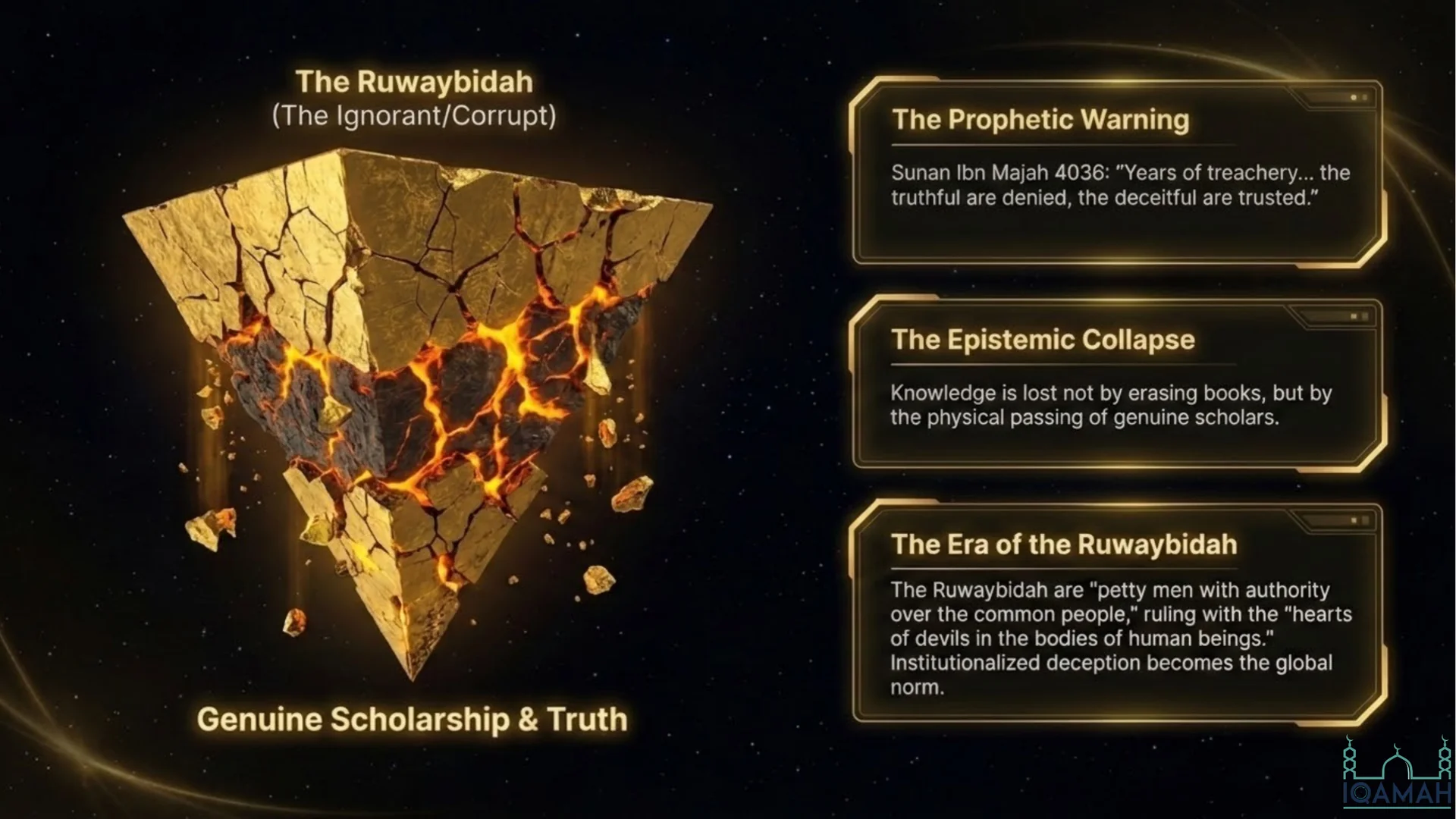
One of these signs deserves its own pause, because it speaks directly to why we are sitting in a study circle at all. The Prophet ﷺ foretold a particular kind of age. He said, as recorded by Ibn Mājah and Aḥmad: 'There will come upon the people years of deceit, in which the liar is believed and the truthful is disbelieved, the treacherous is trusted and the trustworthy is accused of treachery — and the Ruwaybiḍah will speak.' They asked, 'And who is the Ruwaybiḍah?' He said: 'The contemptible, lowly man who speaks on the affairs of the masses.'

Sit with that portrait. It is an age in which authority has been severed from competence: the ignorant and the lowly hold forth on the gravest matters of the dīn and the affairs of the whole community, while the people of genuine, transmitted knowledge are pushed aside and unheard. The slide names this the epistemic collapse — and it adds a crucial point from the Sunnah: that knowledge is not taken from the Ummah by erasing books from the shelves, but, as in the ḥadīth of al-Bukhārī, by the passing away of the scholars who carry it, until the people take ignorant leaders who are asked and who answer without knowledge, and so go astray and lead others astray.

The remedy is named alongside the warning: genuine scholarship and truth. In an age of the Ruwaybiḍah, the believer's protection is to bind himself to authentic, transmitted knowledge — the Qurʾān and the Sunnah as carried and explained by the recognised, grounded scholars — rather than to whoever is loudest or most amplified. In the end times, discernment itself becomes an act of worship.

Slide 18
Slide 18 of 27 #

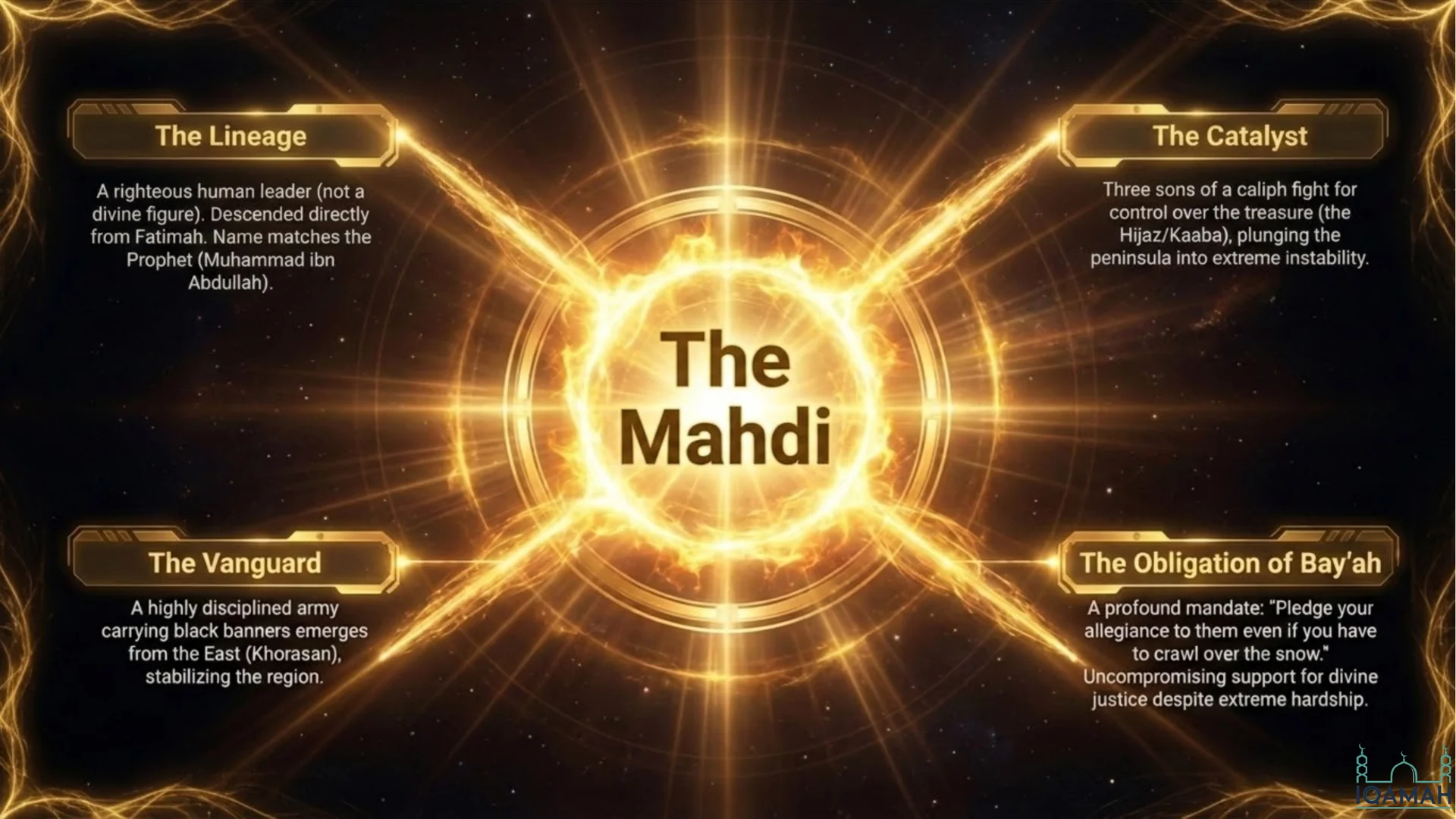
As the trials sharpen, the Sunnah promises a deliverer — al-Mahdī, 'the rightly-guided one.' Let me give you what is established about him. He is from the household of the Prophet ﷺ, from the descendants of Fāṭimah (raḍiya Allāhu ʿanhā), and he bears the name and the father's name of the Prophet himself: Muḥammad ibn ʿAbdillāh. The narrations, in Abū Dāwūd and al-Tirmidhī and others, describe his emergence at a time of overwhelming injustice. The slide sketches the setting: a dispute over the treasure breaking out near the Kaʿbah, the peninsula plunged into instability — and the bayʿah, the pledge of allegiance, given to the Mahdī between the Rukn and the Maqām at the Sacred House. An army bearing black banners comes to his aid from the East, from the direction of Khurāsān. And his rule is summed up in the words of the ḥadīth: he 'will fill the earth with justice and fairness as it had been filled with oppression and tyranny.'

There is even a prophetic command of loyalty to him so emphatic that the Prophet ﷺ said, in the narration, that when you see him you should give him your pledge 'even if you have to crawl over the snow' — for the support of that divine justice is an obligation, however great the hardship.

Two points to keep the creed straight. First, the Mahdī is a man — a just human leader raised up by Allah, not a divine or semi-divine figure, and not a returning hidden saviour. This sets the Islamic expectation sharply apart from the saviour-hopes of the other traditions, as the comparative slide will show. Second, his appearance is bound up with the gravest events of the age — the great battle and the coming of the Dajjāl, which follow. We affirm the Mahdī as a firm point of Sunnī belief, while leaving the finer particulars, on which the narrations differ in detail, to their proper measure of caution.

Slide 19
Slide 19 of 27 #

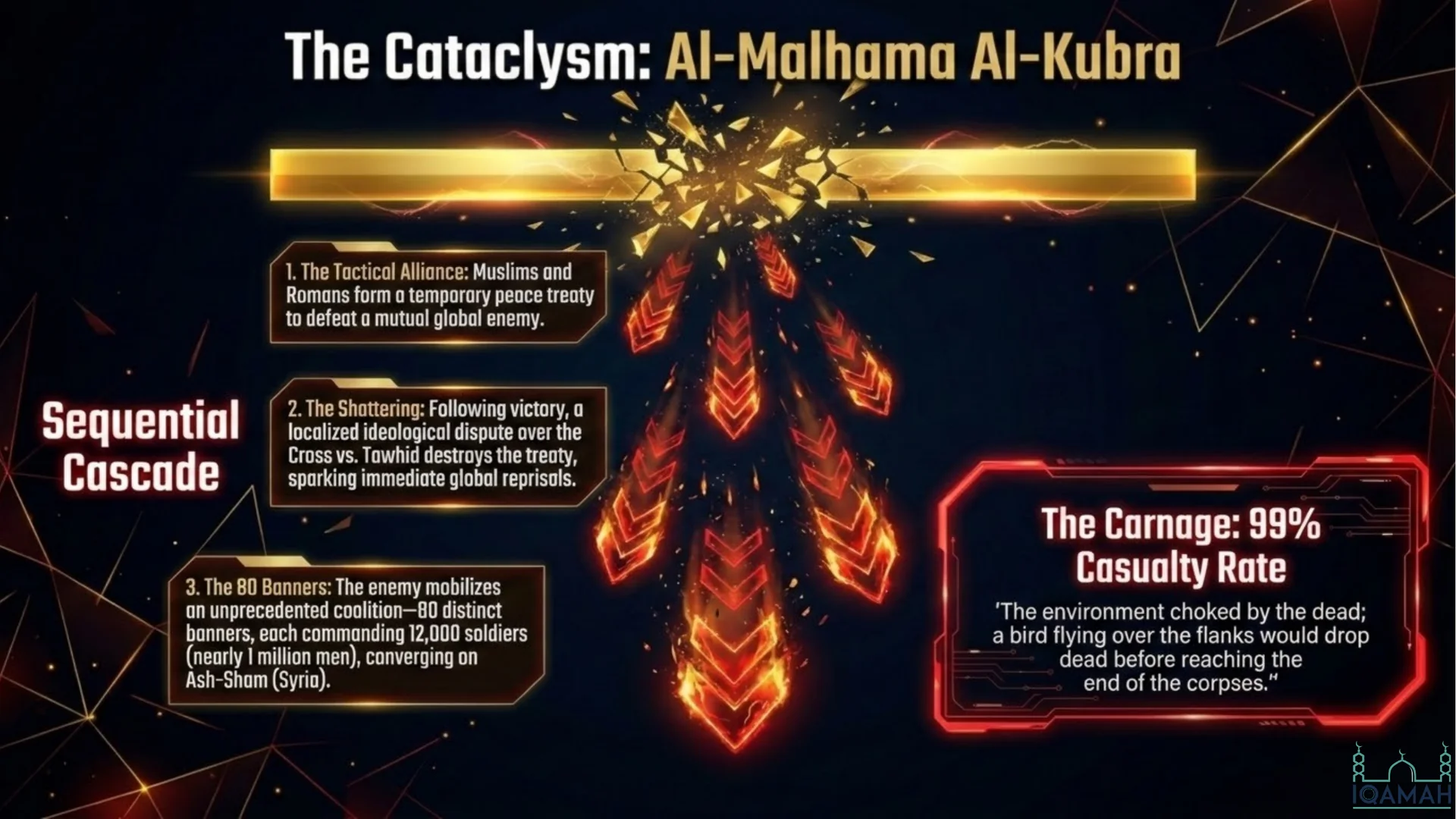
Now the climax that the Sunnah foretells: al-Malḥama al-Kubrā, the Great Slaughter. The other traditions call something like it Armageddon, but our narrations describe it with far greater precision, and — strikingly — it does not begin in open hostility. It begins in an alliance. The authentic ḥadīth relates that the Muslims and 'the Rūm' — historically the Christian powers of the West — will make a secure treaty, and together they will fight a common enemy who lies beyond them, and together they will be victorious.

Then comes the betrayal that shatters everything. In the flush of that shared victory, the narration in Ṣaḥīḥ Muslim and Abū Dāwūd tells us, a man will raise the cross and cry out, 'The cross has conquered!' — and a Muslim, in zeal for the truth of tawḥīd, will rise and break the cross and strike him down. At that the treaty is torn to pieces and the great war erupts. The slide lays out the sequential cascade: the tactical alliance, the shattering over the banner of the cross against tawḥīd, and then the mobilisation — the enemy gathering under eighty banners, each banner with twelve thousand men beneath it, a coalition of nearly a million converging upon Ash-Shām.

And the carnage is beyond reckoning. The narrations describe a slaughter so total that of every hundred men, ninety-nine will fall; and that a bird passing over the flanks of the dead would itself drop dead before it reached the end of the corpses. One caution for our circle: the texts speak of 'Rūm' and of named places, but to map them confidently onto specific modern nation-states is speculation, and the Prophet ﷺ forbade us to force the timing of these things. So take firmly the shape of the prophecy — alliance, betrayal over the banner of disbelief, and catastrophic war — and leave the precise names and dates to their fulfilment.

Slide 20
Slide 20 of 27 #

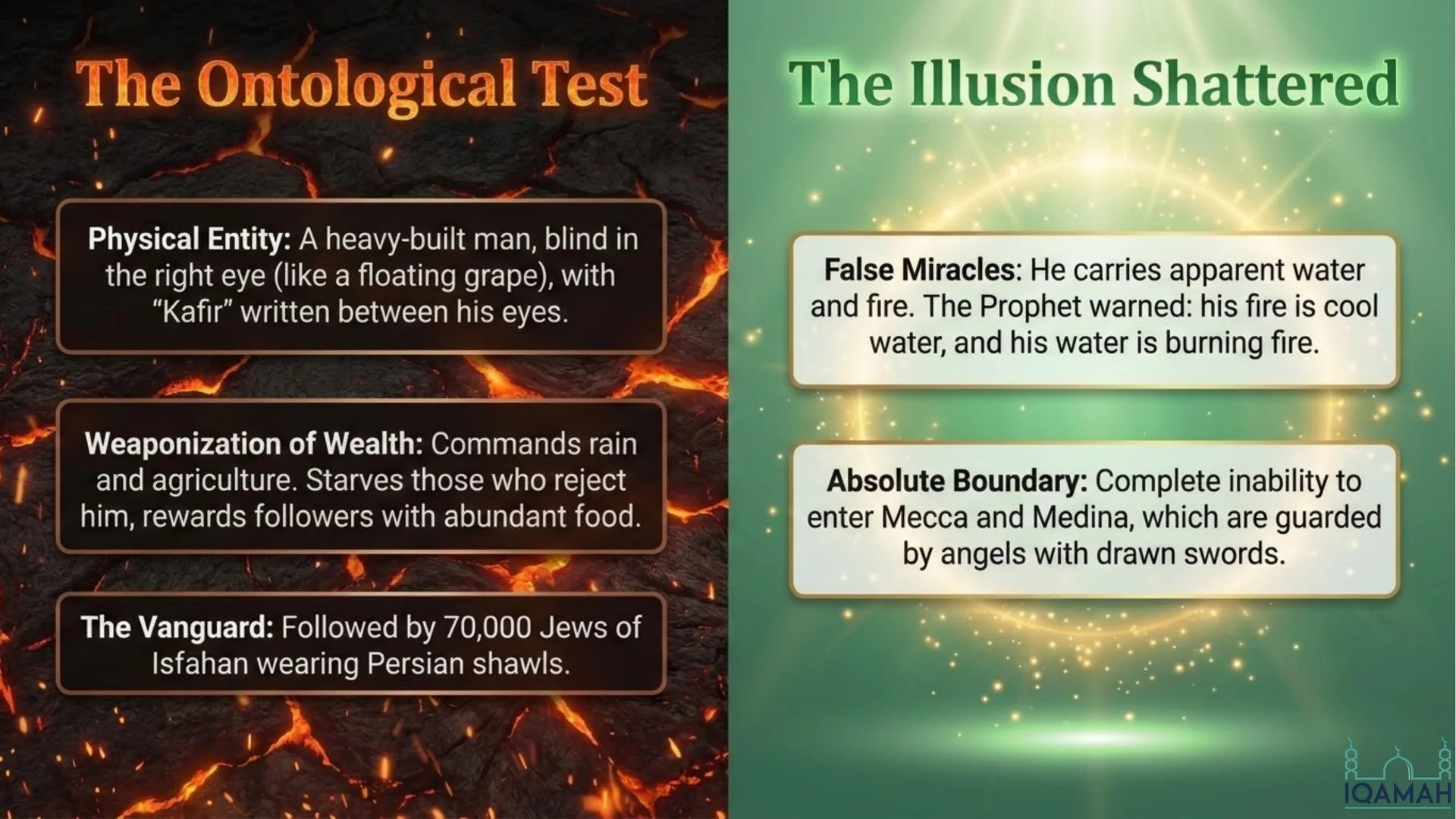
Out of the smoke of the Malḥama emerges the single greatest trial in the history of mankind: al-Masīḥ al-Dajjāl, the false messiah. Understand the nature of his test — it is, as the slide names it, a trial of what is real. Allah grants him terrifying powers precisely as a fitnah, a test of faith. He will command the sky and it will rain; he will command the earth and it will bring forth its crops; he will pass by ruins and say 'bring forth your treasures,' and they will follow him like swarms of bees. He travels the earth, the ḥadīth says, like rain driven before the wind. And he carries with him what appears to be a garden and a fire — but the Prophet ﷺ warned us that his 'fire' is in truth cool water, and his 'garden' is in truth a burning fire. So whoever is made to enter his fire, let him close his eyes and lower his head and drink, for it will be cool and sweet.

His physical description is given so we may know him and not be deceived: a heavy-built man, with his right eye defective like a floating, protruding grape; and between his eyes is written kāfir — k-f-r — which every believer, lettered or unlettered, will read.

His fitnah will reach everywhere on earth save two places: Makkah and Madīnah, whose every approach the angels will guard, so that he cannot enter them. The narration of Ṣaḥīḥ Muslim records that he will be followed by seventy thousand of the Jews of Iṣbahān — Isfahan — wrapped in their Persian shawls. I relate this to you exactly as the ḥadīth gives it: it describes those who will follow his particular deception in that hour, and it is not, in any way, a licence for hostility toward any people living today. And our protection from him is named in the very Sunnah, and it is within the reach of every one of us: firm faith in Allah, seeking refuge from his trial in our prayers — as the Prophet ﷺ taught us to seek refuge from the fitnah of the Dajjāl in every salāh — and committing to memory the opening verses of Sūrat al-Kahf, of which the Prophet ﷺ said that whoever memorises them will be protected from him. His miracles are illusions; the heart anchored in tawḥīd sees straight through them.

Slide 21
Slide 21 of 27 #

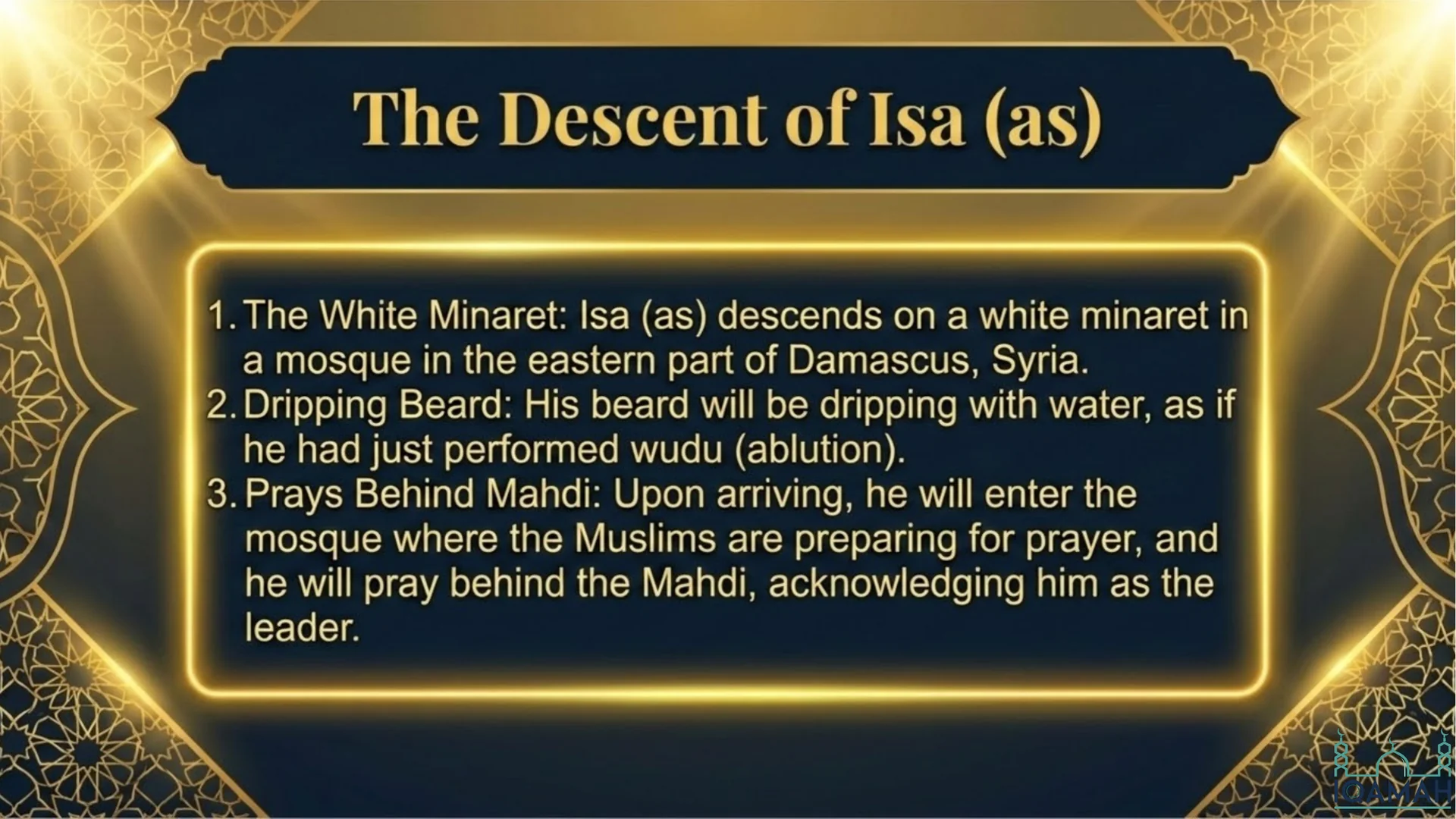
At the very moment of deepest despair — the believers besieged, their backs to the wall in the Levant, the Dajjāl's fitnah at its height — the true Messiah descends: al-Masīḥ ʿĪsā ibn Maryam (ʿalayhi al-salām). And the narration of al-Nawwās ibn Samʿān in Ṣaḥīḥ Muslim gives us the scene with stunning precision. He descends at the white minaret in the eastern part of Damascus, clothed in two garments lightly dyed with saffron, his hands resting upon the wings of two angels. When he lowers his head, drops fall from it as though they were pearls; and when he raises it, beads run down like silver. No disbeliever can catch the breath of his mouth without dying, and his breath reaches as far as his eye can see.

And the detail the slide highlights carries the whole of our creed in a single gesture. The Mahdī will be standing forward, about to lead the Muslims in the fajr salah, when ʿĪsā descends among them. The Mahdī will step back, offering the lead to the Prophet of Allah. But ʿĪsā will decline, and will place his hand between the Mahdī's shoulders, and say, 'Go forward and lead, for the iqāmah was called for you' — and he will pray behind the Mahdī, in honour of this Ummah.

Reflect on what that single act overturns. ʿĪsā returns not as a god, and not with a new law or a new religion, but as a humble follower of the Sharīʿah of Muḥammad ﷺ — a just ruler who, as the ḥadīth says, will break the cross, kill the swine, abolish the jizyah, and fill the earth with the justice of Islam, until a single prostration to Allah is better than the whole world and all it contains. For a world that has worshipped him as divine for two thousand years, the very manner of his return is the correction: the Messiah comes back as the servant of Allah, praying in the ranks of the final Ummah.

Slide 22
Slide 22 of 27 #

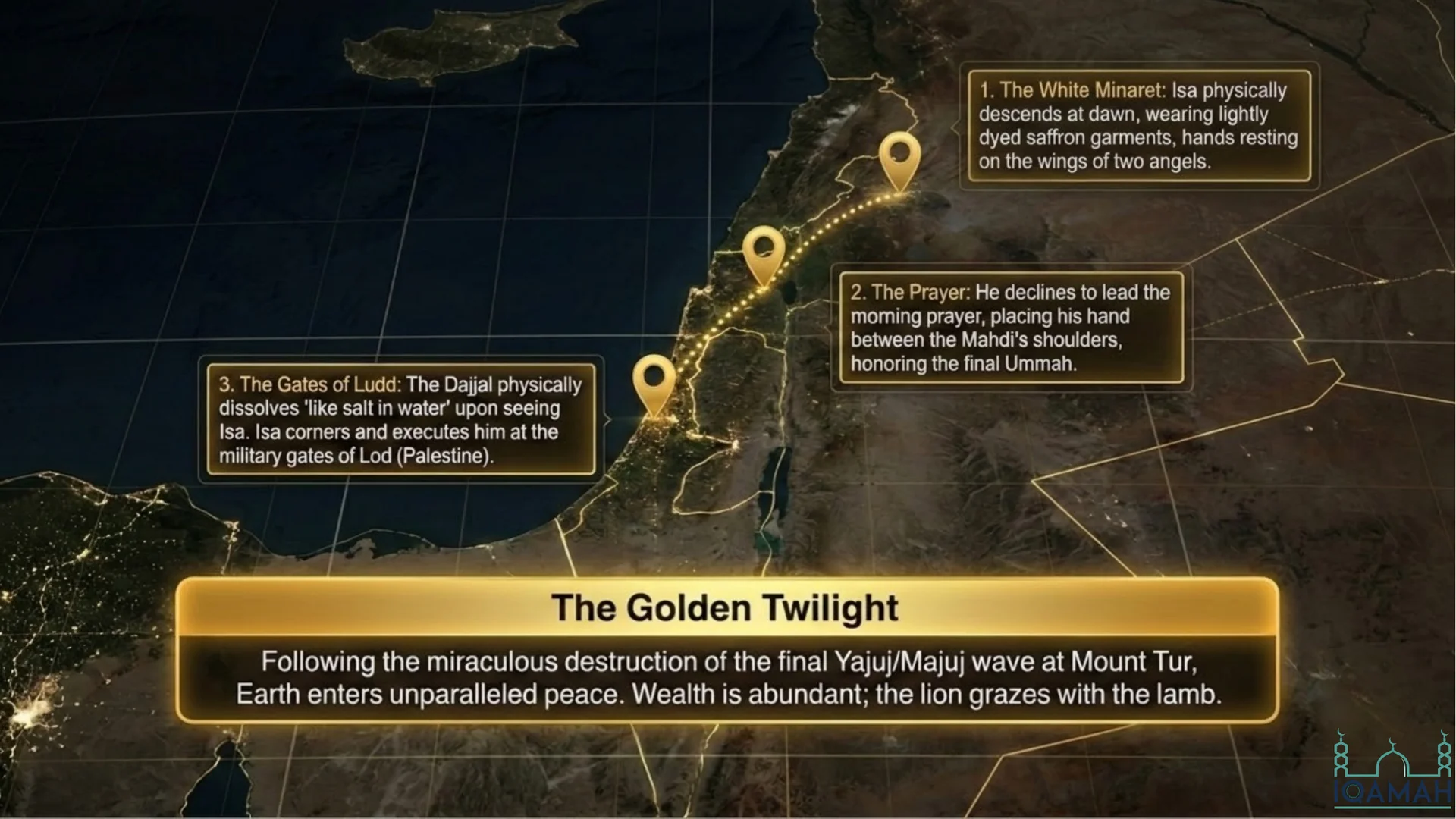
ʿĪsā (ʿalayhi al-salām) now leads the pursuit of the Dajjāl, and the map on the slide traces the final movements. He overtakes him at the gate of Ludd — Lod, in the land of Palestine — and at the mere breath of ʿĪsā the Dajjāl begins to dissolve, the ḥadīth says, 'as salt dissolves in water,' and there ʿĪsā strikes him down, and the greatest deception in human history is ended.

But relief is not yet rest. Allah reveals to ʿĪsā: 'I have brought forth servants of Mine against whom none has the power to fight; so take My servants safely to al-Ṭūr' — for He has loosed the final, greatest surge of Yaʾjūj wa Maʾjūj. They swarm across the whole earth. The first of them passes the lake of Ṭabariyyah and drinks it dry, and the last of them comes and says, 'There was once water here.' They loose their arrows at the sky in their arrogance. ʿĪsā and the believers withdraw and take refuge upon the mountain of al-Ṭūr, and they make duʿāʾ — and Allah sends down a worm, the naghaf, into the necks of Yaʾjūj wa Maʾjūj, and they all die in a single night, as the death of one soul. Then great birds are sent to carry off their stinking corpses, and a rain is sent that washes the earth clean and leaves it like a polished mirror.

And mark this well, for it is the point I flagged earlier against the medieval 'wave': this release — after the Dajjāl, after the descent of ʿĪsā — is the great release of Yaʾjūj wa Maʾjūj that the Ṣaḥīḥ corpus fixes as a major sign of the Hour. What follows is the golden twilight of the world: an age of justice and abundance under ʿĪsā, when, as the ḥadīth describes, rancour and malice leave the earth, a single pomegranate feeds a whole company and its rind gives them shade, the milk of one camel suffices a multitude, the child plays with the serpent and is not harmed, the predator lies down beside its prey, and wealth so overflows that a man will go out with his charity and find no one willing to accept it. It is the nearest this world comes to peace before its end.

Slide 23
Slide 23 of 27 #

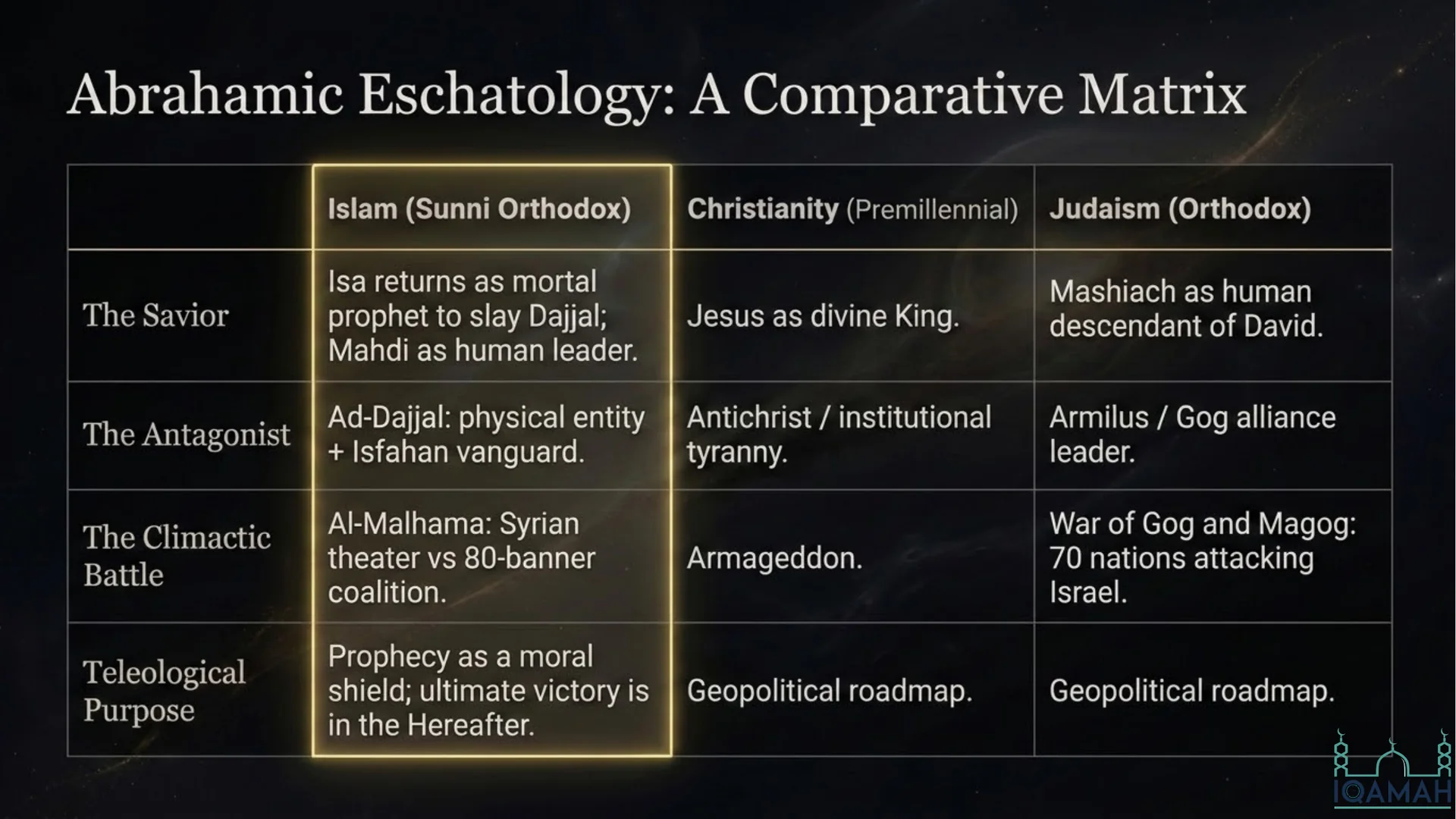
It helps to set the Islamic picture beside the hopes of the two traditions that share our Prophets — not to caricature them, but so that we may see clearly what is distinctive in our own faith. Look across the matrix. On the figure of deliverance: we await ʿĪsā's return as a human Prophet who prays behind the Mahdī, a mortal who comes to serve, not to be served; Christian belief awaits Jesus as God made flesh, a divine king; Jewish belief awaits a human Mashiach, a King of the line of David. On the adversary: we name al-Masīḥ al-Dajjāl, the false messiah with his vanguard; Christian thought speaks of an Antichrist and institutional tyranny; Jewish tradition of an Armilus and a Gog-and-Magog assault. On the final battle: al-Malḥama in the Syrian theatre, Armageddon, and the war of Gog and Magog against Israel, respectively.

But the deepest difference is not in the cast of characters; it is in the purpose — the teleology — and this is the thesis of our entire session. The other two framings lean, in the end, toward an earthly resolution: a restored kingdom, a political triumph, a roadmap to dominion in this world. Islam's horizon is set elsewhere entirely. For us, the end of days is, above all, a trial of faith — a fitnah to be passed through — and its true prize is not rule over the earth but salvation in the ākhirah. ʿĪsā returns not to seize a throne but to overturn the worship of creation and to call mankind, one final time, to the worship of the Creator alone. The 'true promise' that gives our session its name is not a seat of power in Jerusalem; it is the Face of the Lord, which the closing slides will name.

Slide 24
Slide 24 of 27 #

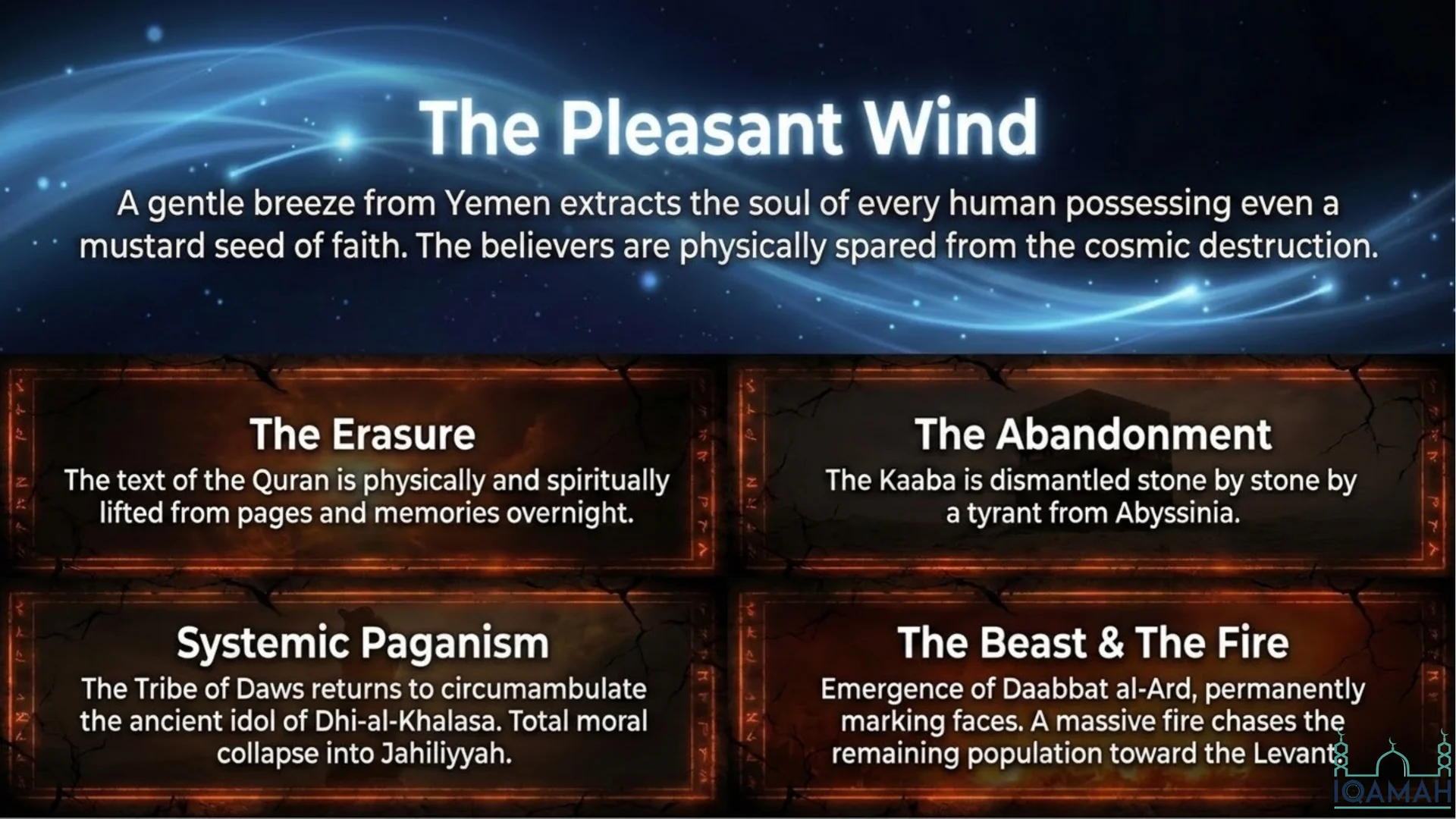
After the long golden age under ʿĪsā, the Sunnah turns soberly to decline — but it opens that decline with a mercy hidden inside it. Allah will send a gentle, fragrant wind from the direction of Yemen, and it will pass beneath the arms of the people, and it will take the soul of every single person who has even a mustard-seed of faith in their heart. The believers, in this way, are gathered to Allah gently and spared what is to come, as in the ḥadīth of Ṣaḥīḥ Muslim. And then only the worst of mankind are left upon the earth — and it is upon them, the narration says, that the Hour will come.

And then the marks of Islam are lifted, one by one, in an inversion of the prophetic mission itself. The slide records four, all from the Ṣaḥīḥ ahadith. The Erasure: the very text of the Qurʾān will be raised — lifted from the pages of the maṣāḥif and from the hearts and memories of men — until a morning comes when the people look and find the pages blank and recall not a single āyah. The Abandonment: the Kaʿbah will be left deserted and will at last be torn down, stone by stone, by Dhū al-Suwayqatayn, 'the man with two thin legs,' from Abyssinia, as in al-Bukhārī. Systemic Paganism: open idolatry will return, and the women of the tribe of Daws will once again circle their old idol, Dhī al-Khalaṣa, just as their pagan ancestors did — a total collapse back into jāhiliyyah. And the Beast and the Fire: the Dābbat al-Arḍ, the Beast of the Earth, will emerge to speak to mankind and to mark their faces, sealing each as believer or disbeliever; a great Smoke, the Dukhān, will cover the earth; and a fire will rise to drive the last of humanity before it toward the land of the Gathering.

Slide 25
Slide 25 of 27 #

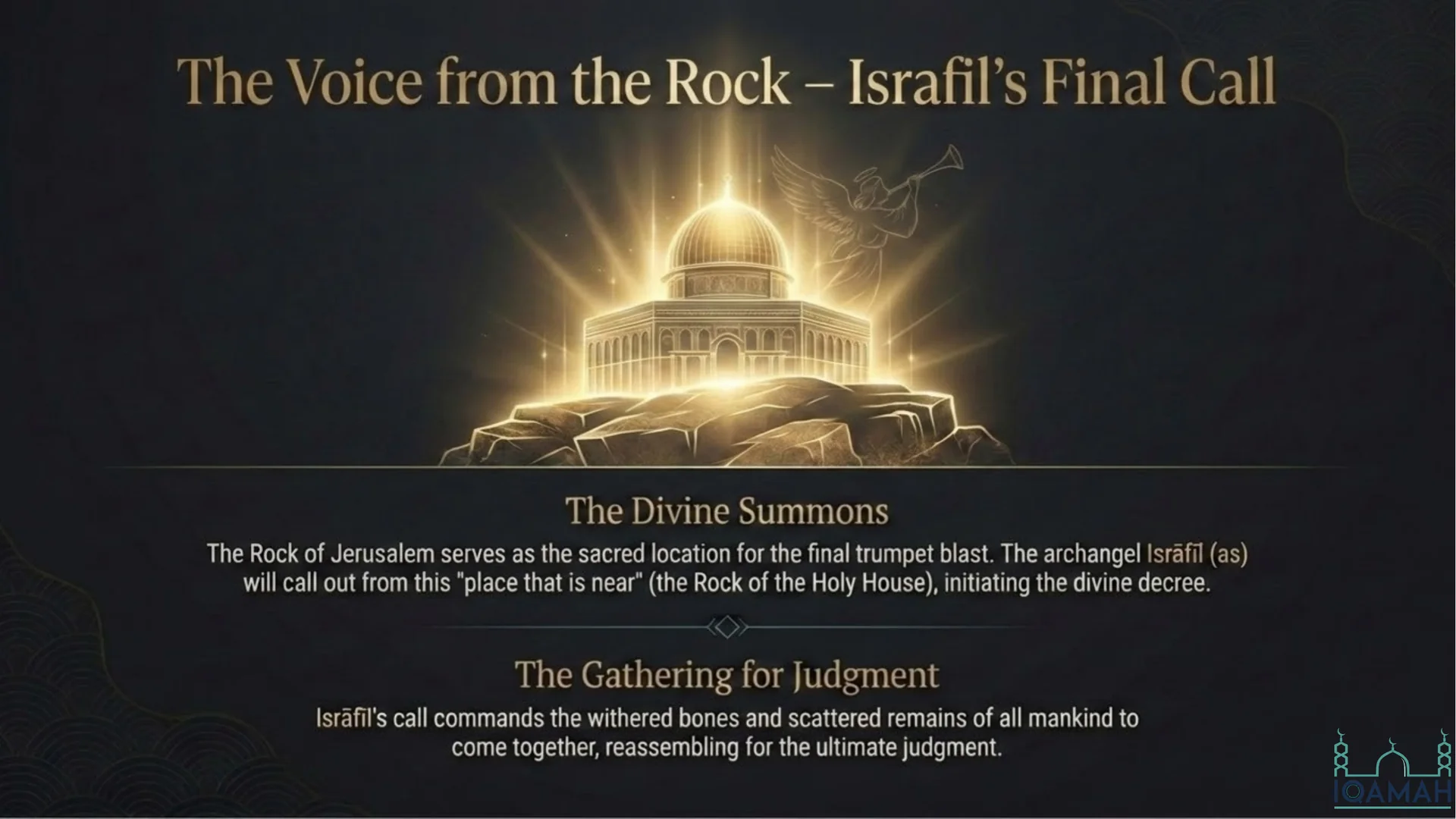
Then comes the command to the angel Isrāfīl (ʿalayhi al-salām) and the blowing of the Horn, al-Ṣūr. And it is fitting beyond words where the Sunnah places the gathering of mankind: in the holy land — the plain of al-Maḥshar in the region of Shām and Bayt al-Maqdis. The slide draws on the reports that the final summons issues from the Rock of Jerusalem — that this is 'the place that is near,' al-makān al-qarīb, of which Allah says in Sūrat Qāf, 'Listen on the Day when the caller will call out from a near place' (50:41). So the very sanctuary that opened our story becomes the threshold of the Gathering.

Pause on the fittingness of this. The first qiblah; the place of the night journey and the ascension; the barometer of the world's faith through every age we have traced tonight — Bayt al-Maqdis stands at the very end exactly as it stood at the very beginning, but now as the muster-ground of all creation. Isrāfīl's call commands the withered bones and the scattered remains of every human being who ever lived to come together and reassemble for the reckoning. The sacred continuum closes its circle: the place from which the Prophet ﷺ ascended to his Lord becomes the place from which all mankind is summoned before that same Lord.

Slide 26
Slide 26 of 27 #

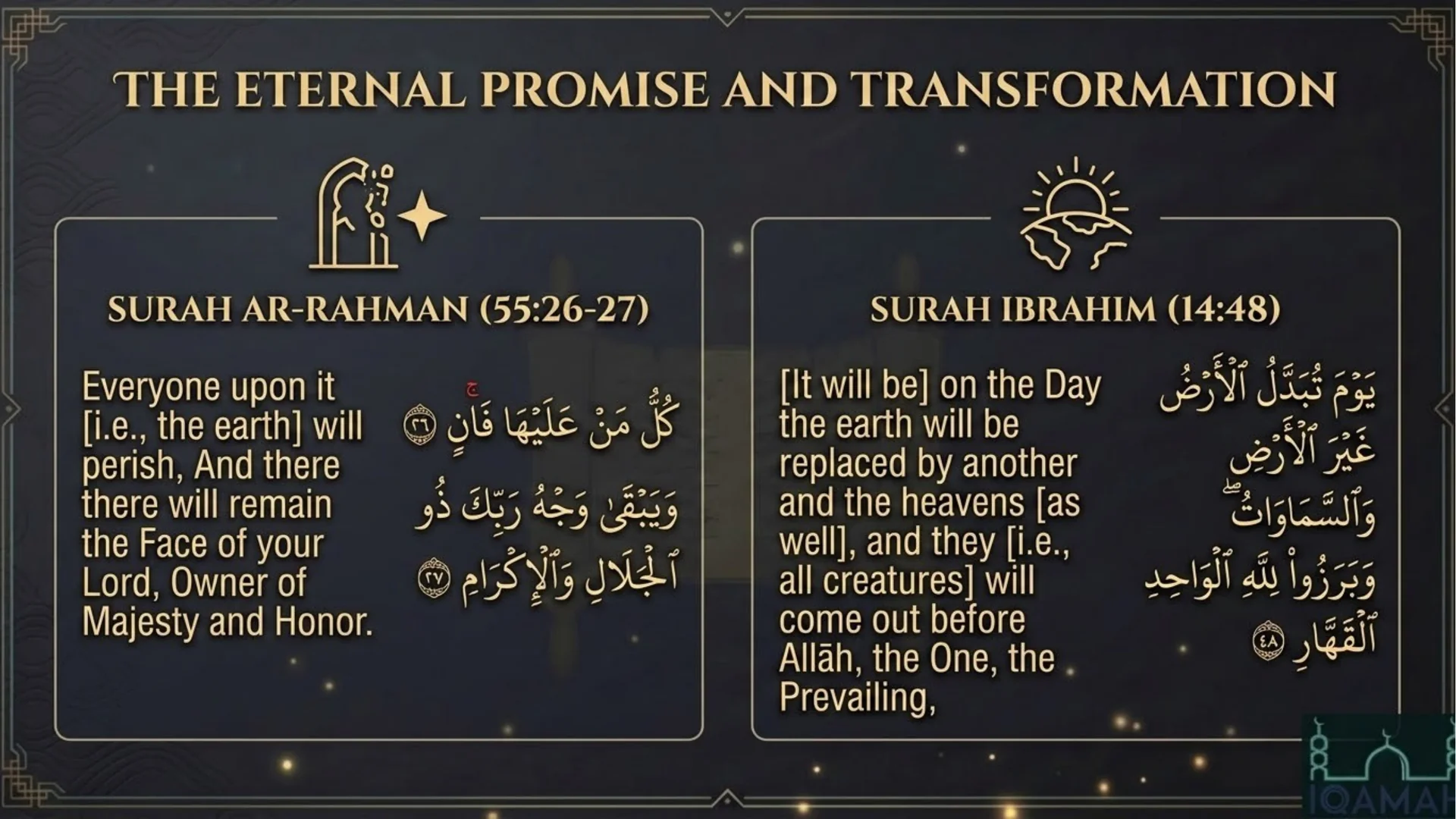
Two verses crown the entire transformation, and they are the destination toward which everything we have traced has been moving. The first: 'Everyone upon it will perish, and there will remain the Face of your Lord, Owner of Majesty and Honour' (al-Raḥmān 55:26–27). Kullu man ʿalayhā fān. At the first blast of the Horn, all that exists passes away — every star, every mountain, every soul, every angel, even the Angel of Death himself by the decree of Allah — until nothing whatsoever remains except Allah, al-Wāḥid, al-Qahhār, the Eternal who alone abides.

And the second: 'On the Day the earth will be replaced by another earth, and the heavens as well, and they will come forth before Allah, the One, the Prevailing' (Ibrāhīm 14:48). The very stage of existence is folded up and exchanged for a new one.

Now bring the whole continuum to rest upon these two verses. Every empire we have followed across these slides — Babylon, Rome, the Crusaders, the Mongols, and every power that has risen since — every one of them belongs to that 'everyone upon it' who 'will perish.' Not one of them endures. The only permanence in all of existence is the Wajh of the Lord, full of Majesty and Honour. Our session opened by speaking of the 'true promise of al-Aqṣā.' Here it stands unveiled at last: the true promise was never a city to be held for a season. It is the Eternal who outlasts the very dissolution of the heavens and the earth.

Slide 27
Slide 27 of 27 #

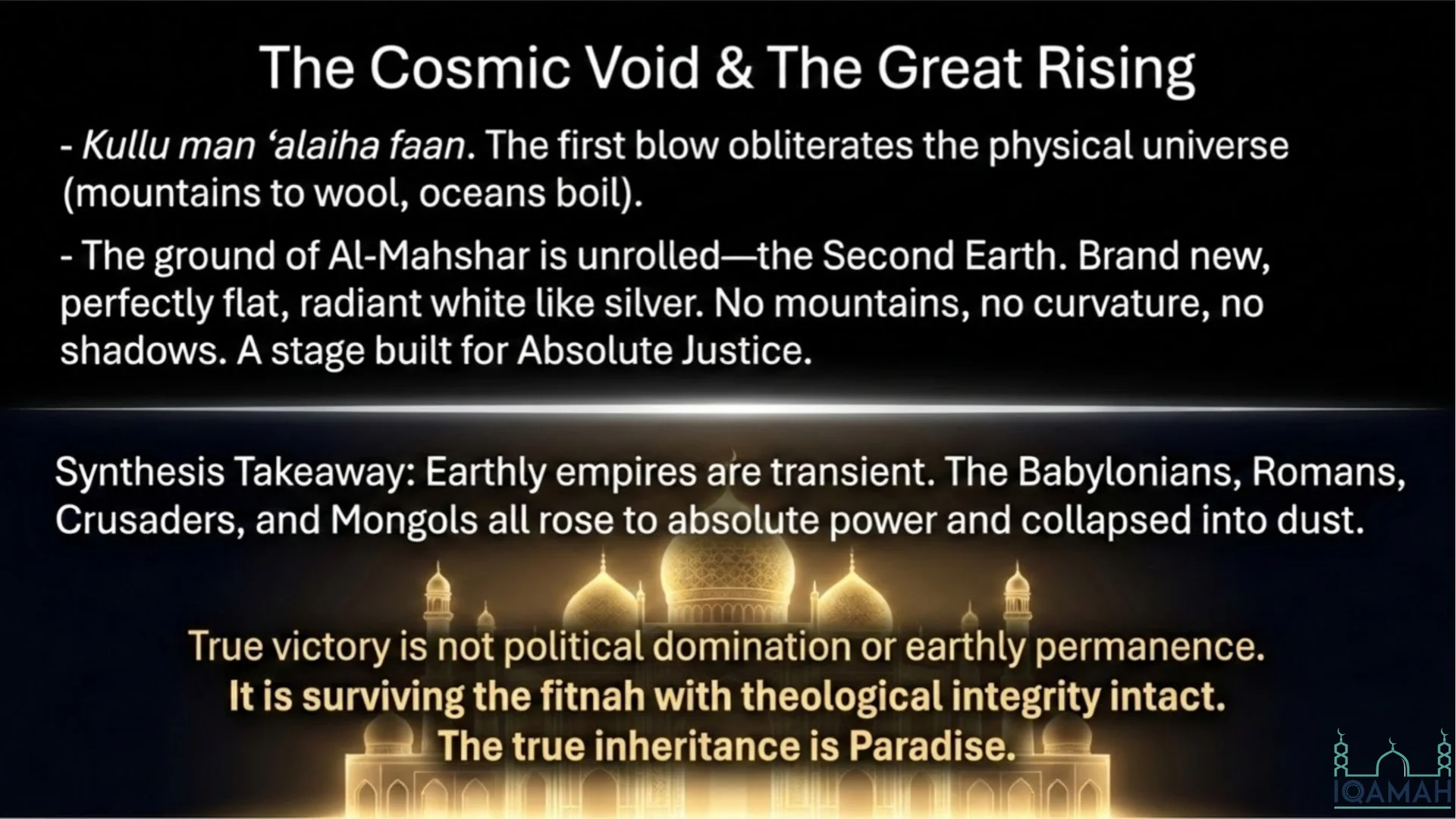
And so the picture completes itself. At the first blast of the Horn, total annihilation — a silent void in which only Allah remains. Then He brings forth the Second Earth, and the Ṣaḥīḥ narrations describe it with awe: the ground of al-Maḥshar will be brand new and radiant, white like pure silver, upon which no sin was ever committed and no innocent blood was ever spilt. As Allah says of it, 'you will see in it no crookedness or curvature' (Ṭā Hā 20:107) — no mountain to hide behind, no valley to sink into, no cave, no tree, no shadow. A single pristine plain, built for one purpose alone: absolute justice.

Then, at the second blast of the Horn, a rain falls from the sky, and from the ʿajb al-dhanab — the tailbone, the one part of a man's body that never decays, as the Prophet ﷺ told us in al-Bukhārī — mankind grows up again out of the earth like plants. The graves give up their dead. Every soul, from the first human ever created to the last wretch driven before the fire, stands raised upon that silver plain — barefoot, bare, and uncircumcised — for the reckoning to begin.

And here is the lesson of the whole night, which I want you to carry home above everything else. Earthly empires are passing things; each one came, and devastated, and then receded like a wave drawn back into the sea. So true victory was never political domination, and it was never earthly permanence — those things crumble to dust, every time, without exception. True victory is to pass through the fitan of this world with your faith and your tawḥīd intact. The true inheritance goes beyond Jerusalem; the true inheritance is Paradise. That is the real promise of al-Aqṣā, and that is the only reason we study these things at all — not to dread the future, but to fortify the heart: to hold fast to the Qurʾān and the Sunnah, and to make our souls ready for the silver plain. May Allah make us among those whose souls are taken by that pleasant wind, and grant us the eternal inheritance. Āmīn.